Are Bitcoin Miners Selling Their BTC?

Why have Bitcoin miners been selling their BTC since October 2025?
Introduction
Since October 2025, a series of Bitcoin sales by mining companies has fed a simple narrative: miners are selling to survive. That narrative is incomplete. The data shows a more structured reality: the sales exist, but they mostly stem from industrial logic (cash flow, debt, capital allocation), not simple capitulation.
Which Bitcoin miners have sold since October 2025?
Documented sales between October 2025 and March 2026 total around 33,700 BTC. But a single company accounts for half of those volumes.
The main sellers
- MARA Holdings: 15,133 BTC sold between March 4 and 25, 2026 (~$1.1B)
- Cango: 7,001 BTC (January → March 2026)
- Riot Platforms: 6,379 BTC (October 2025 → Q1 2026)
- CleanSpark: 3,348 BTC (continuous monthly sales)
- Core Scientific: ~1,900 BTC (January 2026)
There is no uniform, generalized sell-off — rather a few major events and regular sales. MARA’s sale alone represents nearly 45% of the total observed volume.
Monthly series and cumulative total
The monthly totals below are reconstructed from the “sale” volumes (BTC) reported in disclosures (or, for Riot’s Q1 2026, a quarterly aggregate point counted under March 2026 for lack of a monthly breakdown).
| Month | BTC sold (approx.) | Cumulative BTC sold |
|---|---|---|
| 2025-10 | 989.88 | 989.88 |
| 2025-11 | 948.41 | 1,938.29 |
| 2025-12 | 2,395.00 | 4,333.29 |
| 2026-01 | 2,608.66 | 6,941.95 |
| 2026-02 | 5,004.02 | 11,945.97 |
| 2026-03 | 21,816.00 | 33,761.97 |
The dynamic is clear: sales stay relatively moderate until early 2026, before a sharp acceleration in February and especially March, mostly driven by a few exceptional operations.
Why are these mining companies selling their BTC?
Contrary to a common belief, not all Bitcoin sales serve the same function.
1. Covering operating costs (OPEX)
A first category corresponds to regular sales. Their goal is to cover electricity, fund maintenance and maintain stable cash flow. Players like CleanSpark and Riot illustrate this logic: monthly sales, a reported average price, continuous treasury management. Here, Bitcoin is used as a revenue stream.
2. Funding a strategic pivot
A second category corresponds to sales meant to fund a transformation of the business model — investing in new infrastructure, funding an AI / compute / energy pivot, and supporting future growth. For example, Cango funds its AI pivot with its BTC reserve, and Core Scientific its transition to compute infrastructure. Here, Bitcoin is used as a growth lever.
3. Deleveraging and restructuring the balance sheet
The third logic is reducing debt to improve the company’s financial structure or limit dilution risk. MARA illustrates this perfectly with its massive sale aimed at buying back convertible bonds. Here, Bitcoin is used as a balance-sheet management tool.
What this changes for the Bitcoin market
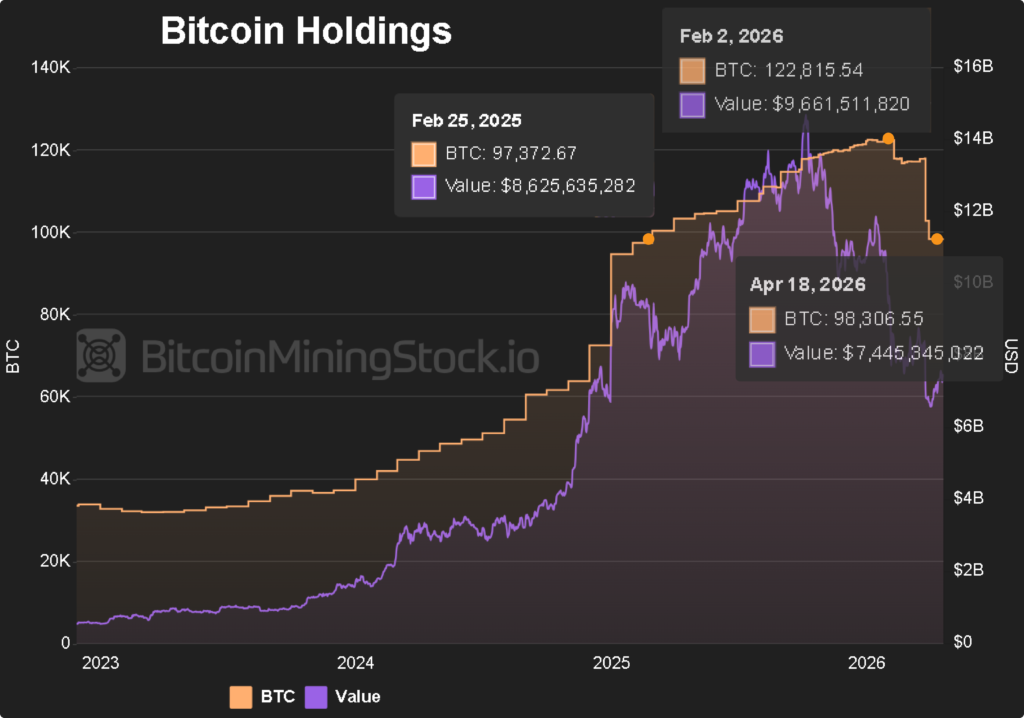
The data shows an important reality: periods of significant selling largely coincide with phases of falling Bitcoin prices. As the chart shows, reserves rise until early 2026, then a distribution phase appears following a major price correction. There is therefore a correlation between miner sales and market declines. The last time cumulative sales exceeded 10,000 BTC, the market was in a full bear market (July 2022 – January 2023).
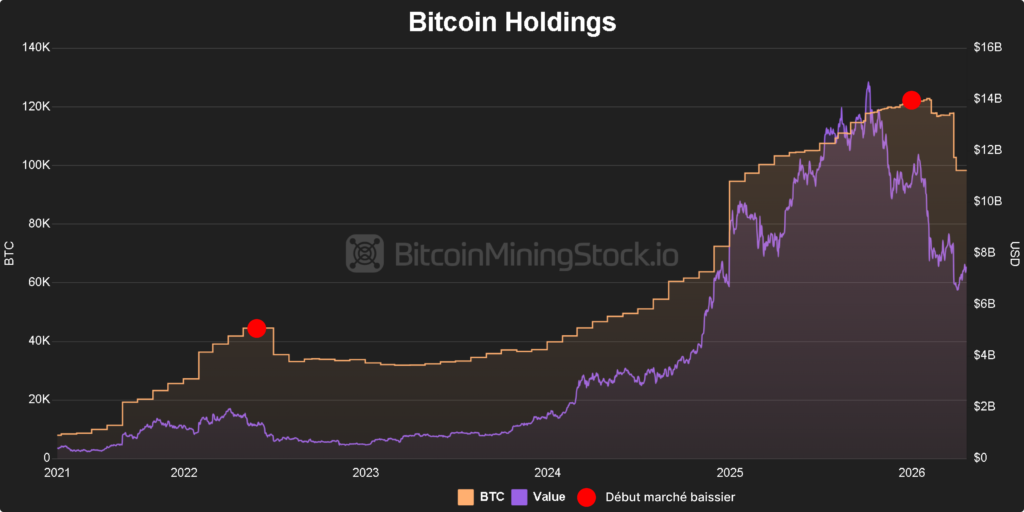
But this reading must be nuanced: correlation doesn’t mean causation. A large part of the sales is triggered by internal constraints (balance sheet, debt, financing), not solely by price. However, a sharp Bitcoin drop amplifies these existing constraints. In short, miners accompany the decline more than they cause it.
January: a key moment for strategic arbitrage
January is a critical phase for companies. After the annual close, balance sheets are structured, performance is analyzed and strategies are adjusted. This leads to a wave of arbitrage decisions: BTC sales, debt restructuring, capital reallocation and the launch of new projects. The sales seen in January 2026 (Cango, Core Scientific, CleanSpark) fit this logic. It’s not a panic reaction, but a normal post-close management process.
The growing financialization of Bitcoin
Bitcoin is now used as a fully fledged financial asset: collateral to obtain financing, leverage to access credit, and a capital-optimization tool. As a result, some sales can be triggered by financing constraints (collateral ratios, margin calls) that depend on market conditions. Mining is evolving toward a hybrid model: producing an asset + managing a financial asset.
Conclusion
Bitcoin miners are indeed selling part of their BTC since October 2025. But these sales answer three distinct logics: funding operations, supporting growth and optimizing the balance sheet. They can coincide with market declines without necessarily being the main cause. The correct reading: miners don’t act out of panic, but out of economic arbitrage.
What we should remember is that, for a miner, Bitcoin is at once:
- a revenue (cash flow to pay OPEX),
- capital (leverage to invest),
- a financial asset (collateral and balance-sheet tool).
Confusing these uses leads to misinterpreting their sales.
From analysis to action
If you mine (or are considering it), the question isn’t “should I sell?” but when and why to sell. Test your scenarios with the Startmining simulator: the impact of the BTC price on your profitability, the selling thresholds to cover your costs, and the trade-off between holding and selling. The goal: turn your production into a managed decision rather than one you simply endure.
As the sector professionalizes, one question becomes central: will the miners who survive be those who mine the most… or those who allocate their Bitcoin best? The answer will determine the winners of the next cycle.
Passez à l'action
Ready to mine Bitcoin with Startmining?
Browse our ASIC shop or simulate your profitability in real time.