Learn
Best Bitcoin ASIC Miners in 2025: The Generation War

In the fast-moving world of Bitcoin mining, the competition between ASIC generations plays a decisive role in operator profitability. In 2025, understanding mining-hardware efficiency and profitability thresholds is essential to decide which Bitcoin ASIC is actually worth running. This article looks at the current state of the Bitcoin network, the efficiency gap between generations, and the investment challenge of replacing older machines.
Still finding the world of crypto and mining a little blurry? See how we got here in our article on the history of money, from barter to Bitcoin. And if you are wondering whether it is better to mine other proof-of-work coins, this guide is for you.
The state of the Bitcoin network: a generational hashrate mix
The Bitcoin network runs on a wide range of ASIC models with varying efficiencies, each contributing to total hashrate. According to research from CoinMetrics, around 60% of today’s hashrate is still dominated by older-generation models launched around 2020, such as the Antminer S19 and S19 Pro.
These machines now face a serious efficiency gap against the latest generation of ASICs, such as the Antminer S21. In 2025, hardware efficiency is a key driver of miner profitability — especially in a context of rising energy prices.
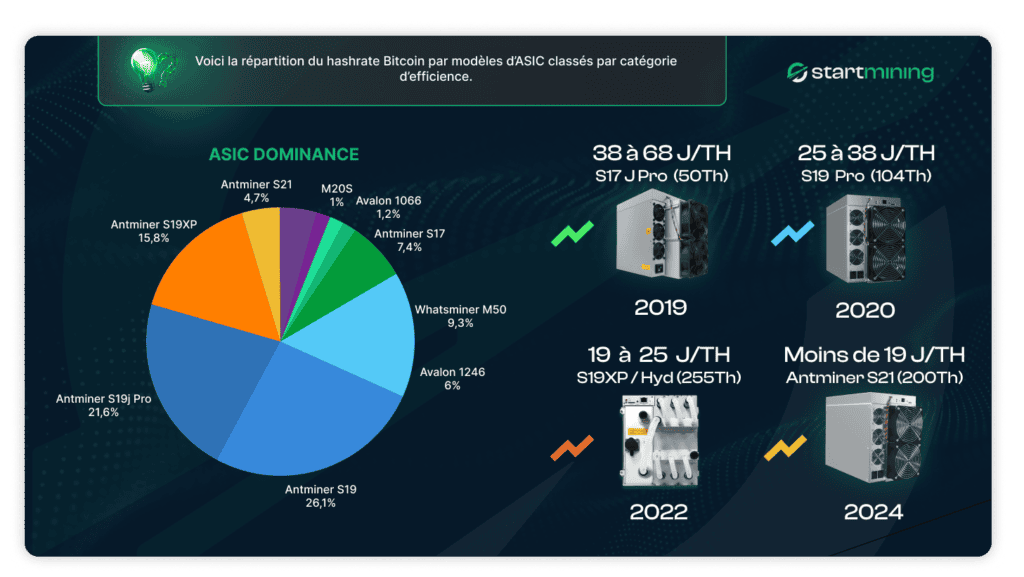
The hashrate-distribution chart shows that models like the Antminer S19j Pro still account for a significant share at 21.6% of the network, while recent models such as the Antminer S21 represent only 4.7% of total hashrate. As the network evolves, that share is expected to grow very quickly.
Production cost by ASIC efficiency for Bitcoin mining in 2025
Every ASIC model has an efficiency figure expressed in joules per terahash (J/TH) — the ratio between power draw and the hashrate it produces. This efficiency directly affects the cost of producing one Bitcoin, especially as energy prices rise.
Take three ASIC generations as an example:
- Antminer S19 Pro (25 to 38 J/TH): draws 3,068 W for 104 TH/s
- Antminer S19 XP (19 to 25 J/TH): draws 3,010 W for 140 TH/s
- Antminer S21 (under 19 J/TH): draws 3,645 W for 270 TH/s
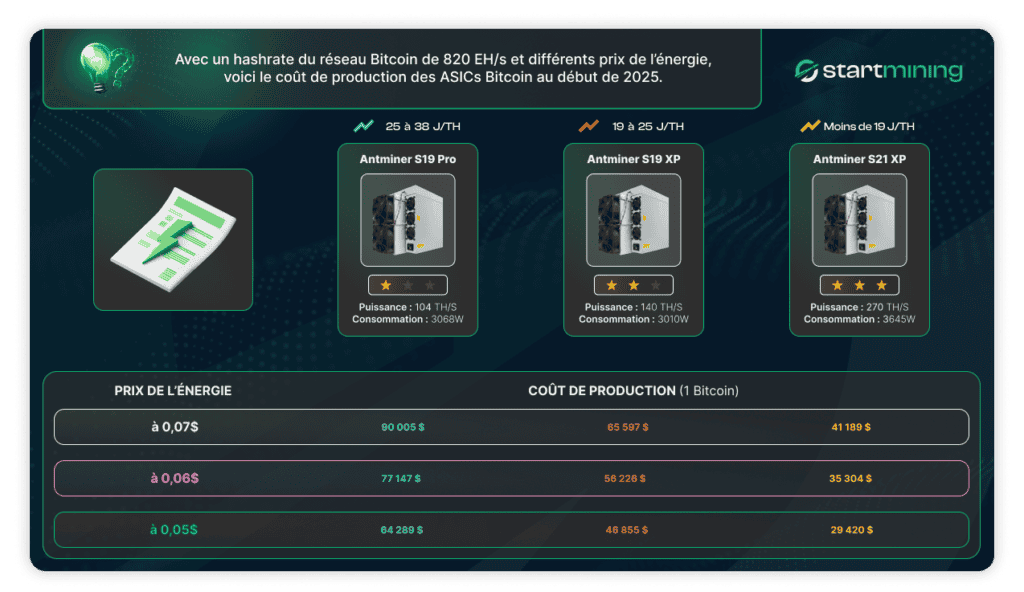
At an energy price of $0.07/kWh, the cost of producing one Bitcoin is:
- $90,005 with an Antminer S19 Pro
- $65,597 with an S19 XP
- $41,189 with an S21
When the energy price drops to $0.05/kWh, those costs fall to $64,289, $46,855 and $29,420 respectively. The table makes the impact of machine efficiency clear — and shows why investing in recent models is a strategic move.
Break-even and profitability thresholds: when should you unplug an ASIC?
Every ASIC has a break-even point that depends on its efficiency and the cost of energy. When the cost of producing one Bitcoin rises above its market (spot) price, miners consider the ASIC unprofitable and switch it off.
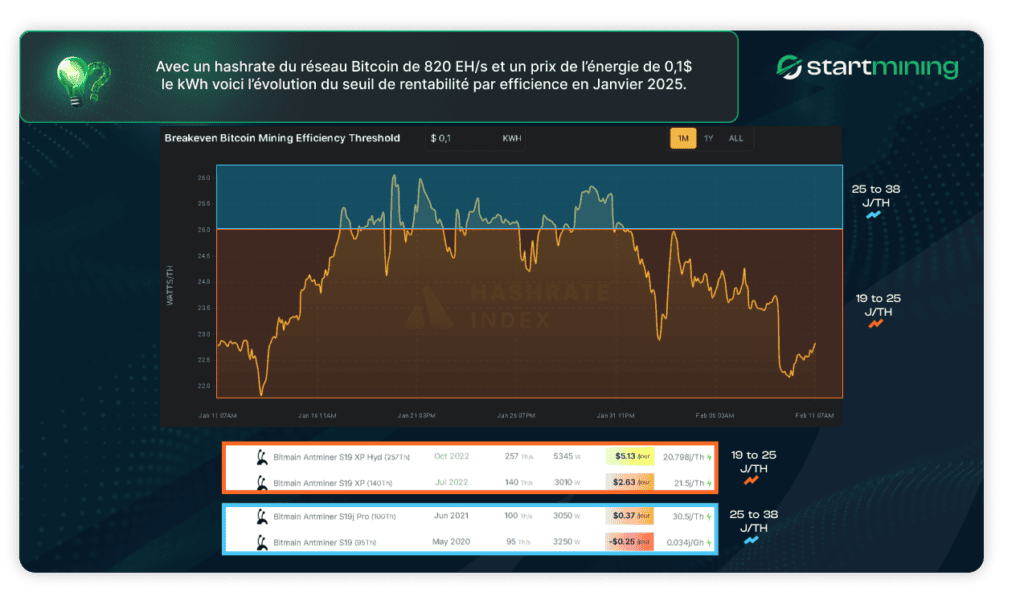
The break-even data shows that at $0.10/kWh, older-generation machines (25 to 38 J/TH) stop being profitable. Recent generations such as the S21, however, keep generating profit even under those conditions.
The generation war: a shifting balance
The relentless pursuit of efficiency fuels the ASIC generation war. The process follows a cycle: the least efficient machines are gradually pushed out as hashrate and production costs climb. Adding new compute power then pushes hashrate back down, because miners unplug unprofitable machines. The network stabilizes, and the cycle starts again.
- $0.10/kWh: only the latest-generation ASICs (S21 and similar) are profitable.
- $0.06/kWh: S19 XP ASICs are still profitable, but with thinner margins.
- $0.05/kWh: many 2020 models, like the S19 Pro, can still run at an acceptable cost.
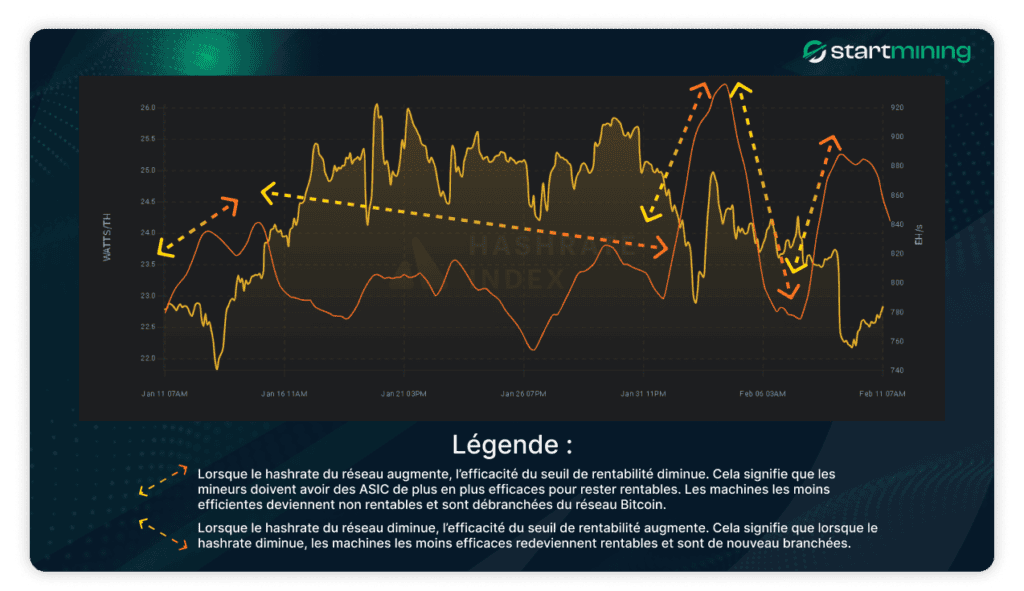
When miners unplug inefficient machines, hashrate dips temporarily, which eases network difficulty. That drop encourages some previously switched-off ASICs to come back online, completing the cycle.
This connect/disconnect mechanism is a core feature of the network. When global hashrate rises and the break-even efficiency falls, only the most efficient ASICs stay online.
Investors and operators therefore need to anticipate these thresholds and adapt their hardware-renewal strategy to maximize profit.
The investment needed to replace older generations
According to Bitcoin network estimates, 75% of hashrate (around 615 EH/s) is still produced by machines at 25 to 38 J/TH or more. Replacing those ASICs with more efficient models represents a colossal investment.
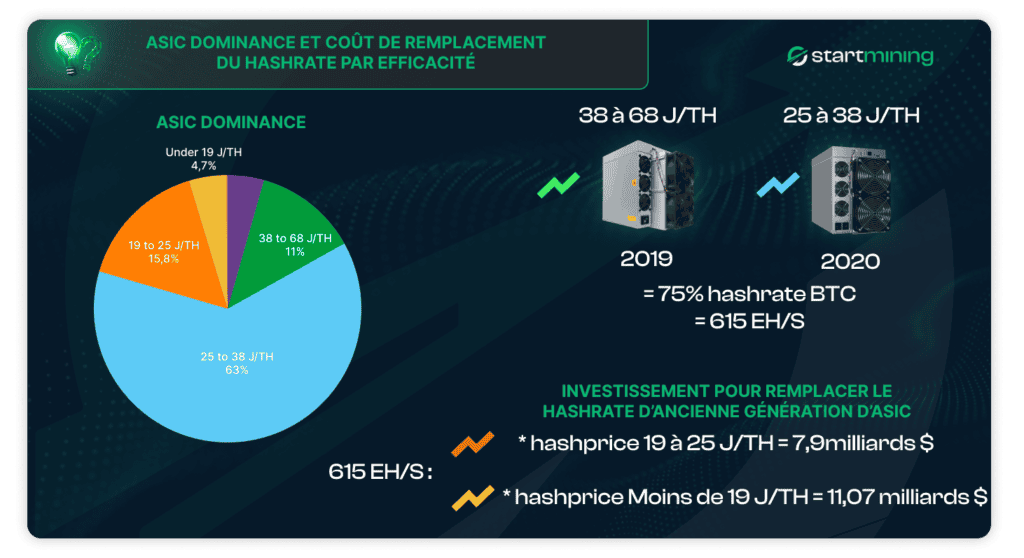
- Replacing that power with 19-25 J/TH models would require roughly $8 billion.
- Replacing it with sub-19 J/TH models would demand close to $11.07 billion.
Investors have to weigh these costs against the potential gains from lower production costs and the overall profitability of their infrastructure.
Which Bitcoin ASIC should you mine with in 2025?
In 2025, mining profitability will largely come down to running the most efficient ASICs — and securing very low energy costs (under $0.05/kWh). A few key recommendations:
- Favour recent models such as the Antminer S21, which combines efficiency (under 19 J/TH) with high compute power.
- Factor in your local energy cost. If you have access to cheap power (below $0.05/kWh), used models like the S19 XP can still be viable for a while.
- Plan a gradual replacement of older generations to avoid a sudden break in production.
The bottom line: profitable mining in 2025 rests on a sharp understanding of efficiency thresholds and on an optimized energy-investment strategy.
Should you buy a new or a used mining ASIC? Read our dedicated guide on new vs. used Bitcoin ASIC miners.
Startmining supports you with solutions tailored to your needs for acquiring and optimising your mining setup. To learn more, explore our full range of offers on the Startmining website.
Passez à l'action
Ready to mine Bitcoin with Startmining?
Browse our ASIC shop or simulate your profitability in real time.