Is Bitcoin Mining Still Profitable in 2026? A Complete Analysis

Last updated: July 2026 — hashprice ~$29/PH/s/day, network at ~0.96 ZH/s, Bitcoin around $61,000.
Quick answer: Yes — Bitcoin mining is still profitable in 2026, but only with recent-generation ASICs (S21 series, S23, under 15 J/TH). At the current hashprice (~$29/PH/s/day, July 2026), an Antminer S21 XP breaks even at ~$0.088/kWh and an S23 Hydro at ~$0.124/kWh, while older S19-class machines need electricity below ~$0.055/kWh — at or below standard industrial rates.
Is Bitcoin mining still profitable in 2026?
Is Bitcoin mining profitable in 2026? It’s a question more and more investors are asking. Since Bitcoin’s early days, the mining industry has changed profoundly: what was once doable with a simple personal computer is now a global industry built on specialized machines (ASICs), industrial mining farms and constant competition for access to the cheapest electricity.
Since the April 2024 halving, the block reward dropped to 3.125 BTC, mechanically reducing miners’ revenue. At the same time, network difficulty and the global hashrate hit record levels. As a result, the cost of producing one Bitcoin has risen sharply, and mining profitability now depends even more on machine efficiency and the price of energy.
So, is mining Bitcoin still profitable in 2026? In reality, the answer depends on several variables: the price of Bitcoin, network difficulty, machine efficiency… and above all the cost of electricity, which is often the deciding factor.
In this article, we analyze the profitability of Bitcoin mining in 2026, the factors that determine miners’ revenue, the most efficient ASICs today, and the tools to precisely estimate the profitability of a mining operation.
The state of crypto mining in 2026 (post-2024 halving)
In 2026, the Bitcoin mining industry enters a new phase of maturity. The network crossed the 1 ZettaHash mark (1 ZH/s = 1,000 EH/s) for the first time in 2025, went through a ~25% miner-capitulation purge around the turn of the year, and sits at about 0.96 ZH/s (963 EH/s) in July 2026. This colossal computing power reflects the sector’s growing industrialization and the massive investments made by major mining players.
At the same time, a key industry indicator — the hashprice (revenue generated per unit of computing power) — has never been so low. In July 2026, it hovers around $29/PH/s/day, a level strongly reminiscent of 2020 after the COVID crash. Back then, the hashprice was around $70/PH/s/day, illustrating the economic pressure now weighing on Bitcoin miners.
However, these figures must be put in context. Since 2020, the economics of crypto mining have changed profoundly. The chart below puts two key elements of this transformation in perspective: the evolution of the hashprice and the falling cost of acquiring ASIC hashrate. While you had to spend around $20 per TH/s for the best machines in 2020, that cost is now close to $10 per TH/s for recent generations. This drop in the price of hashrate partly offsets the decline in hashprice seen in recent years.
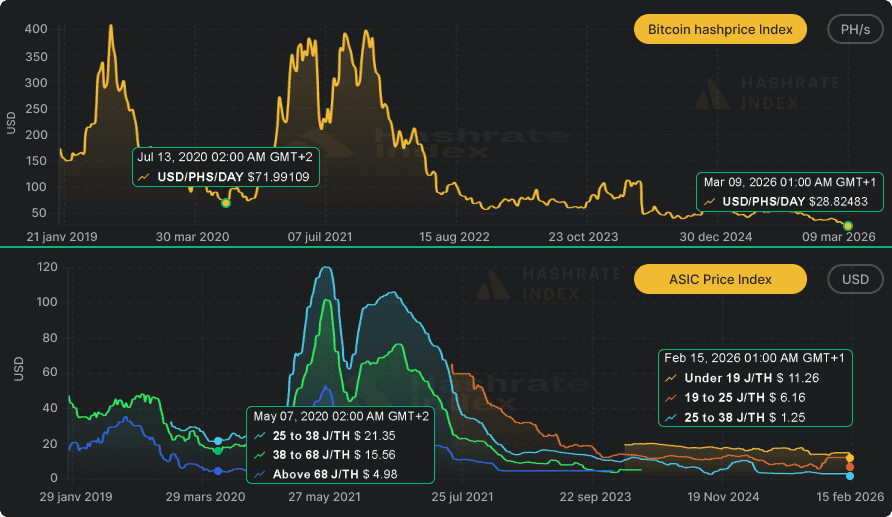
Moreover, technological progress has considerably improved machine efficiency. The consumption needed to produce 1 PH/s of computing power has, on average, more than halved thanks to new ASIC generations. These developments help put the current situation in perspective: at first glance, even though the hashprice is historically low, infrastructure costs and machine efficiency have also improved, allowing many players to stay competitive.
Finally, Bitcoin mining economics remain cyclical. When conditions become too tough, the least efficient miners leave the network, which reduces competition and gradually rebalances profitability for players with the most competitive machines and energy costs.
The factors that determine crypto mining profitability
Even if mining seems simple on the surface, its profitability actually depends on several economic and technical variables. Understanding these factors is essential to determine whether mining can be profitable in your situation.
The cost of electricity
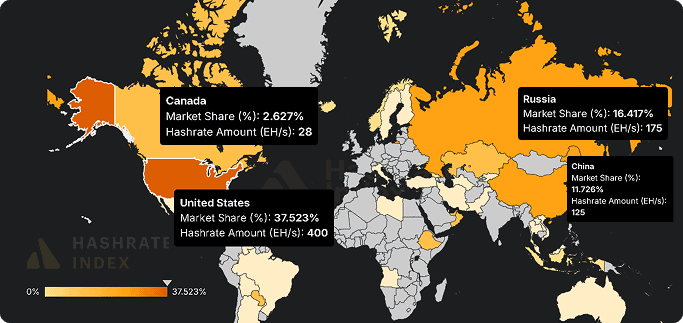
Electricity cost is generally the most decisive factor in mining profitability. ASICs run continuously, 24/7, each consuming several thousand watts. In regions where electricity exceeds €0.20/kWh, it often becomes hard to stay competitive against large industrial farms. That’s why big miners set up their infrastructure in areas with abundant, cheap energy, such as parts of North America, Latin America, the Middle East and Asia. The map below illustrates this: the global hashrate distribution directly reflects access to competitive electricity.
Bitcoin mining profitability and the global hashrate
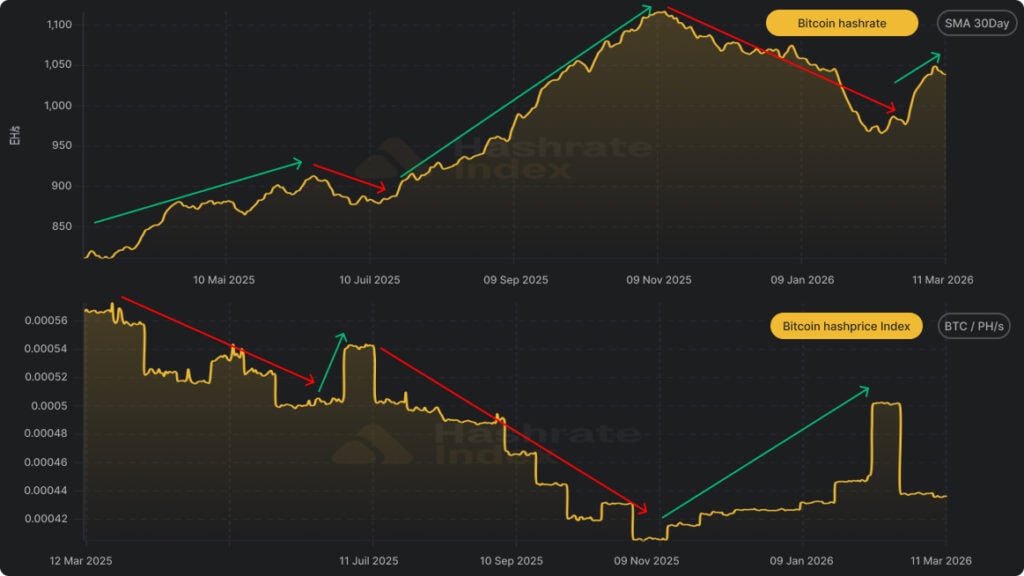
When new miners join the network and the global hashrate rises, competition intensifies and each machine receives a smaller share of the mining rewards. The chart below shows this relationship: when the Bitcoin network’s hashrate grows, the Bitcoin revenue generated per unit of computing power decreases. In practice, a miner can see their revenue fall even without a drop in Bitcoin’s price, simply because competition on the network becomes more intense.
The price of Bitcoin
Bitcoin’s price directly influences mining profitability. Since rewards are paid in BTC, their real value depends on the market price. When the hashrate has risen sharply, a downturn in Bitcoin’s price is a double penalty: fewer rewards, and at a worse price. Conversely, when Bitcoin’s price rises, mining revenue mechanically increases. Market cycles therefore have a direct impact on the industry’s economics.
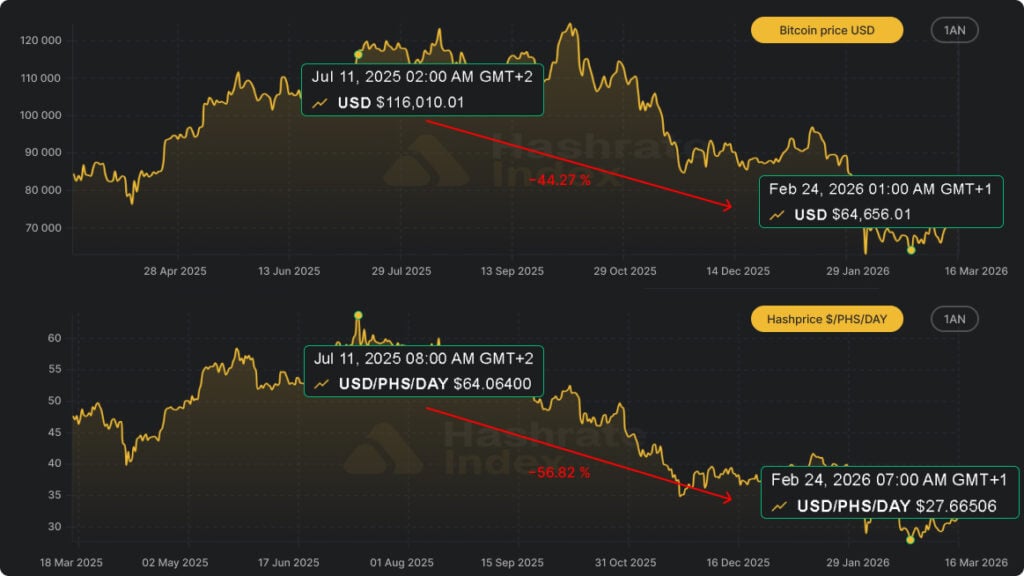
The percentage gap between the drop in profitability (hashprice, in $) and the Bitcoin price reveals the impact of the additional hashrate added between those two dates.
Machine efficiency (J/TH)
An ASIC’s energy efficiency is generally expressed in J/TH (joules per terahash). This metric indicates how much energy is needed to produce one unit of computing power. The lower this value, the more efficient the machine. The latest ASIC generations can produce far more power while consuming less energy than older models.
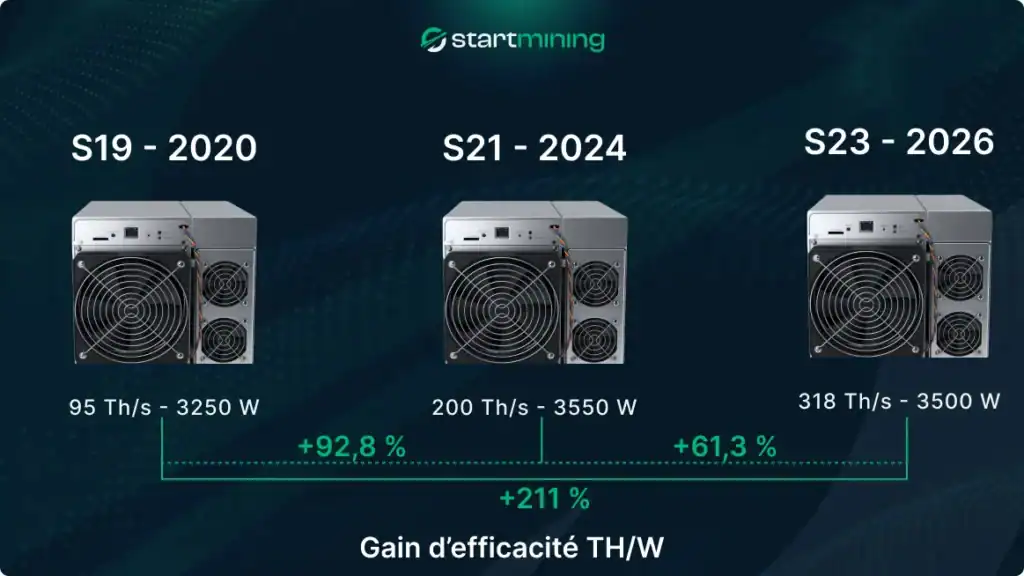
Choosing a high-performance machine becomes essential to hope to stay profitable in an environment where competition keeps rising.
A Bitcoin mining profitability simulator
Understanding the profitability factors is one thing; concretely estimating a machine’s revenue is another. Real mining profitability depends on a set of constantly changing variables: the Bitcoin price, network difficulty and hashrate. That’s why many miners now use mining profitability calculators to model different scenarios before investing in an ASIC. These tools generally let you simulate:
- an ASIC’s estimated daily revenue
- the energy cost based on the price per kWh
- the evolution of network difficulty
- a machine’s return on investment (ROI)
At Startmining, we developed a Bitcoin mining profitability calculator to analyze a mining operation with data close to real market conditions.
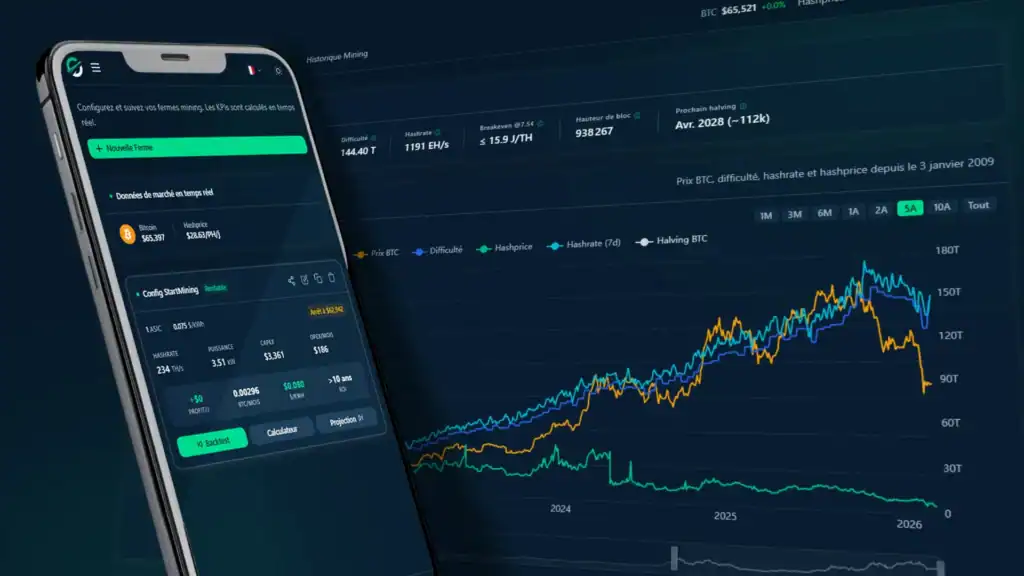
With this tool, you can compare different ASICs, test several Bitcoin price scenarios, or estimate the impact of electricity cost on an installation’s profitability. Using a simulator is now almost indispensable before buying a machine, because two miners using the same ASIC can have very different results depending on their energy cost and infrastructure.
Bitcoin production cost by ASIC generation (2020–2026)
Before analyzing which machines are most profitable today, it’s important to understand a fundamental reality of mining: not all ASICs produce a Bitcoin at the same cost. Depending on their generation, machines have very different energy efficiency, which directly affects each miner’s production cost.
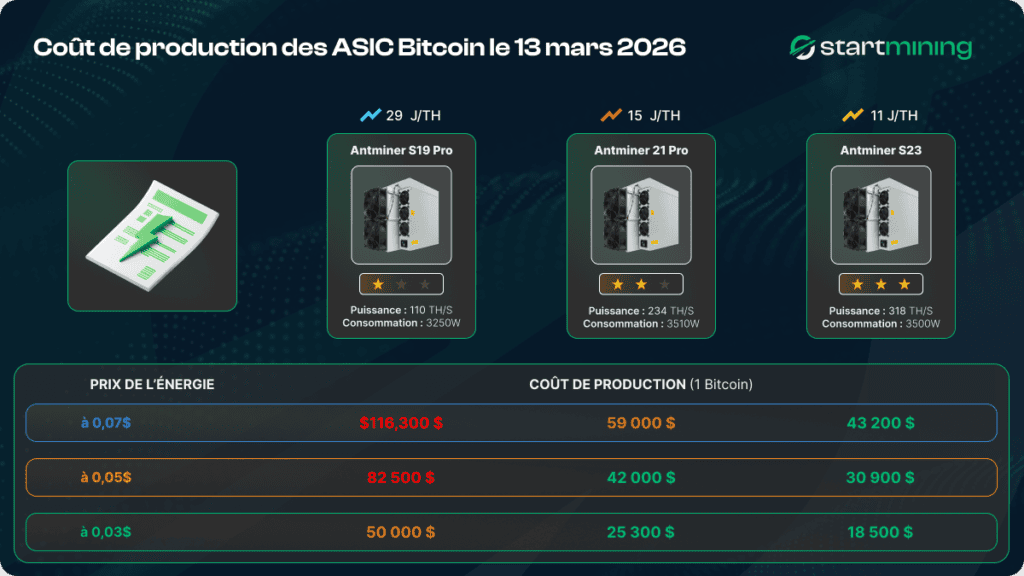
A clear hierarchy between ASIC generations
This chart highlights a structural phenomenon of mining: each new ASIC generation significantly reduces the cost of producing a Bitcoin and improves profitability. In other words, each new generation strongly improves the TH/W ratio, producing far more computing power for a comparable amount of energy.
The gradual obsolescence of older machines
This constant improvement in energy efficiency leads to a well-known phenomenon in the industry: the gradual economic obsolescence of older ASIC generations. When network difficulty rises or Bitcoin’s price falls, the least efficient machines quickly become unprofitable for miners with a standard electricity price.
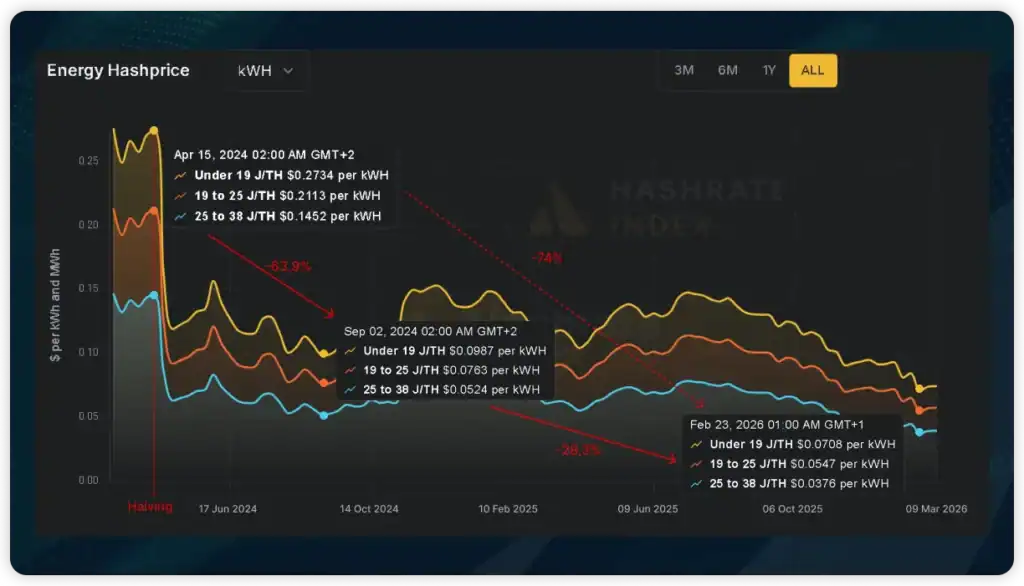
After the 2024 halving, the economic value of the electricity consumed by ASICs fell sharply. The most efficient machines (under 19 J/TH) keep the best per-kWh valuation, while older generations see their profitability degrade much faster. In 2026, some of the least efficient ASIC categories generate around $0.037 per kWh consumed — a level close to, or even below, the average cost of industrial electricity. This economic pressure explains why old generations gradually disappear from the network, replaced by more efficient machines able to produce more hashrate for the same energy.
Which ASICs are the most profitable in 2026?
After understanding the importance of energy efficiency and electricity cost, one question keeps coming up among investors: which mining machines are most profitable today? In 2026, an ASIC’s profitability mainly depends on three criteria:
- its computing power (hashrate)
- its energy efficiency (J/TH)
- its purchase price
The most recent machines generally dominate the market, because they offer a better balance between power consumption and computing power.
Latest-generation ASICs
The most recent models, like the Antminer S21 series or the new S23 models, are today among the most powerful ASICs on the market. The visual below shows an ASIC’s gross annual output and the impact of energy cost on real profitability. Even for very powerful machines, a significant part of the output is absorbed by electricity consumption.
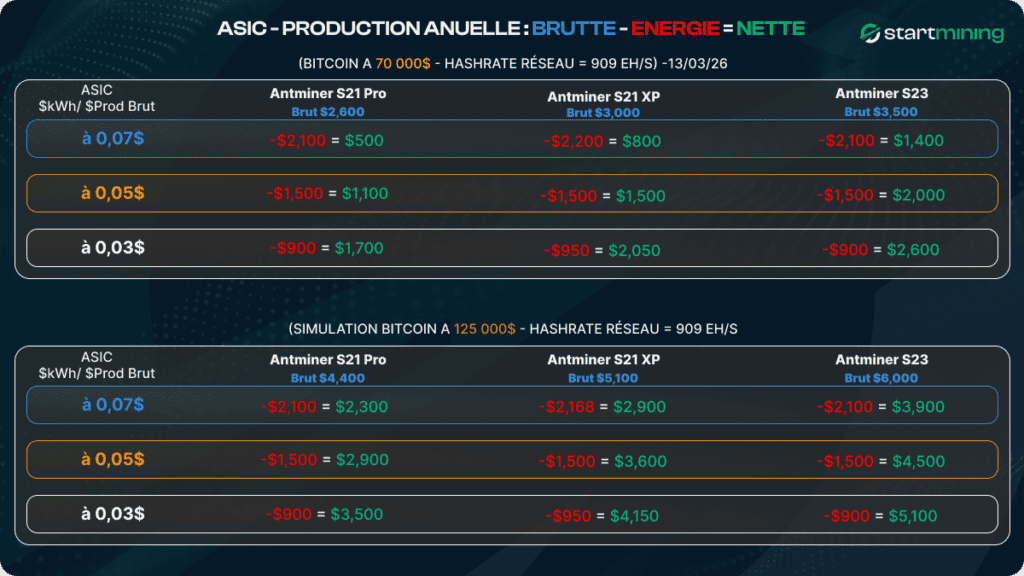
With Bitcoin around $70,000, an ASIC like the S21 Pro can generate roughly $2,600 in gross annual output, but a significant share goes to energy cost. Net profitability therefore depends directly on the price per kWh. In a more favorable scenario — for example, Bitcoin at $125,000 — gross output rises strongly, and latest-generation machines like the S21 XP or S23 can generate several thousand dollars of net revenue depending on the electricity cost. These ASICs are favored today by large industrial farms because they maximize computing power per megawatt consumed while staying competitive even when the hashprice is low.
How to choose the right mining machine
Choosing the right ASIC isn’t only about picking the most powerful and most profitable machine at a given moment. In practice, an investor must consider several factors: the machine’s purchase price, the cost of electricity, the estimated operating period, and the possible evolution of network difficulty. In some cases, a slightly less powerful but much cheaper machine can offer a better return on investment. That’s why many miners use simulation tools to compare several scenarios before investing.
Want to go further and learn how to choose the right mining machine? We published a complete guide explaining how to use a mining simulator to compare ASICs and estimate their profitability based on your electricity price and various market scenarios: choosing the right ASIC with a mining simulator.
An industry already looking toward the next halving?
Bitcoin mining economics are paced by a fundamental event: the halving, which occurs about every four years. The next is expected around 2028 and will again halve the block reward. In concrete terms, miners’ revenue will be instantly cut in half, mechanically doubling the cost of producing a Bitcoin for a given infrastructure. This mechanism acts as constant pressure on technological innovation in the mining industry.
By then, a new generation of ASIC chips will very likely be announced. Each cycle brings major improvements in semiconductor etching, producing more computing power while consuming less energy. For over a decade, ASIC manufacturers have been gradually pushing the limits of miniaturization. With each generation, etching moves a little closer to the nanometer scale — a sign that technological innovation continues to support mining’s evolution.
This dynamic is one reason Bitcoin mining remains an industry in constant transformation. Despite market cycles, technological progress, energy optimization and infrastructure industrialization show that Bitcoin mining still has many years of evolution ahead.
FAQ — Bitcoin mining profitability in 2026
Is Bitcoin mining profitable in 2026?
Yes, with recent hardware and cheap power. At a ~$29/PH/s/day hashprice (July 2026), an Antminer S21 XP (13.5 J/TH) breaks even at ~$0.088/kWh and an S23 Hydro (9.5 J/TH) at ~$0.124/kWh. S19-class machines need electricity under ~$0.055/kWh to stay profitable.
What is the most profitable ASIC in 2026?
The Antminer S23 Hydro (580 TH/s, 9.5 J/TH) currently offers the lowest production cost: roughly $34,200 per BTC at $0.07/kWh, versus ~$48,600 for an S21 XP and ~$77,300 for an S19 XP (July 2026, ~0.96 ZH/s network).
How cheap does electricity need to be to mine profitably?
With Bitcoin around $61,000 and the network at ~0.96 ZH/s, breakeven electricity is roughly $0.088/kWh for an S21 XP, $0.068/kWh for an S21 and $0.055/kWh for an S19 XP. Below ~$0.06/kWh, the whole S21 generation mines at a profit.
Useful resources to get started in Bitcoin mining: explore our ASICs with integrated hosting in the Startmining store, understand how ASIC prices evolve, and learn whether to buy a new or used ASIC.
Passez à l'action
Ready to mine Bitcoin with Startmining?
Browse our ASIC shop or simulate your profitability in real time.