The Bitcoin Halving Explained
Bitcoin’s price and the network’s hashrate are flirting with record highs, reflecting market optimism and growing mining activity as the halving approaches. Everything is speeding up, which can seem complex to the uninitiated. So let’s look at the stakes and prospects of this quadrennial event written into the Bitcoin protocol. You have probably already heard of it — but what exactly is it?
What is the halving?
The halving is the cutting in half of mining rewards in BTC — and therefore of the number of bitcoins issued when a new block is validated on the blockchain. This event, programmed into the Bitcoin protocol, takes place every 210,000 blocks, or roughly every four years.
The halving in a few figures
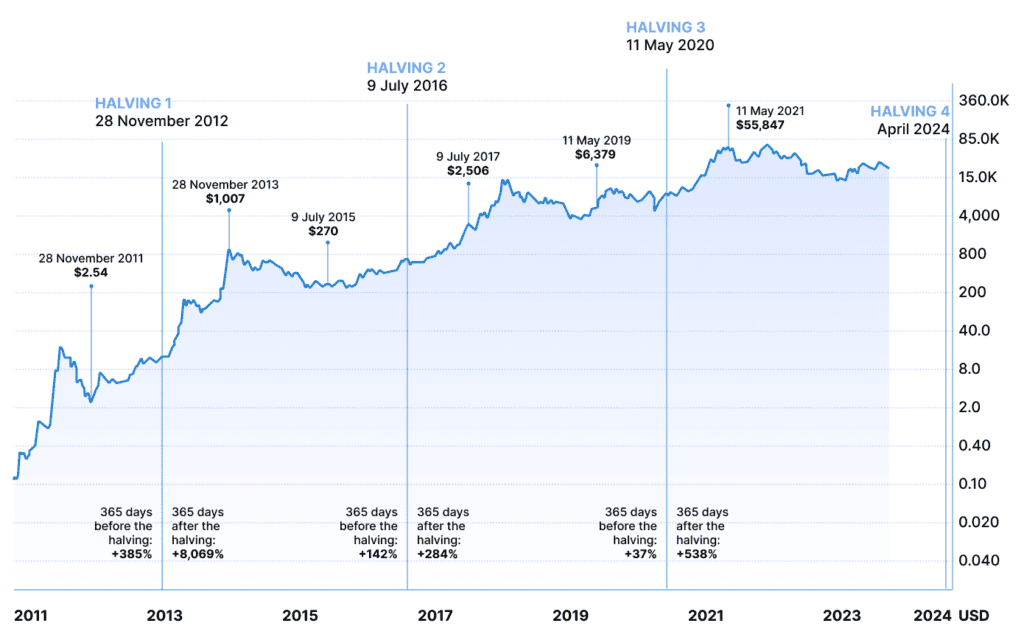
At Bitcoin’s launch in 2009, miners earned 50 BTC per mined block. Then, in 2012, the first halving took place and the reward dropped to 25 BTC. In 2016, rewards were halved again to 12.5 BTC. At the third halving in 2020, they fell to 6.25 BTC. Finally, in April 2024 — the date of the next halving — block rewards drop to 3.125 BTC, and so on, until the 32nd and final halving expected around 2140. But miners can rest assured: they will still earn the income tied to transaction fees.
The halving: a deflationary process
From the outset, the halving is a function of the Bitcoin protocol designed as a tool to control inflation. It limits the total number of bitcoins in circulation (21 million), creating scarcity and potentially increasing its value. Bitcoin is therefore a deflationary monetary system created to support and improve its peer-to-peer network.
Of the 21 million bitcoins planned by the protocol, 19,679,593 had already been mined at the time of writing — more than 93% of the total issuance.
When will the next halving take place?
The next halving will occur at block 840,000, which should happen in late April. Its exact date depends on the speed of block production, which depends on the computing power on the network: the more machines mining, the faster blocks are validated. Mining difficulty adjusts every 2,016 blocks (roughly every 14 days) to maintain a consistent block time. It is therefore impossible to predict the exact date of the halving — which is why countdowns differ from one another. The closer we get, the more precise the date becomes.
What impact on the price of Bitcoin?
Historically, halvings have always been followed by a rise in Bitcoin’s price over the medium term. Some think the halving has already been priced in by the market, which would explain Bitcoin’s already-high price. Others, by contrast, believe the drop in new bitcoins combined with growing demand for the queen of cryptocurrencies should lead to a price increase. It is worth noting that this time, Bitcoin reached its all-time high just a few weeks before the halving — an unprecedented situation.
What are the consequences for transaction fees?
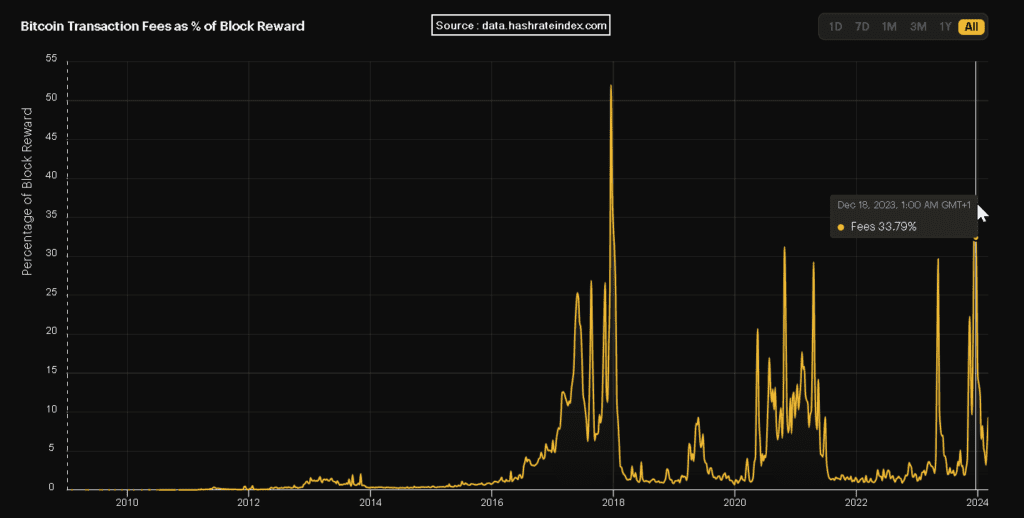
The halving has no direct impact on transaction fees. However, fees tend to rise during the bull market that follows a halving. They generally reflect wider use of the network, which translates into more on-chain activity. Yet we again face an unprecedented situation: Bitcoin transaction fees have already risen even though we are in the pre-halving period. The explanation comes partly from growing interest in storing data on-chain on Bitcoin.
On-chain innovation in the service of miners
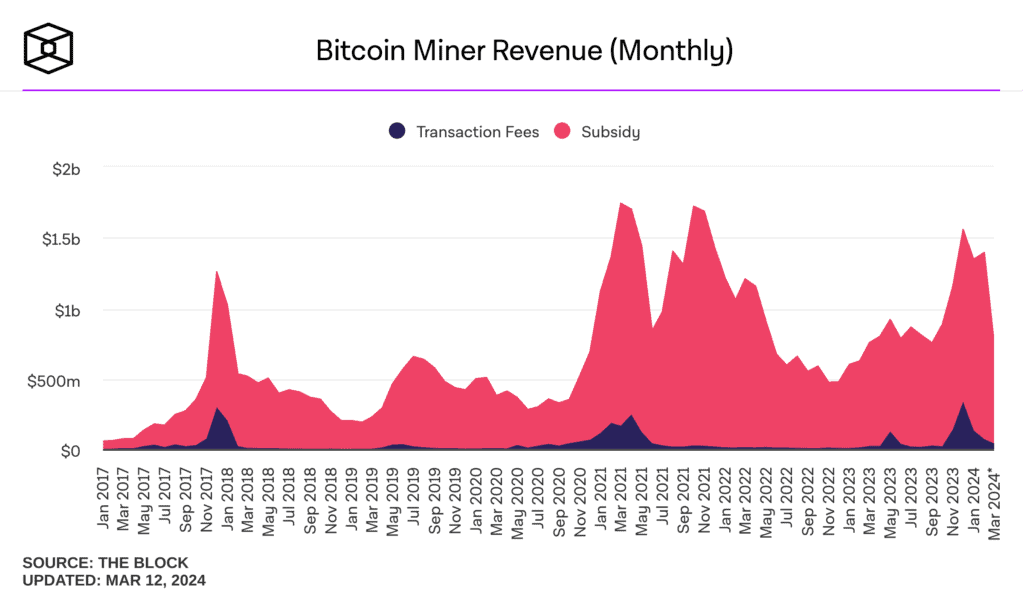
The arrival of on-chain inscriptions and NFTs on Bitcoin in early 2023 (the Ordinals protocol) is redefining the future of miner revenue. The share of transaction fees relative to block rewards has never been so high before a bull run. At the end of 2023 (at the peak of this new technology’s use), transaction fees represented nearly 30% of block revenue, sometimes exceeding 100% of the per-block reward. By comparison, these amounts are equivalent to those seen at the peak of a bull market, when euphoria is at its height and on-chain activity at its maximum. This data demonstrates the value of on-chain innovation in increasing fee-based revenue. The security advantage of the Bitcoin network is decisive in the choice of a decentralized storage solution.
How will the halving affect miners?
In the context of the Bitcoin halving, it is crucial to understand the impact on miners’ income. Currently, about 900 new bitcoins are issued daily, forming the basis of miners’ income. That amounts to a total of roughly $64 million to share each day among all active miners (at a price of $71k per BTC). This figure represents a significant revenue opportunity, even after the planned halving.
The impact on block revenue
When the halving occurs, it halves the reward for each mined block. If Bitcoin’s price doesn’t rise to offset this reduction, mining profitability (hashprice) can fall. Miners then receive less Bitcoin for the same amount of energy spent. This can reduce interest in the activity, lower hardware investment, and potentially reduce the network’s overall hashrate.
Positive consequences nonetheless
The halving’s effect on hashprice is not purely negative or linear. Generally, a rise in Bitcoin’s market price follows from its increased perception of scarcity. If the price rises enough after a halving, it can offset the reduced block reward and maintain — or even increase — mining profitability. In short, although the halving may initially reduce hashprice by lowering miners’ rewards, market adjustments (Bitcoin price moves, hashrate) play a crucial role in long-term mining profitability.
Note that if the halving is initially accompanied by a lag in Bitcoin’s price increase, it will inevitably affect miners. Profitability will no longer be there, and shutting down their machines will become unavoidable for some. This is what we have seen in the past: each halving has been accompanied by a hashrate drop lasting from a few days to several weeks.
More than 60% of the current hashrate comes from S19s hosted at more than €0.07/kWh. The halving will therefore reshape the mining landscape, and miners who want to stay in the race will have to show resilience.
The impact of mining-hardware evolution on the consensus
An ASIC’s model defines its energy efficiency, generally expressed in joules per terahash (J/TH). Like the price of energy, energy efficiency plays a crucial role in determining the cost of producing one Bitcoin. That production cost then defines whether a miner is profitable or not. Mining-hardware innovation has always been part of the evolution of participation in the consensus. Each new ASIC series has quickly replaced the previous models, especially when profitability falls in a bear market or post-halving period.
When profitability is at its lowest and close to the production cost of most participants, the role of mining hardware becomes fully apparent.
Miners’ production cost and break-even by ASIC model and energy price
To illustrate the halving’s impact on miner profitability (at a given moment, March 24, 2024) and the role of product efficiency, the data compares the profitability of two ASIC models from different series before and after the halving (energy cost of $0.07 and 0% mining fees).
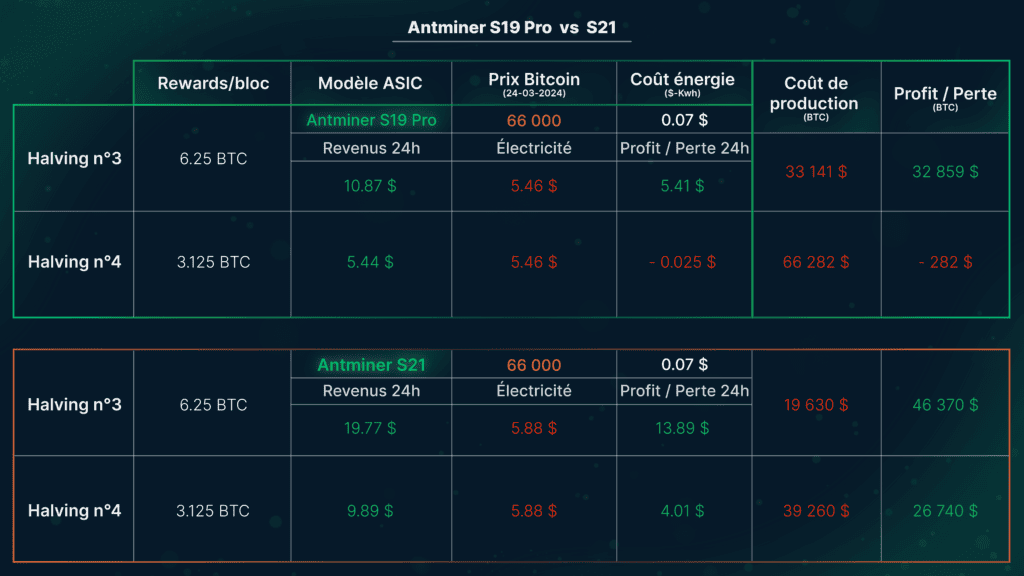
The energy-efficient, latest-generation ASICs will come out the big winners. For now, their prices remain stable, offering a window of opportunity for investors seeking high-performance mining hardware.
As the halving approaches, however, many miners delay acquiring latest-generation hardware, fearing a rise in difficulty and a drop in rewards. This could trigger strong post-halving demand, intensifying competition and potentially leading to price increases and reduced supply. Anticipating hardware investments is therefore crucial.
Will history repeat itself?
Cycles follow one another but do not necessarily resemble each other. The current context is very different from that of previous halvings. As we saw, Bitcoin reached its all-time high in March, just a few weeks before the next halving — an unprecedented situation proving that anything can happen with the queen of cryptos.
The SEC’s approval of Bitcoin ETFs at the start of the year strongly affected the market, driving unprecedented demand (far above production). Miners are also using new strategies to adapt to market challenges: some use machine underclocking, which improves energy efficiency and favors durability. Finally, transaction fees could rise because of the value of the first blocks mined post-halving, which should encourage miners to continue operating despite lower per-block rewards.
We can therefore conclude that even if history tends to repeat itself, nothing is written — except, of course, Satoshi Nakamoto’s white paper.
Our mining offers
Startmining offers turnkey mining solutions. Our team helps you successfully navigate these changes, whether by increasing your mining capacity or optimizing your existing operations.
Beyond selling mining hardware and our hosting offers in our farms in Iceland, we also offer the START token. This innovative solution is a gateway to Bitcoin mining, accessible online in just a few clicks. Once staked in one of our pools, START lets you receive Bitcoin rewards directly in your wallet. The whole team is here to support you on your path to sustainable, profitable mining.
Passez à l'action
Ready to mine Bitcoin with Startmining?
Browse our ASIC shop or simulate your profitability in real time.