Bitcoin Hashrate −25%: A Simple Dip or a Strong Signal?
Introduction
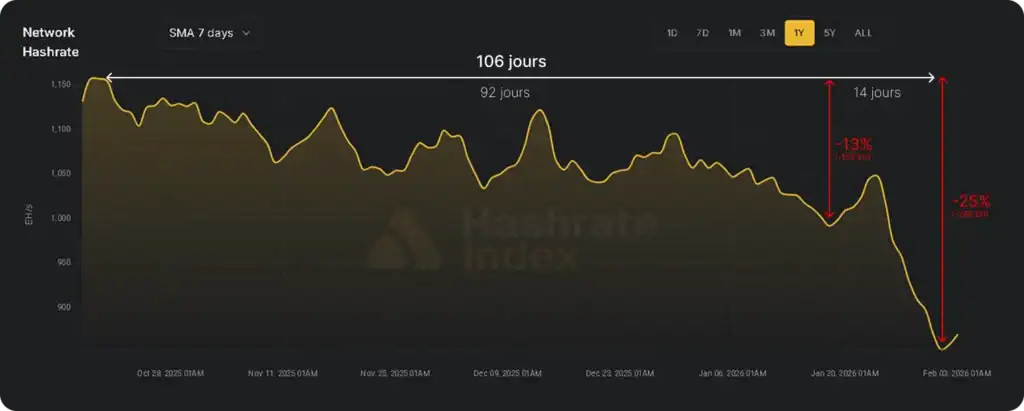
The drop in Bitcoin’s hashrate seen since October 2025 has not gone unnoticed. Between October and late January 2026, Bitcoin’s hashrate fell from around 1,145 EH/s to 859 EH/s — a decline of nearly 25% in a few months.
Some see a sign of network weakness, others a worrying miner capitulation. In reality, this recent drop is explained by two very concrete factors that illustrate the economic and energy mechanics of Bitcoin mining.
What is Bitcoin’s hashrate (a quick reminder)?
The hashrate represents the total computing power mobilized by miners to secure the Bitcoin network (validate blocks). It depends directly on:
- the number of ASICs in operation,
- their energy efficiency,
- network difficulty.
The hashrate is not an abstract variable: it is the direct consequence of the real profitability of mining around the world at any given moment.
When do we really talk about a hashrate “drop”?
We don’t talk about a drop when the hashrate swings by a few percent or the variation is absorbed within a few days. We talk about a significant drop when the decline exceeds 10–20%, spreads over several weeks, and reflects a massive shutdown of machines.
The move from 1,145 EH/s to 859 EH/s between October and January clearly falls into this category. Such events are rare and generally temporary.
The main causes of a Bitcoin hashrate drop
1. The economic shock: unprofitable S19s and S21s at the edge of profitability
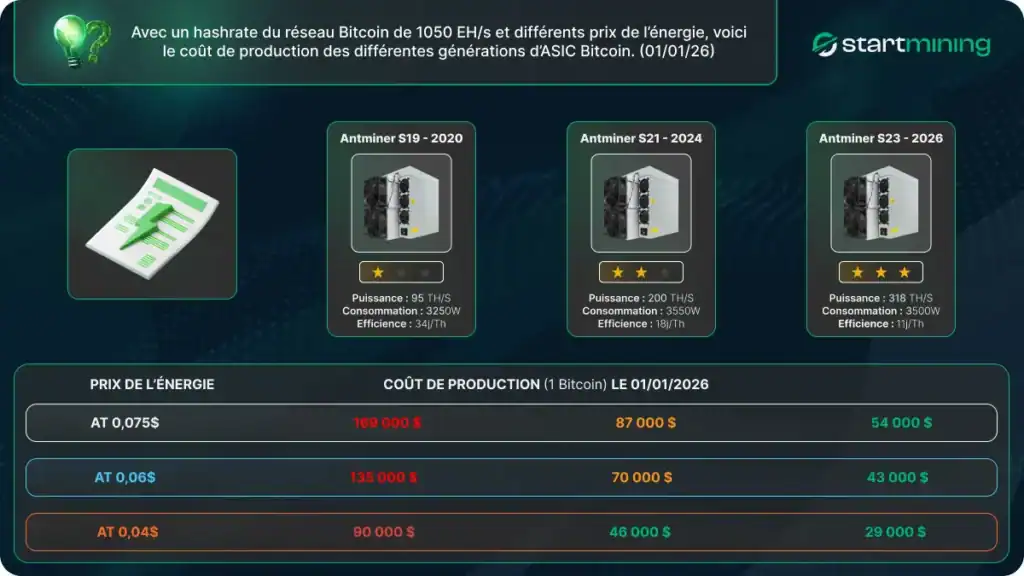
The first cause is purely economic. Despite a very competitive energy price ($0.04/kWh), S19-generation ASICs now show a production cost of around $90,000 per BTC — a figure above Bitcoin’s spot price at the time of writing ($77,000, February 2, 2026).
In this context, a large share of the S19 fleet has become structurally unprofitable. The result: machines switched off, massive underclocking, and/or permanent exit from the network. More than 20% of the global hashrate still relied on S19s until recently.
This is not a network collapse, but a natural selection of hardware.
2. Capitulation of the least competitive miners after a continuous hashrate rise
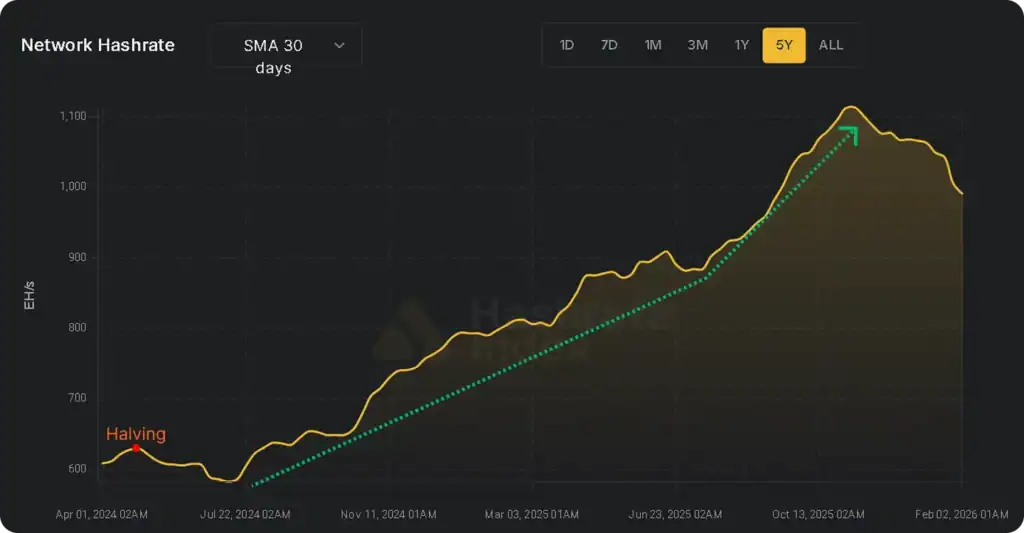
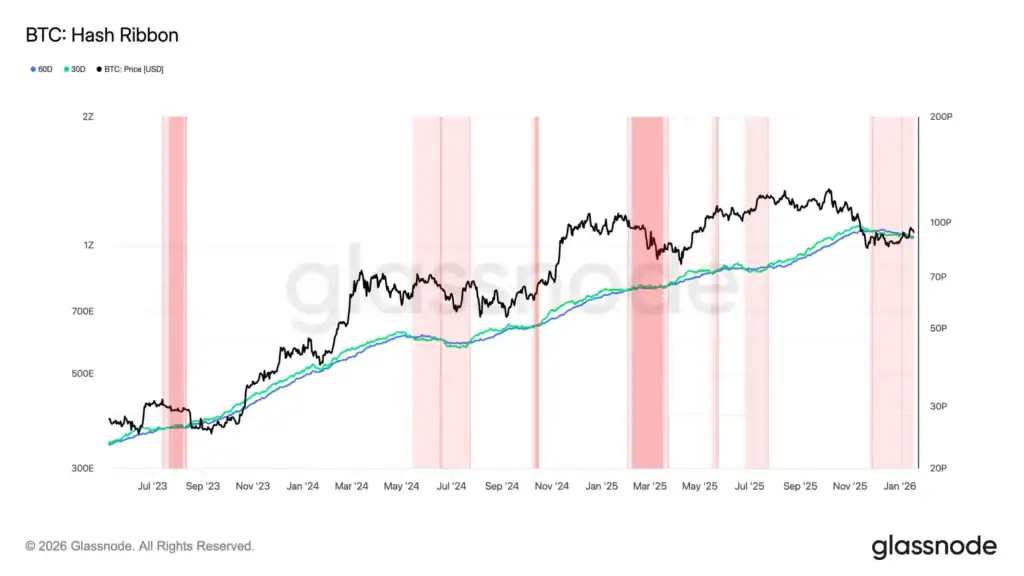
Before this drop, the network saw a near-uninterrupted rise in hashrate since 2024 (new models: S21 < S21 Pro < S21 XP < S21 Hydro < S23) and constant pressure on hashprice (between $40 and $60 per PH/day since 2024), with margins gradually eroded by energy inflation.
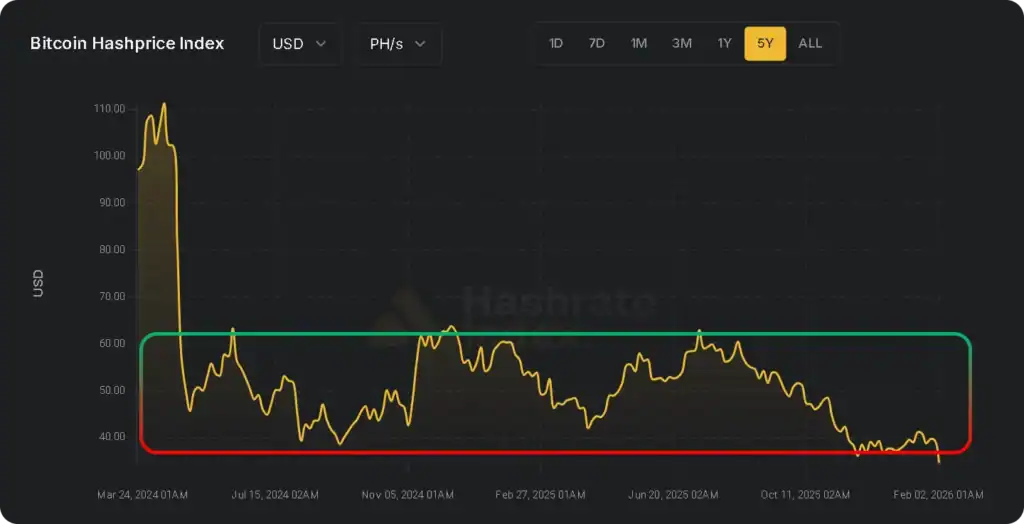
Since the last halving, many miners kept operating at break-even or at a loss, betting on a quick price recovery or a difficulty drop. When the spot price didn’t follow, capitulation became inevitable — first among the least efficient players or those with the highest energy price.
This capitulation is a classic mechanism, observed after every phase of excessive hashrate expansion.
3. Energy events: extreme cold in the US and the key role of Texas
The second major explanation for this drop is energy-related, not economic. The winter of 2025–2026 was marked by episodes of extreme cold in the United States, strong strain on the power grids, and in particular Texas, whose grid is independent (ERCOT).
Since 2021, Texas has relied heavily on Bitcoin miners as a tool of energy flexibility and an adjustment variable in case of overload. In concrete terms, farms are contractually incentivized to disconnect, sometimes for several days or weeks, to stabilize the power grid.
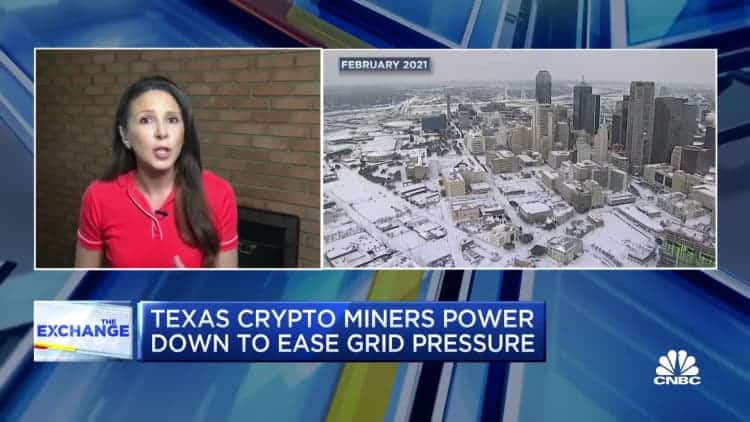
So hundreds of EH/s can disappear temporarily without any machine truly leaving the mining cycle. It is a voluntary, known and anticipated phenomenon, already seen in previous winters.
A historical reading: what the past teaches us
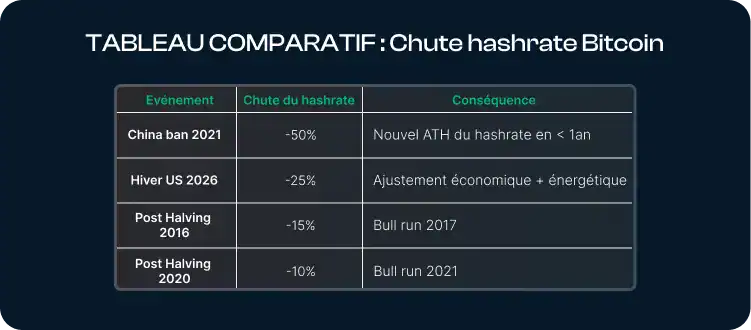
A sustained hashrate decline can lead to a drop in Bitcoin mining difficulty at the next retarget. At constant individual hashrate, this adjustment increases the expected BTC production per unit of computing power for miners that remain online.
Conclusion
The recent Bitcoin hashrate drop is neither an accident nor a sign of protocol weakness. It reflects:
- a clear economic reality: some ASIC generations are no longer viable and suffer from the slightest drop in Bitcoin’s spot price;
- an accepted energy reality: mining has become a tool for stabilizing power grids;
- a healthy Proof of Work regulation mechanism that has been part of Bitcoin’s DNA and strength since its launch in 2009.
Bitcoin protects neither the machines nor the miners. It protects the network. And as long as blocks keep being produced, Bitcoin works exactly as intended.
The Bitcoin hashrate drop is a reminder of one essential thing: mining is above all a matter of efficiency, timing and the right hardware. When some ASIC generations exit the network, others take over. It is precisely in these adjustment phases that the best opportunities arise for the best-equipped miners.
Discover the Bitcoin ASICs currently available in the Startmining store.
Passez à l'action
Ready to mine Bitcoin with Startmining?
Browse our ASIC shop or simulate your profitability in real time.