Buying vs. Mining Bitcoin
Two completely different approaches
The choice between buying or mining Bitcoin should be made according to your short- or medium-term goals. It should also factor in market timing, your risk tolerance and the resources you allocate. As a general rule, it is wise to do thorough research before investing.
In this article, we simulate and compare a buying strategy against several mining-investment strategies. Need a refresher on the fundamentals of investing in Bitcoin? See our introduction to investing in Bitcoin.
Buy or mine Bitcoin: which is more profitable?
The answer is not so simple, because it largely depends on market conditions. As stated at the start, timing plays an essential role in defining the profitability of an investment. Comparing buying to producing Bitcoin is, broadly speaking, impossible. Should you compare an investment from the market bottom (around $20k) or from an alternative level (BTC $40k, $50k, $70k)? Such a comparison amounts to picking market conditions that favor one solution or the other. For example, buying Bitcoin at the best moment of a bear market is not the same as buying it at a market peak.
Likewise, buying Bitcoin at the top of a bull market, when its spot price is far above its production cost, amounts to handing miners a buying premium. Investing in Bitcoin — whether by buying or mining — is always a hypothesis made at a given moment, confirmed or not in the future.
ASIC product innovation: the start of a new mining cycle?
Mining-hardware innovation generally follows market cycles. So we compare a mining strategy that includes buying a last-generation ASIC from the previous cycle (S19 Pro) against a DCA strategy over the same period (October 2020 – April 2024).
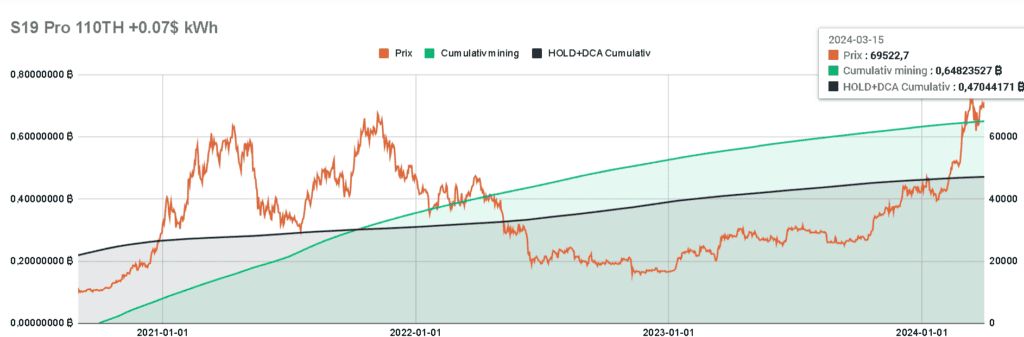
For this chart, we simulated the cumulative output of an S19 Pro (bought for €2,500) commissioned in October 2020, adding a daily energy spend equal to €169 per month. To mirror that reality, we simulated the following DCA strategy: an initial €2,500 purchase of BTC in October 2020 with a daily reinvestment equal to €169 of Bitcoin bought each month.
In this simulation, the mining strategy catches up with DCA as early as October 2021. It yields more bitcoin while preserving the residual value of the hardware — which, once it is no longer profitable at $0.07, will still have value. Miners with a very attractive energy price (under $0.05) will still be profitable.
Energy price: the competitive edge between miners?
Energy price and ASIC efficiency are key parameters in a mining strategy. The cheaper the energy, the more profitable mining is. The more efficient an ASIC, the lower its production cost. Let’s illustrate the advantage of energy — the real nerve of the war.
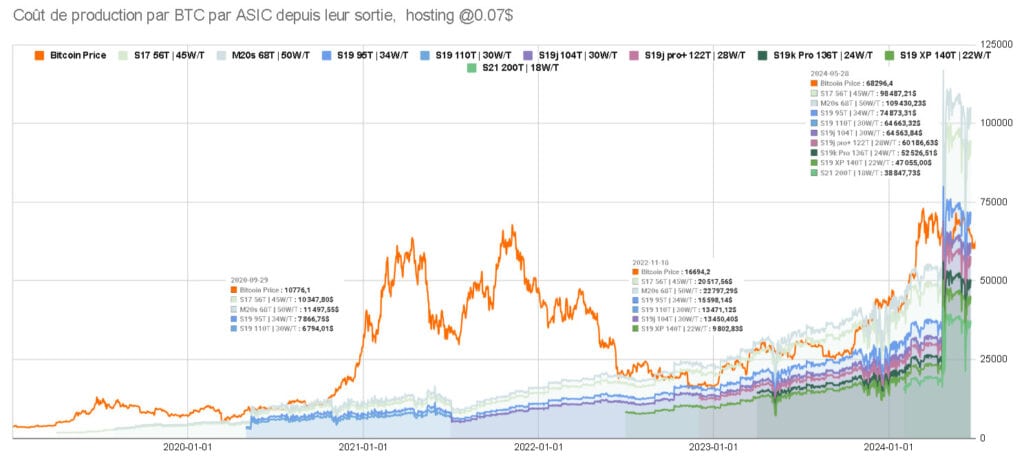
This shows that ASIC models released since 2019 are still profitable (with a very attractive energy price). The production-cost gap, which doubles depending on the model, illustrates how much hardware efficiency matters.
- The S21 Pro, released in 2024, has a production cost of $20,220 with BTC at $61.5k (June 2024).
- The M20s, released in 2019, has a production cost of $56,959 with BTC at $61k (June 2024).
Average energy price and ASIC obsolescence
From the production cost of the various ASIC models since 2019, we can infer the obsolescence of certain models based on market metrics. For example, the S17 and M20s have not been profitable in 2024, and have not been since the 2022 bear market. Today, the cost of producing one Bitcoin with these models is close to $100,000 — far above the market price.
Mining-hardware efficiency: the ultimate competitive factor?
Newer models with the best efficiency (S19 XP and S21) have a production cost between $38,000 and $47,000. By contrast, models from the previous cycle (2020/2021 — S19 series) have a production cost between $52,000 and $63,000. We can conclude they will be the next models to become obsolete as new series join the network.
This confirms how much product efficiency matters — and the impact of purchase timing. An ASIC becomes obsolete over time; that is a fact, and it shows the value of buying models at launch. Technological obsolescence is already built in by the sector’s race to innovate.
Profitability windows: bull and bear markets
The S17 ASIC, released in 2018, produced the equivalent of 0.96 BTC over 1,907 days for a consumption of 115,335.36 kWh. At an energy price of $0.20, the cost of producing those 0.96 BTC over the whole period equals $23,000. At $0.07, the cost is $8,073. At that energy price, when the halving hit in 2020, the S17 was barely profitable anymore. Luckily, the bull market extended its profitability until the bear-market capitulation in December 2022. We can conclude that mining is hard to make profitable for individuals (above $0.07/kWh). Fortunately, Startmining’s mission is to make it accessible again under the same conditions as industrial players.
Miners’ production costs: the ideal DCA indicator?
When the ratio of “mining costs / BTC price” is below 1, the activity is profitable for all participants (the yellow curve above the blue curve). Conversely, near the bottom of each cycle’s bear market, the activity is profitable for only a small number of miners (very low energy price + the most efficient ASICs). So when miners are no longer profitable, it becomes very interesting to set up a Bitcoin buying strategy: the price is generally below its average production cost (the yellow curve below the blue curve).
Halving, mining cycle and new ASIC series
Outside of bear markets, mining is barely profitable right after a new halving. That is usually when a new miner series (ASIC) is announced. The efficiency of the new models and the reward cut from the halving signal a new mining cycle — the ideal moment to get positioned.
So the simplest answer is this: the more profitable option between buying and mining Bitcoin remains producing it — as long as your production cost is below the market price. In other words, as a Bitcoin producer, drawing a parallel with buying, it amounts to obtaining most of your bitcoin at a discount (production price below spot price). But this is only true when the miner takes a professional approach to the activity (uptime management, energy cost, maintenance cost, cooling cost, failure handling, etc.).
Conclusion
As you will have understood, it is very hard to say which is the best option between buying and producing Bitcoin. The profitability of mining or buying Bitcoin depends on many factors:
- Mining machine and technological innovation (hash power, consumption, efficiency, firmware)
- The blockchain network (issuance policy, block reward and transaction fees, difficulty and number of participants)
- The miner’s choices (model, reinvestment in the most efficient ASICs)
- Buying at the bottom of a bear market vs. buying at the market top
Our mining hosting offers
At Startmining, we have operated bitcoin mining on behalf of our clients since 2019. Thanks to our expertise, we handle every step needed for mining operations to run smoothly:
- the sale and assembly of the machines,
- shipping and installing the machines in our mining farms,
- monitoring and maintenance,
- tracking of operations.
Have a mining project you would like support with? Looking to relocate your miners? Explore our mining and hosting offers or book a call with one of our experts. We would be glad to discuss the feasibility of your project and how we can set it up with you.
Passez à l'action
Ready to mine Bitcoin with Startmining?
Browse our ASIC shop or simulate your profitability in real time.