Choosing the Right ASIC with a Mining Simulator

Introduction
When a new ASIC generation is announced, the choice seems simple: take the most powerful and most efficient one. At Bitmain, for example, there’s the version that introduces a new series — say the “S21.” Then the professional “S21 Pro,” and finally the premium “S21 XP.”
Three models. Three power levels. Three prices. But one real question: which to choose, and for which scenario? Because an ASIC is never “good” or “bad” in itself. It performs well in a given context: the price per kWh, the state of the market (bear or bull) and the network hashrate (stable or rising). Without these variables, comparing models means comparing spec sheets… not strategies.
This is exactly where the Startmining simulator comes into its own. Rather than debating in theory, we’ll analyze a concrete case:
- S21 Pro hosted in the US
- S21 XP hosted in the US
- Current market conditions (hashrate, Bitcoin price)
- Then a scenario where Bitcoin returns to its previous ATH ($124,000)
The goal: determine which model is genuinely most relevant in each scenario.
Current scenario: choosing an ASIC when the market is under pressure
Let’s start with the current context. Bitcoin trades around $64,000. The network hashrate is historically high. Margins are compressed. In other words, we’re in a demanding environment.
Let’s first analyze the S21 Pro, hosted in our US farm at $0.075/kWh.
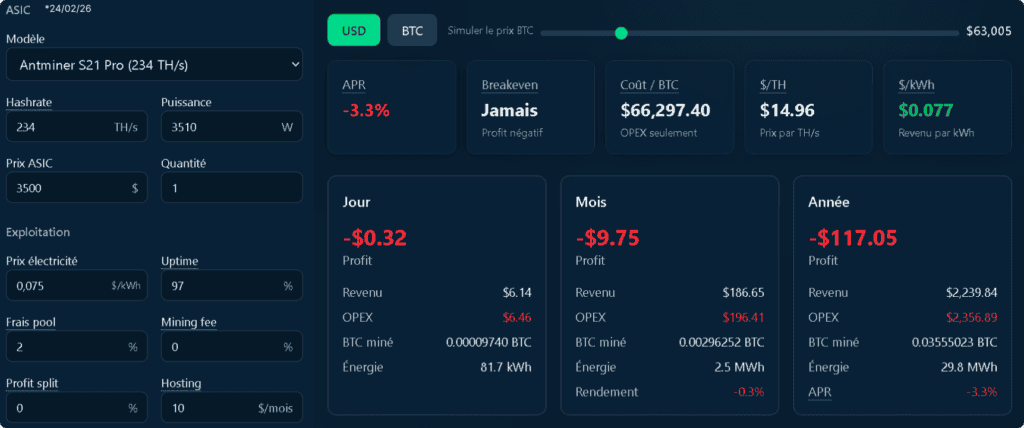
The conclusion is clear: the machine is operationally in the red.
- Daily profit: negative
- APR: −3.3%
- Break-even: never
This means that at the current Bitcoin price and with this energy cost, the machine doesn’t even cover its OPEX (operating cost).
Now to the S21 XP, under the same conditions.
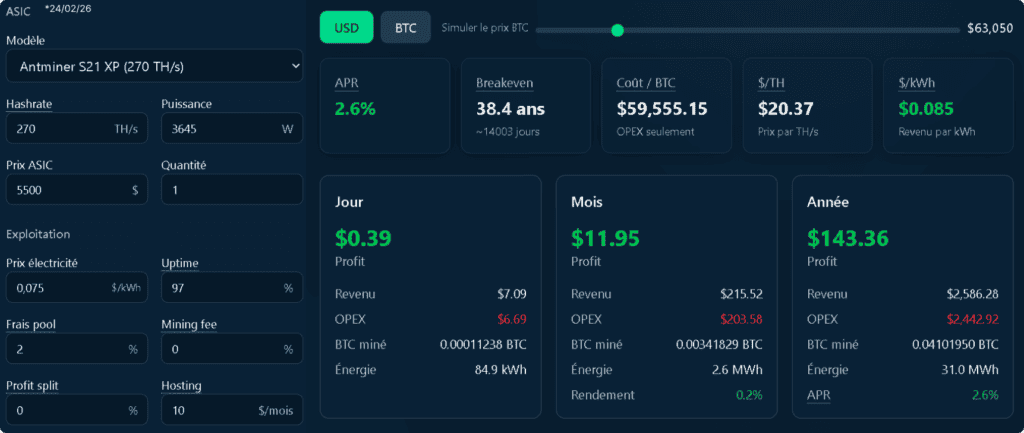
The situation changes slightly.
- Daily profit: slightly positive
- APR: around 2–3%
- Break-even: very long, but it exists
The difference comes from the XP model’s superior energy efficiency. In a compressed market, every watt counts. Every joule per terahash becomes decisive. This highlights a first reality: in tense periods, premium models survive better than intermediate versions. But mining isn’t thought about over a week — it’s thought about over a cycle. And that’s where the simulator becomes even more interesting.
Bull-run scenario: if Bitcoin returns to $124,000
Mining is a long-term game. When you buy Bitcoin at spot, it’s rarely to sell it the next day — it’s in the hope of a return close to its previous ATH. Let’s apply that logic to mining. We keep exactly the same configurations (US hosting at $0.075/kWh and the current network hashrate) but change a single variable: Bitcoin at $124,000.
Result for the S21 XP:
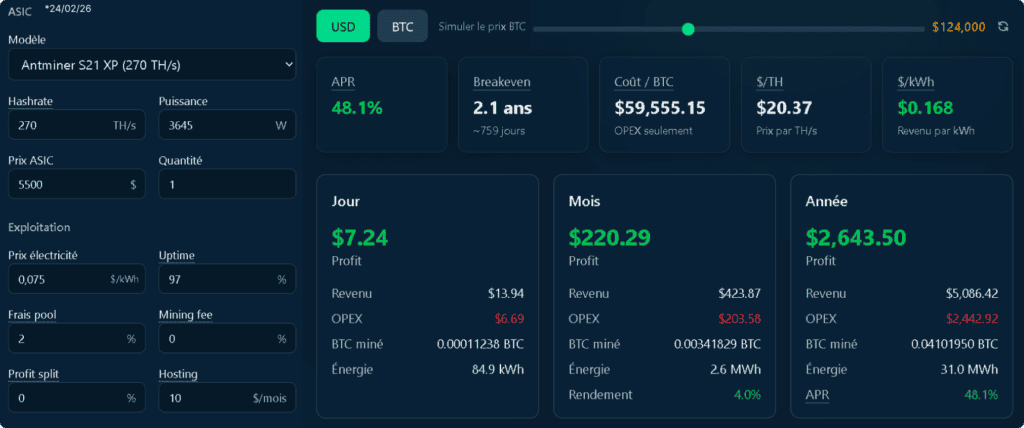
- APR close to 50% (48%)
- Break-even around 2 years
- Annual profit above $2,600
The machine becomes strongly profitable. Now to the S21 Pro. Surprise!
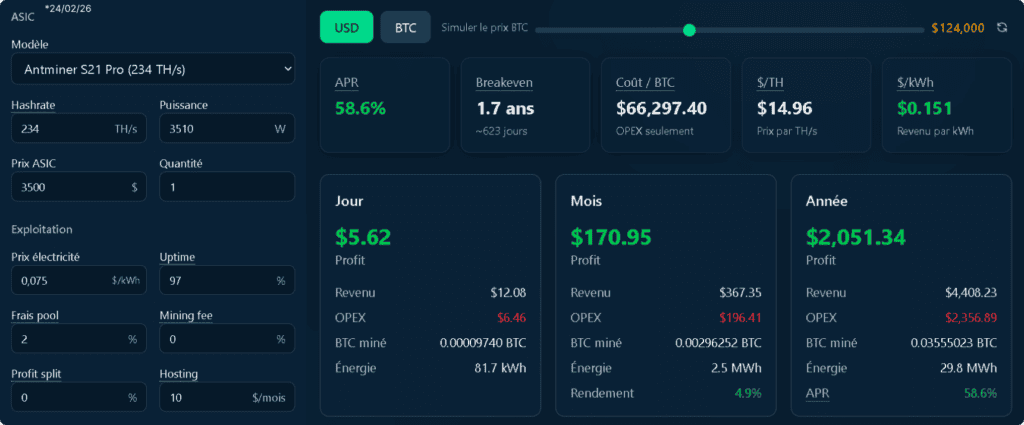
- APR above 55%
- Faster break-even
- Annual profit above $2,000
In this scenario, the Pro model even surpasses the XP in relative return. Why? Because in a bull phase, profitability no longer depends solely on extreme efficiency. It depends on the purchase price / power / revenue ratio. In other words: in a tense market, the premium protects; in a bull market, the best performance/price ratio can dominate.
And that’s exactly what the simulator reveals. Here’s where the analysis gets interesting, because you have to keep one essential fact in mind: the S21 XP costs almost as much as two S21 Pros. So, for the same capital, an investor could deploy two Pro machines rather than a single XP. In a bullish scenario, the relative return becomes decisive.
Conclusion — there’s no “best” ASIC. There’s a right scenario.
This demonstration highlights a simple reality: the choice of an ASIC is never absolute. It’s always conditional — on your situation, your scenarios, and then reality. In a compressed market, the most efficient model protects best. In a bull run, the model with the best capital/performance ratio can outperform.
Mining isn’t a power contest. It’s a capital allocation under constraints: energy cost, market timing, network hashrate, investment horizon. Each variable changes the hierarchy. And that’s precisely why the simulator makes sense. Before investing, test your assumptions. Change the Bitcoin price. Simulate a bear market. Project a return to the ATH. Because in modern mining, performance isn’t guessed — it’s calculated.
Access the simulator at pro.startmining.io, and discover our ASICs available with hosting at startmining.io/boutique.
Passez à l'action
Ready to mine Bitcoin with Startmining?
Browse our ASIC shop or simulate your profitability in real time.