Mining Bitcoin: Should You Sell or Hold Your Rewards?

A 15-year-old question… still without a universal answer
When people talk about Bitcoin mining, most discussions revolve around ASICs, the price of electricity or hashrate. Yet an equally important question is often overlooked: what should you do with the bitcoins you produce?
Should you sell your rewards regularly to secure your income? Or, on the contrary, hold every satoshi in the hope of fully capturing Bitcoin’s upside?
At first glance, the answer seems obvious. If Bitcoin rises over the long term, then holding your rewards looks like the best strategy. But the reality is more nuanced.
Thanks to the historical data from the START token pools, we can compare two approaches under real production conditions:
- Mining Sell: the rewards are sold regularly.
- Mining Hold: the rewards are kept.
The value of this comparison is simple: energy costs are already built into the token’s economic model. We can therefore observe the direct impact of the reward management strategy, without the price of electricity clouding the analysis.
Two strategies pursuing different goals
Before analyzing the results, it’s important to understand that these two approaches do not pursue the same objective.
The Sell strategy
The principle is simple. Each Bitcoin reward received is sold. The miner gradually converts production into dollars, euros or stablecoins.
This approach resembles the way a traditional business operates: it produces, it sells, it collects.
The main objective is to secure gains as they come. Performance generally progresses in a steadier, less volatile way.
The Hold strategy
The principle is just as simple. No selling. Every bitcoin produced is kept. The miner then becomes a BTC accumulator.
This strategy adds a second layer of risk: on top of depending on mining’s production capacity, performance also depends on the evolution of Bitcoin’s price.
Holding therefore gradually turns the miner into an investor.
Case #1: when Hold dominates by a wide margin
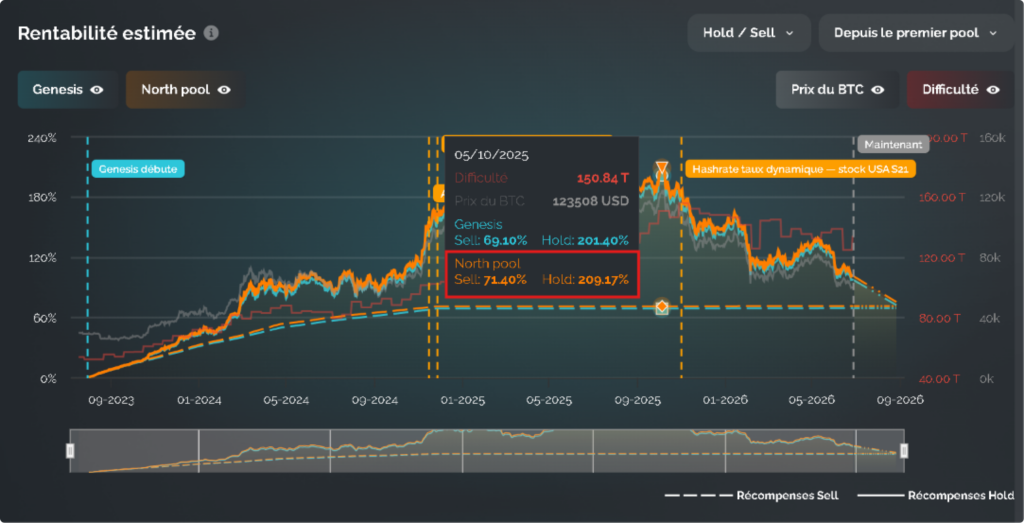
Take the example of North Pool. The pool starts while Bitcoin is still trading far from its cycle peak. Its spot price is $30,000 at the beginning of the pool’s mining.
The accumulated rewards then benefit from the entire market rally.
Two years later, with Bitcoin’s ATH ($121,000), the result is spectacular:
- Sell: +71%
- Hold: +209%
The Hold portfolio delivers almost three times the performance of the Sell portfolio. Why?
Because the Hold miner benefits from a double effect:
- it keeps producing new bitcoins;
- the bitcoins already accumulated also gain value.
Every satoshi produced in previous months benefits from the market rally. Holding then acts as a natural leverage on Bitcoin.
Why Hold often looks unbeatable
This first chart illustrates a well-known reality: in a prolonged bull market, keeping your rewards is extremely powerful.
This is precisely why many publicly listed mining companies have gradually adopted Bitcoin treasury strategies.
As long as Bitcoin’s price rises faster than production costs grow, holding creates a compounding effect that is hard to beat.
But this logic has a weakness. It implicitly assumes that the market keeps rising. And that is rarely the case in a straight line.
Case #2: when the market reverses
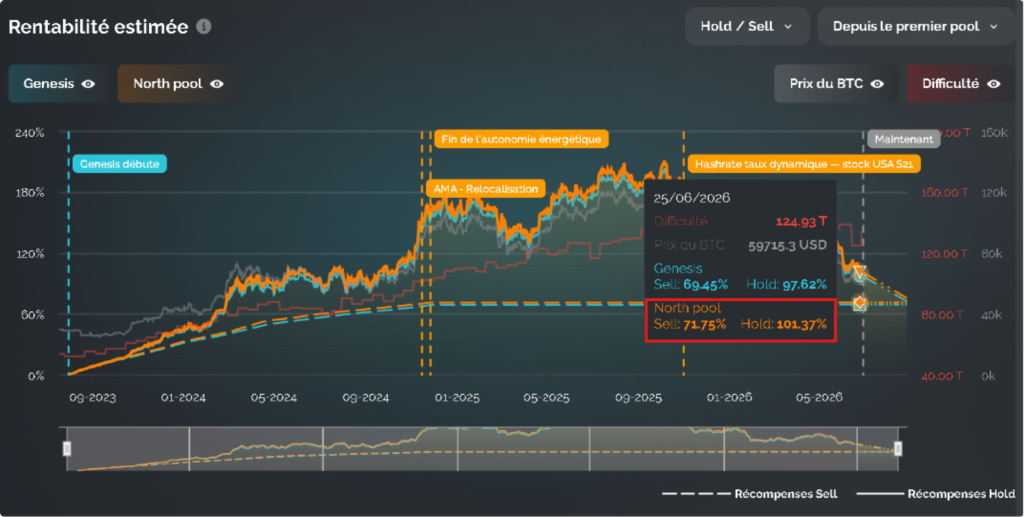
A few months later, the context changes. Bitcoin corrects sharply after its peak. North Pool remains profitable. But the gap between the two strategies narrows considerably:
- Sell: +71%
- Hold: +101%
Hold remains ahead. However, a significant part of its lead has vanished. Why? Because the accumulated bitcoins lose value when the market pulls back. The miner keeps producing rewards, but its BTC holdings now carry the same risk as those of a traditional investor.
This phase reveals an essential characteristic: Hold amplifies market movements in both directions.
When Bitcoin rises: Hold outperforms.
When Bitcoin falls: part of the outperformance disappears.
Case #3: when Sell wins
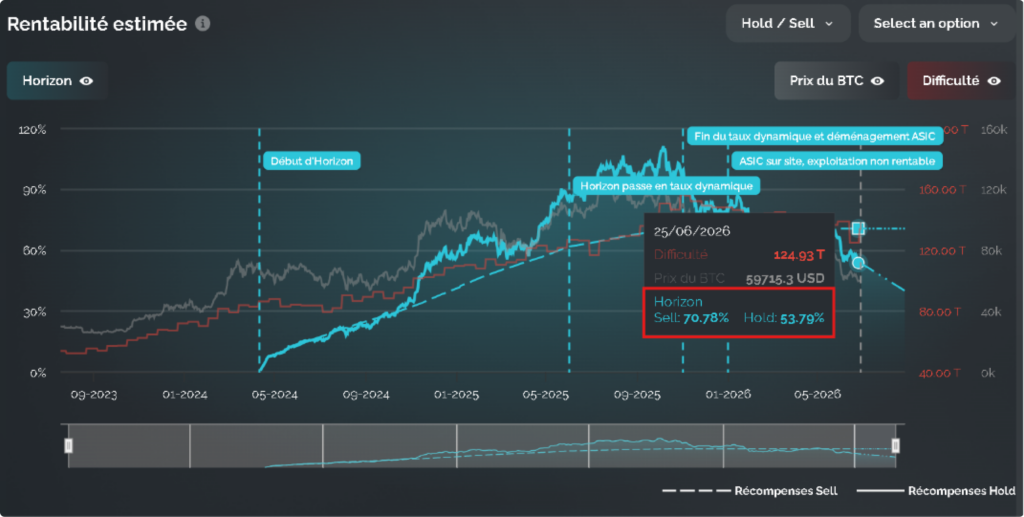
This is where the analysis becomes particularly interesting. Let’s now look at Pulse pool.
Unlike North pool, this pool starts much later.
Its launch happens in March 2024, when Bitcoin is already trading around $68,000. Yet at the time we are writing this article, Bitcoin’s spot price is lower (June 17, 10:05 UTC – $64,780) than the price at the pool’s launch.
In other words: the first bitcoins produced are accumulated at already high prices.
Two years later:
- Sell: +87.28%
- Hold: +78.10%
This time: Sell beats Hold.
Why? Because Bitcoin’s price at the time of the analysis is lower than the average price at which a significant share of the rewards was accumulated.
The Hold miner kept its bitcoins. The Sell miner sold them gradually at higher levels ($80,000, $90,000, $100,000, $120,000).
Result: the Sell strategy finishes ahead.
This case demonstrates something fundamental: Hold is not systematically superior.
It depends entirely on Bitcoin’s future trajectory.
What these three scenarios teach us
The three charts actually tell the same story. Holding does not improve the quality of mining. Holding simply increases exposure to Bitcoin.
When that exposure is favorable: Hold outperforms by a wide margin.
When that exposure becomes unfavorable: Sell can become the best strategy.
In other words: the question is not only “how to mine?”
The real question is: what is your conviction about Bitcoin at these price levels?
Do you have to choose between Hold and Sell?
Not necessarily. Many miners today combine both approaches.
For example:
- sell part of the rewards to secure income;
- keep the rest to capture Bitcoin’s long-term potential.
This hybrid approach often reduces volatility while maintaining market exposure.
As is often the case in investing, the best strategy is not necessarily the one that maximizes theoretical returns.
It’s the one that remains psychologically bearable over several years.
Conclusion
The historical data from the START pools shows that there is no universal answer to the question: should you sell or hold your mining rewards?
Holding can outperform by a wide margin when Bitcoin experiences a prolonged bull market. But that outperformance can shrink quickly, or even disappear, when the market reverses.
Conversely, selling offers more stability and lets you secure realized gains gradually. Ultimately, the choice depends less on mining than on your view of Bitcoin itself.
The miner who sells their rewards acts like a producer. The miner who holds their rewards acts like an investor. And sometimes, the best strategy is simply to be a bit of both.
Compare your own strategies
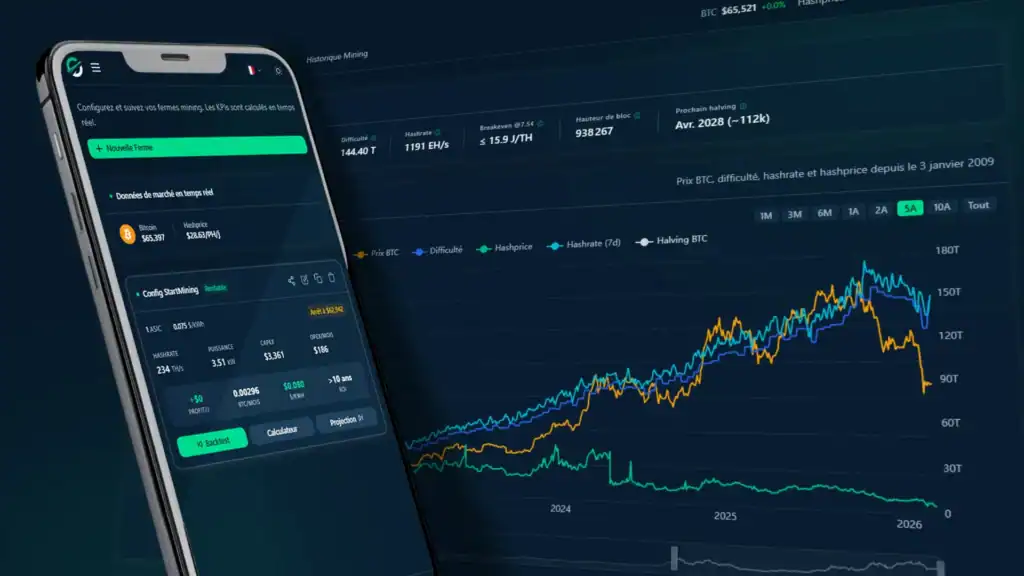
The VERSUS comparator from Startmining Pro lets you analyze different approaches to managing mined Bitcoin and visualize their performance across multiple market scenarios.
Because in modern mining, producing Bitcoin is only the first step.
The second is deciding what to do with each satoshi produced.
Take action
👉 Simulate your profitability: https://pro.startmining.io/
👉 Discover our ASIC + hosting solutions on our shop: Buy a Bitcoin ASIC | Startmining Shop – Startmining
👉 Learn more about hosting and our mining farms: Bitcoin ASIC Hosting — Hosting | Startmining
👉 Learn more about mining with our 2026 guide: Mining Bitcoin in 2026: complete guide – Startmining
Passez à l'action
Ready to mine Bitcoin with Startmining?
Browse our ASIC shop or simulate your profitability in real time.