The Most Profitable Bitcoin ASICs of All Time
Introduction
What is the best ASIC in Bitcoin’s history? You might think you know the answer. Spoiler: it’s probably not the one you imagine — because it all depends on what you measure.
If we talk about the total number of bitcoins mined, then the first machine generations start with a crushing advantage. Back then, the block reward was 50 BTC, network difficulty was low, and each terahash produced far more than today. But in mining, what really matters isn’t just what you mine — it’s what you keep after paying your costs.
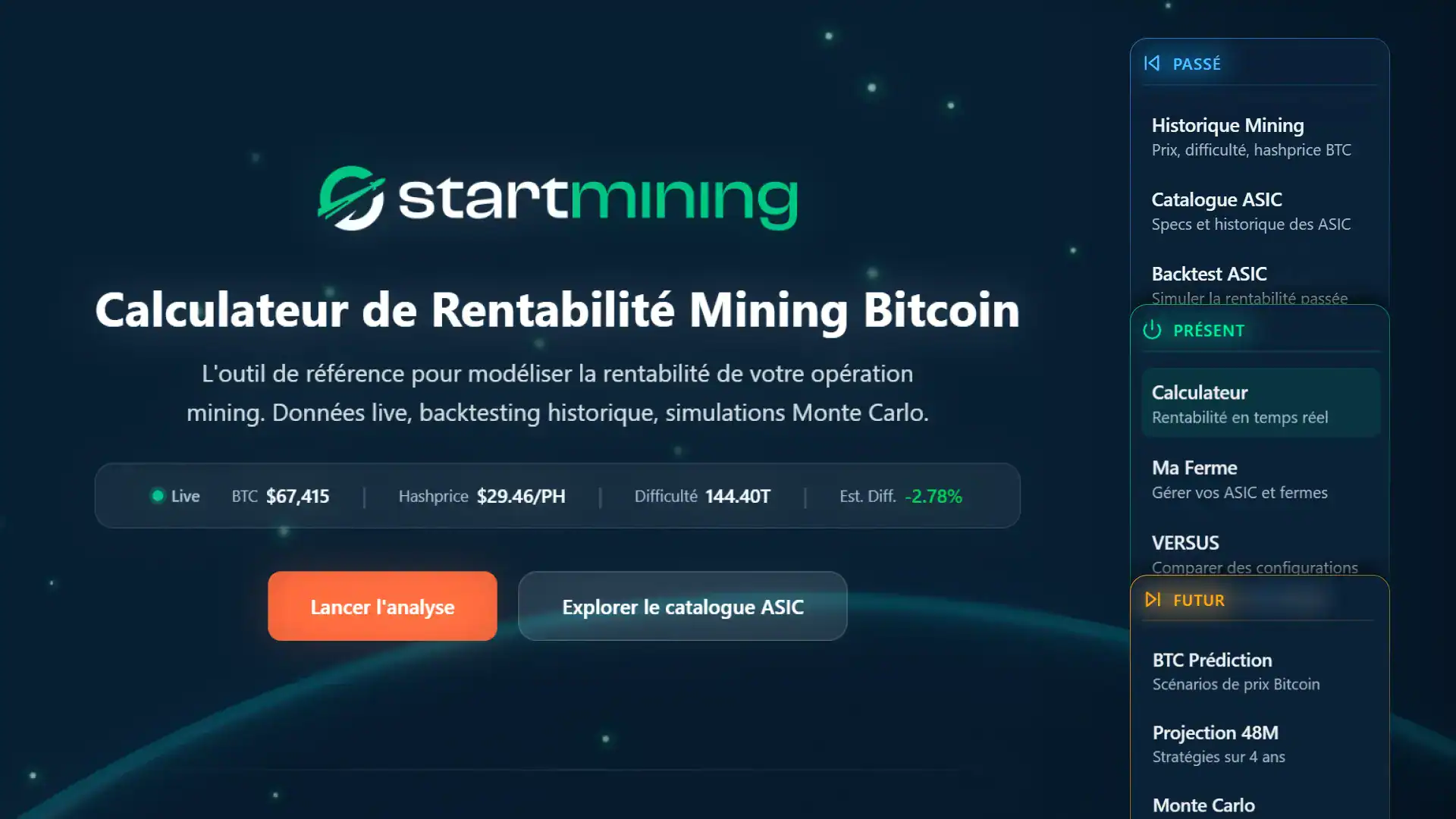
So, to answer this objectively, beyond gut feelings and memories, we need a tool that can simulate these parameters over time. And that’s exactly what the new all-in-one simulator from Startmining does. Past, present, future. You have questions? We have answers. “In mining, convictions count, but numbers decide.”
How do you define “the most profitable Bitcoin ASIC”?
The internet loves simplistic rankings. “Top 5 most profitable ASICs.” “This machine did 10x.” “This ASIC delivered a 321% ROI.” The problem? Most of these rankings mix everything up. To seriously answer the question of the “best ASIC of all time,” you first have to define what “best” really means.
There are several ways to measure profitability
You can rank ASICs by:
- Total number of bitcoins mined: a very interesting historical indicator… but misleading for building a strategy. The first generations benefited from massive block rewards — which doesn’t mean they were the most profitable in their time.
- ROI (return on investment): attractive on paper, very popular in comparison tools, but in practice deeply biased for analyzing the past.
- Cumulative net operating profit: what a machine actually generates after paying for its electricity. This is where the real comparison happens.
Why we deliberately exclude ROI
ROI assumes one thing: that everyone bought their machine at the same price. In mining, that’s false.
- The manufacturer’s price isn’t the price a professional negotiates.
- Purchase volumes completely change the conditions.
- The secondary market reshuffles the deck.
- ASIC prices swing violently with the Bitcoin cycle.
The same model can double, triple… or collapse in a few months. Comparing ROIs without standardizing the purchase price means comparing incomparable situations. That’s precisely why we analyzed ASIC price evolution in detail in a dedicated article. So we make a clear methodological choice: no ROI in this ranking.
What we will actually measure
We focus on what doesn’t lie:
- Daily net profit
- The number of consecutive profitable days
- A clearly defined electricity price
In other words, we measure an ASIC’s ability to generate net operating profit in different market contexts. Because in mining, it’s not promises that count — it’s cash flows. (Note on the “Hall of Fame” calculations: they stop at the first unprofitable day, counting only consecutive profitable days since the ASIC’s release, the BTC mined during those days, and the profit over that period.)
Hall of Fame: number of bitcoins mined
To remember the “good old days” that very few actually experienced, let’s look at the first ASICs that produced the most Bitcoin. For teaching purposes, we simulated two electricity prices: $0.03 and $0.10/kWh. The result is surprising: the difference in operating lifetime is massive, but the difference in total BTC mined is far smaller.
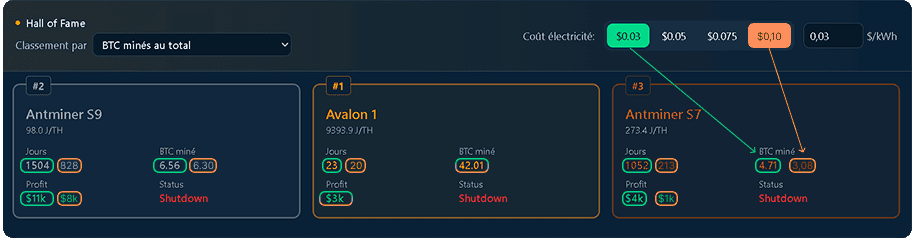
Take the Antminer S7. At $0.10/kWh, it quickly becomes unprofitable: its electricity cost is around $3.10 a day. As soon as the hashprice drops below that threshold, it shuts down. At $0.03/kWh, the same machine survives much longer — but those extra days are late days, when difficulty has exploded and per-terahash output has collapsed. In other words, the first months concentrate most of the production. Mining is like a gold rush: on day 1 you find 100 grams; on day 1,000 you find 0.3.
Extending an ASIC’s lifespan doesn’t proportionally multiply the bitcoins mined. This highlights a reality often ignored: in mining, timing weighs more than longevity. That’s why it’s generally strategic to buy an ASIC at release, when its production capacity is still at its peak.
Consecutive profitable days
This time, we no longer look at total BTC mined, but at how long an ASIC stays profitable without interruption. As before, we used two electricity-price assumptions: $0.075 and $0.10/kWh, matching the low and high range observed in the industry during the 2020–2024 cycle. And once again, the energy price radically changes the reading.
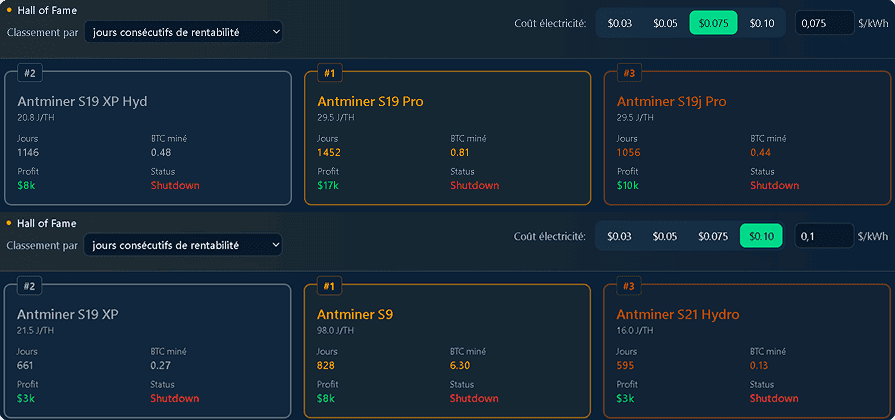
At $0.075/kWh, several S19-series models clearly stand out, staying profitable for nearly a full cycle (about four years). At $0.10/kWh, the situation deteriorates quickly: profitable lifetime drops sharply and profits fall by more than 50%.
This result is especially interesting. You might have imagined that older generations, like the S17, would do well thanks to their age and bigger block rewards (the 2020 halving coincided with the S19 release). But that forgets the major technological leap between the S17 and the S19. The S19 series marked a clear break in energy efficiency, quickly making the S17 (released in 2019) obsolete. As for the S21, its gradual arrival in 2024 left the S19 several years to dominate the network and contribute massively to hashrate growth.
This confirms one thing: it’s not always the pioneers who win the longevity battle, but the machines that arrive at the right technological moment in the right profitability cycle (the strong 2021 bull market + the China ban).
Cumulative profit: the real arbiter
After analyzing total BTC mined and profitable lifetime, it’s time to look at what really matters: cumulative profit generated over the whole operating period. In the end, a machine can mine for a long time and produce a lot early on — but what decides things is the accumulated net cash flow.
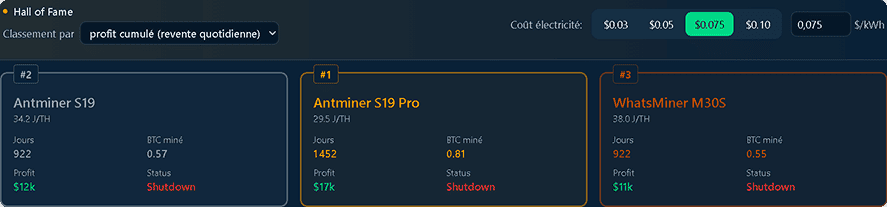
At an electricity price of $0.075/kWh, one model clearly stands out: the Antminer S19 Pro. With more than 1,400 consecutive profitable days and nearly 0.8 BTC mined, it dominates the cumulative-profit ranking. This is no accident: the S19 series arrived at the start of the 2020–2024 cycle, when Bitcoin’s price was entering a bull phase, the global hashrate hadn’t yet exploded, and energy efficiency crossed a major technological milestone.
The timing was almost perfect. At this level of analysis, one thing becomes clear: it’s not necessarily the very first machines that win, nor the most recent — it’s those that combine energy efficiency + power + the right market moment. And that’s exactly what the S19 series managed to do.
Will the future of mining be profitable again?
Mining is entering a new era. The days of brutal technological leaps and returns multiplied in a few months seem to be behind us. The sector’s industrialization has reached a form of maturity.
The good news? Technological progress has been spectacular. In a little over a decade, ASIC energy efficiency has improved nearly 100-fold — machines went from several thousand joules per terahash to under 10 J/TH today. But this exponential progress is slowing.
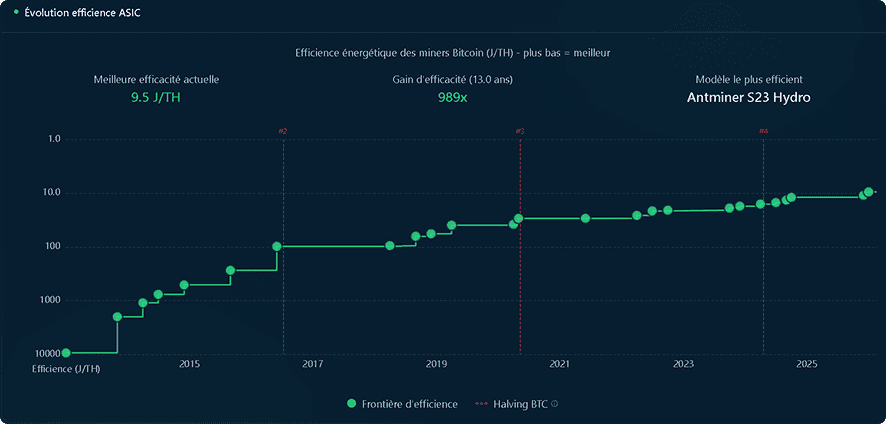
Chip etching is approaching physical limits. Barring a major technological revolution, efficiency gains will now be more gradual. And that transforms the network’s dynamics. Between 2020 and 2026, the hashrate multiplied tenfold. But between 2024 and 2026, it “only” doubled.
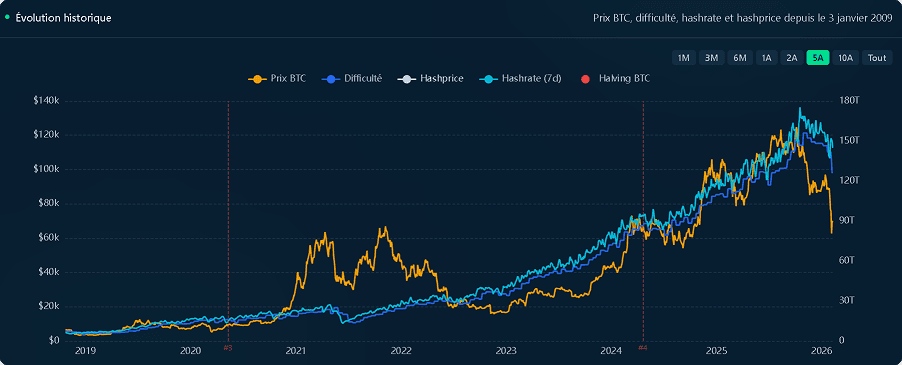
In the zettahash era, doubling global power becomes industrially much more complex. In the past, the network could absorb new machines en masse in a few months. Today, that acceleration is slower. Remember Part 1? The first months concentrated most of the profitability. That reality still exists… but it’s far less extreme. And paradoxically, that offers an advantage: more visibility.
Conclusion
Mining is no longer a chaotic gold rush. It’s becoming an industry. And in a mature industry, profitability no longer depends solely on timing — it depends on strategy and, above all, on production cost. “In modern mining, the question is no longer which machine to buy, but at what cost to produce — and for how long.”
In an environment that has become more mature, more industrial and more competitive, profitability rests on mastering the variables: energy efficiency, the price per kWh, market timing and hashrate evolution. That’s precisely why a simulation tool becomes essential. Because in mining, intuition isn’t enough, and neither are memories of past cycles. Only the numbers can decide.
Past, present, future: simulate your scenarios, test your assumptions and discover which ASIC is really the most profitable… in your context. Ready to explore the world of mining? Access the all-in-one simulator at pro.startmining.io.
Passez à l'action
Ready to mine Bitcoin with Startmining?
Browse our ASIC shop or simulate your profitability in real time.