Why Host Your ASIC Instead of Mining at Home?
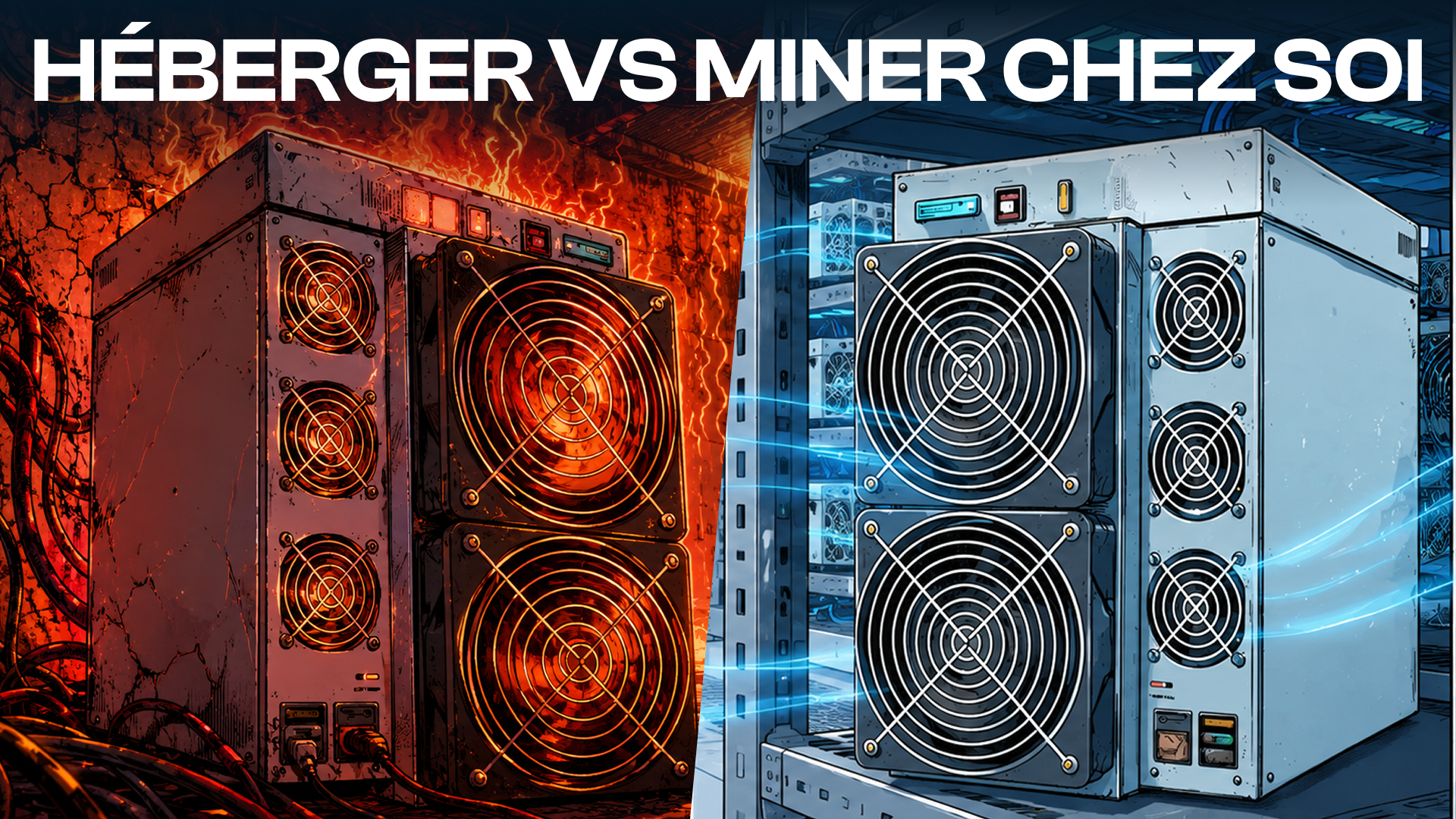
Mining at home seems intuitive. You buy the miner, you plug it in, you stay in control. On paper, it looks simpler than sending your ASIC off to a mining farm.
The problem is that mining doesn’t reward simplicity. It rewards the best cost structure.
And in most cases, that’s precisely where home mining loses its edge.
The real question isn’t “where am I most comfortable?”. The real question is: where does my ASIC produce Bitcoin at the lowest cost, with the least operational friction?
This analysis is not a substitute for professional advice.
The choice every miner has to make
Before comparing models and choosing the right ASIC, you have to settle a more important question: home mining or hosting?
Spoiler: the hosting answer is, unfortunately, the winning one most of the time. This choice directly impacts profitability because it determines:
- the real price of the kWh;
- the miner’s uptime;
- the quality of the cooling;
- how often you have to intervene;
- the time spent running the operation.
Assumptions for the comparison
- Residential France: regulated Base tariff 6 kVA at €0.194/kWh incl. tax, i.e. around $0.21/kWh, as of February 1, 2026 (source: CRE, indicative EUR/USD conversion to be confirmed at the time of publication).
- Startmining hosting: average reference of $0.075/kWh all-inclusive at the USA/Washington site, with a published range of $0.061 to $0.075/kWh depending on the sites available.
- Example ASIC: Antminer S21 Pro 234 TH rated at 3550 W on the Startmining store.
The worked example below compares only the costs and operating conditions. It is not a promise of profitability.
Mining at home in France: simple in appearance
The advantages
Home mining keeps two genuine advantages.
The first is control. The miner is at your place. You see what’s happening, you keep your hands on the setup and you can step in immediately.
The second is accessibility. For an individual who wants to learn, test a setup or run a small configuration, starting at home can feel more direct than a hosting deployment.
The major limitation of mining at home
These advantages aren’t enough if the operation rests on a weak economic foundation.
👉 In France, the problem isn’t only the price of the kWh. It’s the combination of energy, domestic constraints and the time you have to manage.
The 3 problems with mining at home
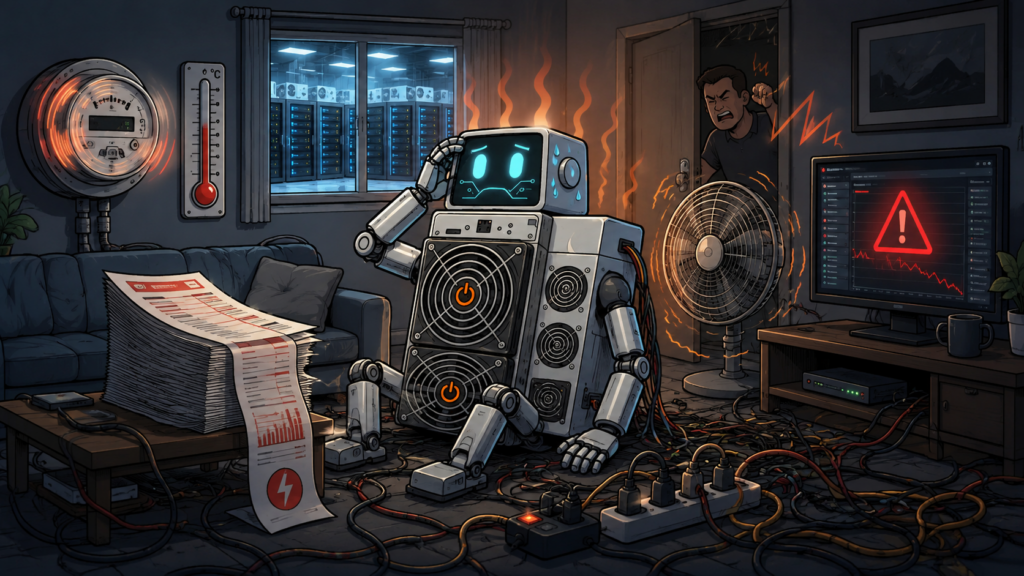
Electricity that’s too expensive
This is the decisive point.
As of February 1, 2026, the residential price is listed at €0.194/kWh incl. tax for individuals, i.e. around $0.23/kWh (source: Morningstar June 17, 06:59 UTC).
Compare that with a Startmining hosting rate of around $0.075/kWh all-inclusive at the USA/Washington site, or $0.065 to $0.075/kWh depending on the sites.
At equal power, residential mining starts with a massive handicap before you even talk about the market, the hashprice or the difficulty.
And this calculation is still incomplete. At home, you often have to add:
- a potentially higher electricity subscription;
- ventilation or extraction of the hot air;
- in some cases, additional cooling in summer.
Mining is a cost-management business before it is a question of which model you pick.
Noise / heat / constraints
A recent air-cooled ASIC at around 3550 W doesn’t only produce hashrate.
It also produces:
- continuous heat;
- noise;
- constant pressure on your living space.
In a residential environment, this quickly creates concrete limits:
- noise nuisance (75 dB = equivalent to a powerful vacuum cleaner at 1 m, a busy street with heavy traffic, or a packed restaurant);
- a temperature rise in the room (if the incoming air = 20°C, then the outgoing air ≈ 45 to 50°C);
- electrical safety constraints (for the latest S23 Hydro model, a three-phase 380 V installation is required);
- difficulty keeping the installation clean, stable and well ventilated over time.
Home mining is sometimes “simple” to start. It’s much more painful to keep running.
Maintenance and downtime
At home, you are the operator.
If the miner stops, if a fan weakens, if the temperature drifts or if the network goes down, it’s up to you to diagnose, fix and restart.
Meanwhile, the ASIC produces nothing, but your capital stays tied up.
💡 A stopped ASIC doesn’t only cost you comfort. It costs you lost production time.
Why hosting changes everything
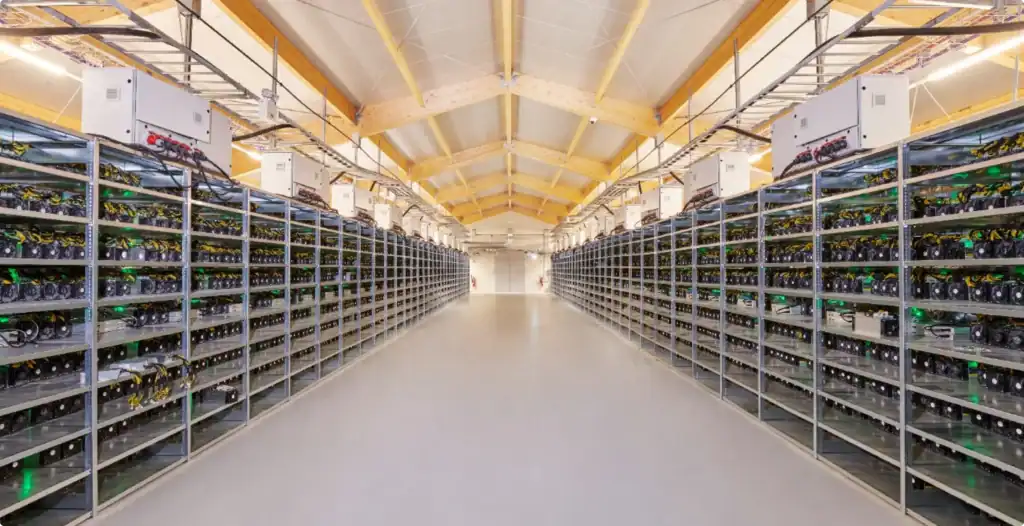
Industrial electricity cost (factor #1)
Hosting first changes the most important factor in mining: the price of energy.
In an optimized farm, with competitive energy and negotiated contracts, the kWh is no longer a residential rate you simply have to accept. It becomes a controlled industrial variable.
That’s what lowers the break-even point and mechanically improves the production cost per BTC.
Uptime + maintenance
Good hosting doesn’t only sell a kWh price.
It also sells:
- uptime;
- maintenance;
- supervision;
- an operating framework designed to absorb incidents faster than an individual could.
At Startmining’s sites, you find these same operational building blocks: 24/7 secured sites, maintenance, real-time monitoring via dashboard, logistics and on-site intervention.
Overall performance
The real gain from hosting is the sum of the variables.
You don’t just improve your electricity bill. You also improve:
- thermal stability (hardware longevity);
- operating quality;
- production consistency;
- the time you no longer have to spend on technical support.
Hosting doesn’t just change where the ASIC runs. It improves the whole operation.
How to choose the right ASIC with the mining simulator
A direct side-by-side example
Let’s take a simple illustrative case: an Antminer S21 Pro 234 TH rated at 3550 W, run 24/7 for 30 days, with no major downtime and under normal operating conditions.
Its theoretical monthly consumption is: 3.55 kW x 24 x 30 = 2556 kWh
Here is the comparison:
- Price of kWh used — Home mining (France): ≈ $0.21/kWh at the French residential rate, converted. Startmining hosting: $0.075/kWh all-inclusive.
- Calculation basis — Home mining: continuous use, residential housing, excluding any specific adaptation of a dedicated room. Hosting: continuous use, infrastructure designed for mining.
- Theoretical monthly electricity cost — Home mining: ≈ $536.76. Hosting: $191.70.
- Constraints included in the environment — Home mining: noise, heat, ventilation, strain on the domestic installation, interventions at your expense. Hosting: pooled supervision and technical environment.
- Costs not included in this calculation — Home mining: subscription surcharge, air extraction, additional cooling, time spent, possible miner downtime. Hosting: possible ancillary fees outside the scope of the chosen offer: maintenance / repair.
- Monthly gap on energy alone — Home mining: +$345.06. Hosting: reference.
The takeaway is clear:
For the same miner, the energy differential exceeds $345 per month in this example, and the tighter the market gets, the more strategic that gap becomes.
👉 This isn’t a comfort detail. It’s a structural difference in production cost.
Understanding the price of Bitcoin ASICs: when should you buy your miner?
The real criterion: your production cost
Many miners ask: would I rather keep my miner at home or host it?
The right question is: how much does each BTC produced in this “home” setup actually cost me?
Mining is an economic equation, nothing more, nothing less. It’s not a question of comfort. Not a question of image. Not a question of personal preference.
Your real equation depends on:
- your kWh price;
- your uptime;
- the efficiency of the ASIC;
- the quality of the cooling;
- the amount of downtime;
- the level of maintenance;
- the market context.
If just one of these variables degrades the final result too much, the strategy stops being robust.
An ASIC doesn’t become profitable because it runs. It becomes profitable because it runs at the right cost.
Conclusion: which choice should you make?
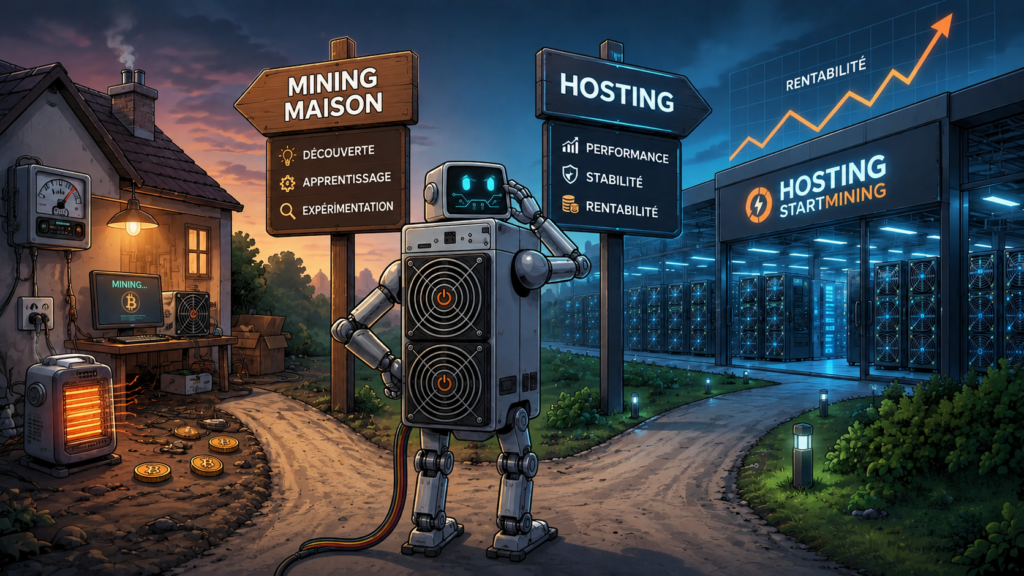
For an individual who wants to learn, test a miner or accept a more experimental approach, home mining can still make sense.
Provided you accept that, in the vast majority of cases, it isn’t a competitive structure.
For an investor looking for a more serious, more stable and more profitable operation over time, hosting is generally the better trade-off.
Not because it’s more comfortable, but because it improves the variables that truly matter. Everything you need to know about hosting your ASICs.
In short:
- Profile 1: individual → home mining can make sense to explore, test or run a small setup out of curiosity or enjoyment.
- Profile 2: investor → hosting becomes the most rational approach as soon as the goal is economic performance and building a lasting operation.
The key idea to remember is this: an ASIC doesn’t become profitable because it’s at your place. It becomes profitable when its production cost is low enough and lets you withstand several market scenarios, barring unforeseen events.
Move from intuition to scenario
Before deciding, compare your scenarios with real assumptions for kWh, uptime and miner.
- Access the StartMining Pro simulator: https://pro.startmining.io/
- Compare Startmining hosting offers: https://startmining.io/boutique/

Passez à l'action
Ready to mine Bitcoin with Startmining?
Browse our ASIC shop or simulate your profitability in real time.