If AI Pays More, Why Keep Mining Bitcoin?
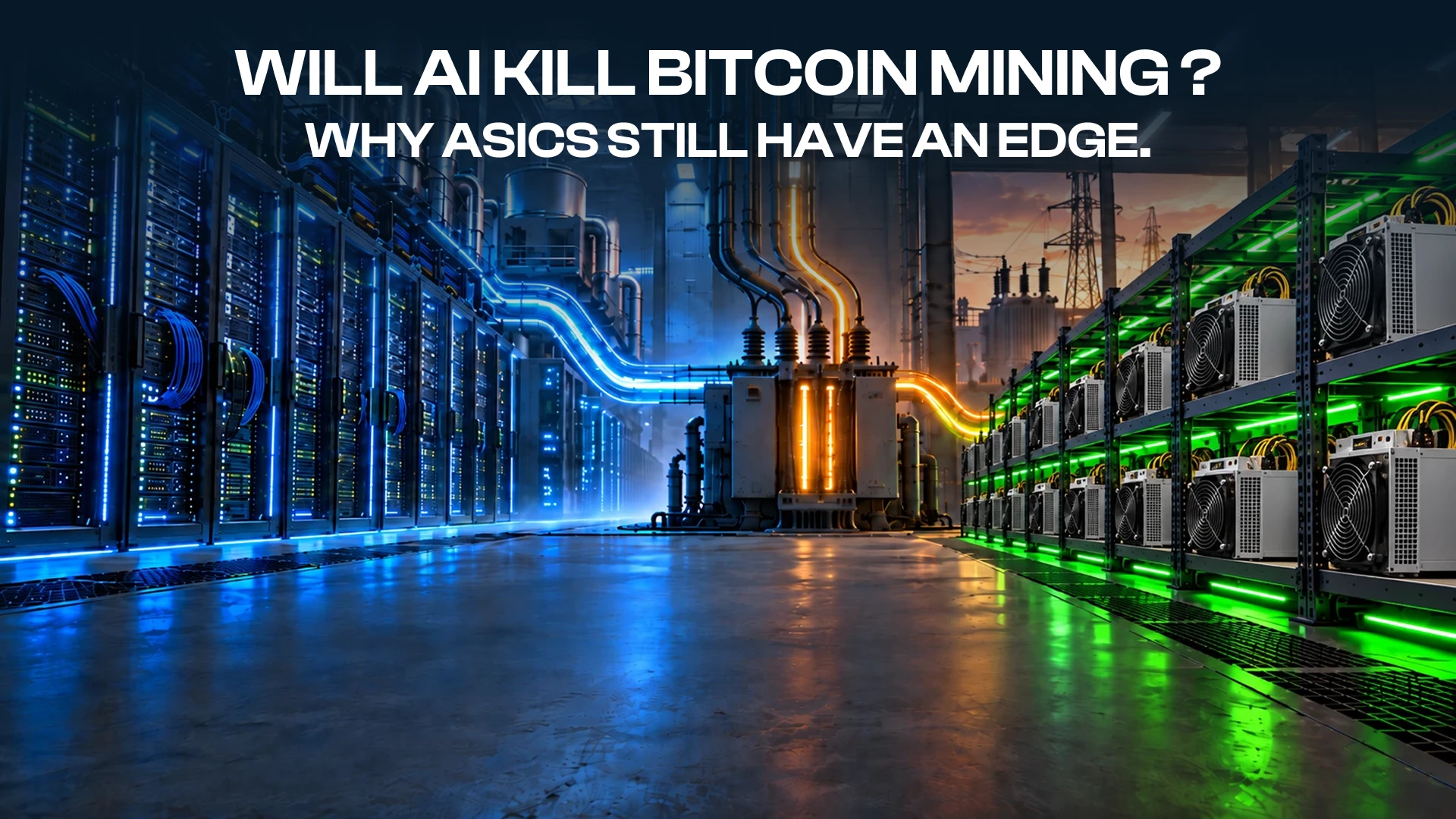
AI vs Bitcoin mining is not simply a comparison of revenue per megawatt. Bitcoin ASICs can adapt their power consumption or keep operating during a site’s conversion, subject to technical and contractual constraints. Whether continued mining makes economic sense depends on available operating hours, actual costs and the capital already committed or still required.
Several major mining operators are now converting their farms into data centers for artificial intelligence. If these new contracts allow them to earn more from their infrastructure, why keep Bitcoin ASICs running?
Because AI and mining do not always face the same constraints. An ASIC can be switched off when electricity becomes too expensive or the grid needs to reduce consumption. It can also remain useful while a site is being converted. However, this flexibility alone does not make operating it profitable.
Inspired by the question raised by Nico Smid in AI Pays More, So Why Keep Mining?, this article examines when keeping ASICs makes sense and what that means for an owner of hosted miners.
Why doesn’t AI automatically replace mining?
Comparing AI and mining revenue per megawatt (MW) may seem straightforward. In reality, their business models differ.
A miner operates ASICs to produce Bitcoin. Revenue depends in particular on its hashrate, network difficulty and the BTC price. An AI data center operator, meanwhile, may lease space, available electrical capacity and infrastructure services to a customer without directly receiving the revenue from that customer’s computing workloads.
The comparison therefore needs to consider revenue after costs, as well as investment, construction work and availability obligations. Core Scientific’s contractual documents distinguish hosting fees, electricity and funding for construction work. Converting to AI may offer more predictable revenue while requiring capital and time before operations can begin.
Another limitation: unused power is not necessarily available. In an October 2025 presentation, Core Scientific describes take-or-pay contracts with CoreWeave: the customer pays for reserved capacity even when it does not use all of it. That capacity therefore cannot be assumed to be available for ASICs.
This is why a site’s conversion and what happens to its mining hardware need to be examined separately.
Flexibility: an advantage of Bitcoin mining, but no guarantee of revenue
A mining farm is a controllable electrical load: subject to the site’s technical and contractual constraints, its ASICs can reduce their power draw or shut down temporarily. This flexibility can be useful to electricity grids when demand rises or prices become unfavorable.
In Texas, ERCOT announced a voluntary consumption reduction program as early as December 2022 for large flexible loads, including mining. Solutions such as Braiins Energy Intelligence also offer control of ASIC shutdowns based on prices and flexibility mechanisms in the US ERCOT and PJM markets.
However, an ASIC that is switched off produces no new bitcoins. The operator may save electricity or receive a payment provided for in a contract, while giving up production hours. Some fixed costs may continue to accrue.
Nor is this flexibility exclusive to mining. In March 2026, Google said it had incorporated 1 GW of demand response capacity into its US energy contracts, with the ability to shift or limit certain machine learning workloads. This is contracted capacity, rather than a measured 1 GW reduction at a particular moment.
Mining’s real advantage is therefore its ability to adapt consumption when conditions allow, rather than any supposed inability of AI to do the same.
When might keeping ASICs make sense?
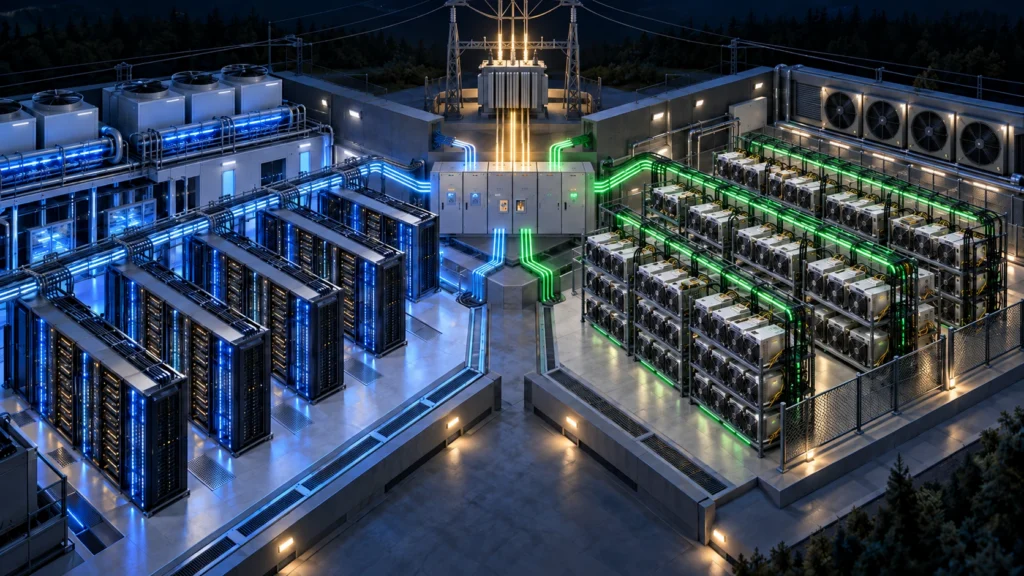
While a farm transitions to AI
Converting a farm takes time. An operator may continue mining to cover part of its expenses or meet its commitments while construction work is underway.
Core Scientific provides a documented example. In its report for the second quarter of 2026, the company said it was still operating its own mining fleet at two sites and hosting miners for one remaining customer, while continuing to phase these activities out. At that time, it expected to end its mining hosting activities by the end of 2026. This is a transitional activity, rather than evidence of permanent, profitable coexistence.
On separate capacity that is genuinely available
In principle, a site could dedicate part of its infrastructure to AI and another part to mining. However, electrical capacity must be available and authorized for that use, with electrical protection, cooling and operating priorities compatible with the site’s contracts.
Capacity reserved for an AI customer does not become available simply because the customer is using little of it at a given moment. Such coexistence remains a possibility to assess, rather than a service offered by all data centers.
When consumption needs to be reduced
In some electricity markets, an operator may decide to switch ASICs off temporarily to avoid an expensive period or respond to a request to reduce consumption. The economic benefit then depends on the BTC production forgone, the costs avoided and any payments actually owed.
This does not mean ASICs can be switched on in place of an AI load shut down to meet a curtailment requirement: the requested reduction in the site’s electricity consumption must still be achieved.
Useful mining hours may not be enough to pay back new ASICs
Consider a hypothetical example: a facility draws 1 MW at the meter when operating, including cooling and ancillary equipment. Over a 30-day period, its energy consumption varies considerably with operating time.
| Operating time | Power draw while running | Energy consumed over 30 days |
| 8 hours per day | 1 MW | 240 MWh |
| 24 hours per day | 1 MW | 720 MWh |
Calculation: energy (MWh) = power (MW) × hours per day × 30 days. Power draw is assumed to remain constant while running; any residual consumption during shutdowns is excluded.
At eight hours per day, the miners have one-third of the production hours available under continuous operation. Their variable energy costs may be lower, but so may their potential BTC production. This table alone cannot determine margin or payback time: those depend in particular on Bitcoin network conditions and actual billing.
The decision requires a distinction between two situations:
A fleet already installed. Continuing to mine may make sense if the additional revenue, after pool fees and incremental costs, exceeds the benefit of shutting down, relocating or reselling the miners. Electricity costs already contractually owed should not be counted twice, but resale value and continuing costs still matter.
A new fleet to purchase. The cost of the ASICs, their installation and other investments must also be recovered. An operation that is worthwhile for a few hours a day may still be insufficient to pay back that purchase.
BTC production and payments for switching miners off must not both be counted for the same hours. This is precisely the distinction between operating margin and payback that we explain in our economic comparison of Bitcoin ASICs.
What this means for the owner of a hosted ASIC
The site’s economic interests are not necessarily those of each miner’s owner. Before choosing a hosting offer, three questions are particularly important:
- How many hours will my ASIC actually be able to run? Check the advertised availability (uptime), planned interruptions and operating priorities.
- Which charges remain payable during shutdowns? The kWh price alone is not enough: examine fixed fees, minimum consumption requirements and billing rules.
- Who benefits from any flexibility revenue? Savings or payments received by the operator are not automatically passed on to the ASIC’s owner.
These points build on our guide to the clauses to check in a mining hosting contract.
AI may generate more value from certain infrastructure without making Bitcoin mining useless. The decision depends on the electrical capacity you are authorized to use, the operating hours actually available, the costs incurred and the capital already committed or still to be invested.
If you are considering mining Bitcoin, start by comparing Startmining’s ASIC hosting terms, then assess your project’s expected production and risks.
Passez à l'action
Ready to mine Bitcoin with Startmining?
Browse our ASIC shop or simulate your profitability in real time.