What Happens to Bitcoin ASICs When Miners Pivot to AI?
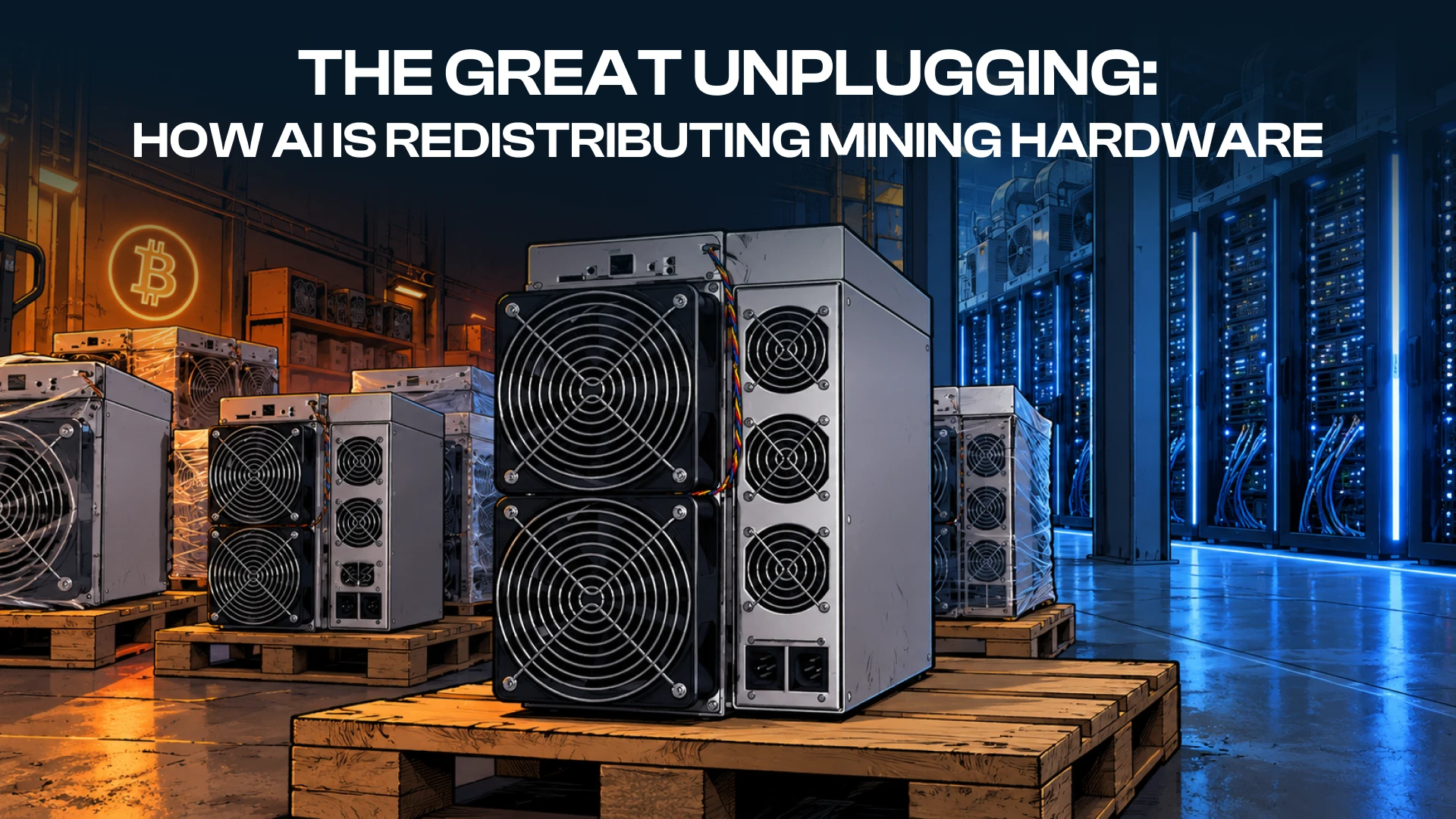
On September 1, 2026, Hyperscale Data switched off every Bitcoin miner at its Dowagiac site in Michigan. The goal was not to pause production for a while, but to prepare the site for infrastructure dedicated to artificial intelligence.
The shortcut is tempting: large operators move to AI, their ASICs hit the used market and prices collapse. Yet the Hyperscale Data, Cipher Mining and Keel Infrastructure filings show three different paths: a sale under consideration, a partial sale paired with a return to service, or a fleet still held for sale.
The short answer is therefore more nuanced. A Bitcoin ASIC cannot be turned into an AI server. It can be redeployed, resold, stored, used as a source of spare parts or retired for good. These fleets do represent potential supply for the secondary market, but the available data does not yet show a new across-the-board price drop since June or July 2026.
To size up the opportunity for smaller operators, you have to follow where the hardware actually ends up rather than the announced AI contracts alone.
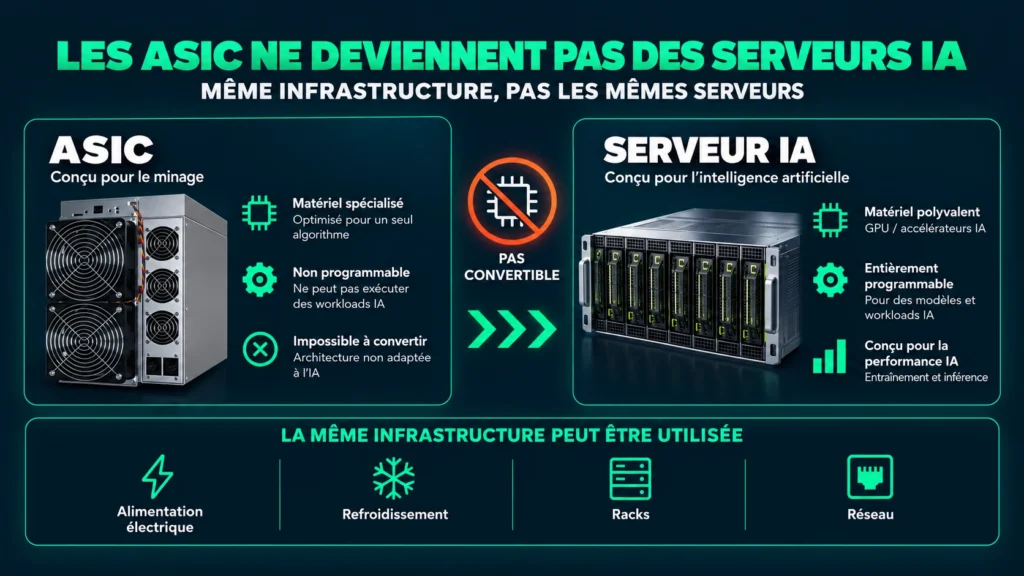
A Bitcoin ASIC cannot be turned into AI hardware
An ASIC, short for application-specific integrated circuit, is a chip designed for one determined function. The NIST defines this class of component by its specialization. A Bitcoin ASIC runs the SHA-256 algorithm, and it cannot be reassigned to training or running artificial-intelligence models the way a GPU can.
So what operators convert is not the hardware, but the site that hosts it. A mining farm already owns sought-after assets: electrical capacity, a grid connection, land, a building, cooling, fiber and an operations team. AI still calls for adaptations, notably around redundancy and cooling, but a significant share of the infrastructure is already there.
That is what explains Hyperscale Data’s decision. Its initial agreement covers 20 MW over ten years, with two possible five-year extensions. The headline figure of more than $1.2 billion assumes the maximum contract term: it is not revenue already banked. What is effective, however, is the shutdown of every Bitcoin miner on the site since September 1.
Infrastructure can change purpose. The ASICs themselves have to find a new destination.
The four possible destinations for unplugged ASICs
An ASIC that is switched off is not automatically an ASIC put up for sale. Where it goes depends on its efficiency, its condition, the cost of electricity available elsewhere and the operator’s strategy.
| Destination | What happens to the ASIC | Immediate effect on the used market |
|---|---|---|
| Redeployment | The ASIC is moved to another mining site | Low: it does not necessarily change owner |
| Resale | The unit is sold directly or through a broker | Potential: depends on the volume and the price actually negotiated |
| Storage or standby | The ASIC sits idle, in transit, under maintenance or waiting for a site | None as long as it is not actually offered for sale |
| Parts or retirement | The unit is stripped, cannibalized or scrapped | Shrinks the operable fleet rather than feeding the used market |
Redeployment lets an operator keep its hardware on a site where electricity is cheaper, or that is still dedicated to mining. When it signed its high-performance computing (HPC) agreement with CoreWeave in 2024, Core Scientific planned to migrate some miners to other sites. VanEck also expected in May 2026 a redistribution toward buyers or regions with cheaper energy. That scenario still requires transport, electrical capacity and recommissioning.
Resale is where the confusion sets in. In a financial report, “held for sale” is an accounting classification, not hardware already sold, paid for and delivered. Between shutdown and transaction there is still inventory, testing, lot building, negotiation and logistics. The final price can therefore differ from the value carried in the accounts.
Finally, an idle ASIC may be in transit, under maintenance, curtailed or temporarily unprofitable. The 227 EH/s of idle ASIC capacity estimated by Luxor in August 2026 is therefore not available inventory. Units that cannot be resold can, for their part, supply spare parts before being retired for good.
Three conversions that show where mining fleets really go
The disclosures from Hyperscale Data, Cipher Mining and Keel Infrastructure show three different situations. Above all, they show why an intention to sell has to be told apart from what actually happens to the hardware.
| Operator | Situation observed | Known status of the ASICs | What remains unknown |
|---|---|---|---|
| Hyperscale Data | Every miner at the Michigan site was switched off on September 1, 2026 | Sale under consideration for the mining servers tied to the site | Count, models, prices and sale timeline |
| Cipher Mining | $30.8M of rigs classified as held for sale as of March 31, 2026, after Black Pearl’s transition to HPC | As of June 30, nothing remained in that category: part was sold to Canaan and $25.816M of miners were returned to service | Count and models sold or redeployed, unit price of the rigs |
| Keel Infrastructure | Several US sites shut down in the first half of 2026 | $13.013M of miners held for sale as of June 30, 2026 | Count, models, buyers, prices and transaction dates |
Hyperscale: a fleet switched off, but not yet documented as sold
Hyperscale Data says it expects proceeds from the contemplated sale of its mining servers. As of September 8, 2026, no unit count, model, price or buyer has been published. The signal is industrial before it is commercial: the site has changed priorities, but the arrival of its ASICs on the secondary market is not yet quantifiable.
Cipher: sale and return to service within the same fleet
Cipher offers the most instructive case. As of March 31, 2026, the company classified $30.8 million of rigs as held for sale and had recognized a $7.4 million fair-value loss. But in its report as of June 30, 2026, no equipment remained in that category: some Black Pearl rigs had been sold to Canaan, while $25.816 million of miners had been returned to service.
In other words, a single conversion decision can produce two flows: part of the ASICs feeds the secondary market and another part goes back to mining. The book value reported in March therefore cannot be read as inventory sold in full, nor as the final price of the transactions.
Keel: identified inventory, not yet cleared
As of June 30, 2026, Keel Infrastructure carried $13.013 million of miners held for sale, against $166,000 at the end of 2025, after shutting down several US sites. Keel also recognized $2.684 million of impairment on those assets and $885,000 of write-offs for non-functional miners. The impairment covers hardware still intended for disposal; the write-off covers units taken out for good. None of these amounts reveals the number of ASICs, their price per TH or the final sale proceeds.
These three cases should not be added together to manufacture a “market volume”: they describe different situations and different dates. What they do allow is following the chain that runs from a site shutdown to the final destination of the hardware.
To place these conversions in the wider competition between mining and intensive computing, you can also read our analysis of mining infrastructure moving to AI.
Are AI conversions already pushing used ASIC prices down?
The causal link is not established. Older ASIC generations have depreciated very sharply over twelve months, but the public snapshot available does not show a fresh continuous slide since June or July 2026. It suggests instead that several categories bottomed out in the first half before rebounding.
The table below uses figures dated August 9, 2026, published by Bull Miners from Luxor’s ASIC Price Index. Since the full primary index is not freely accessible, this is an indicative snapshot in dollars per TH, not a guaranteed current price nor an average of closed transactions.
| Efficiency | Indicative price on August 9, 2026 | Twelve-month change | First-half low | Rebound from that low |
|---|---|---|---|---|
| 14-19 J/TH | $4.95/TH | −72% | $2.30/TH on June 15 | About +115% |
| 19-25 J/TH | $2.11/TH | −68% | $1.15/TH on April 20 | About +83% |
| 25-38 J/TH | $1.02/TH | −71% | $0.88/TH on March 2 | About +16% |
Source: dated reprint of Luxor’s ASIC Price Index by Bull Miners, accessed September 8, 2026. These units are worth far less than a year earlier, but none of the three bands observed was still at its low on August 9.
June was above all an economic capitulation
According to Luxor, average hashprice — the gross daily revenue attached to one unit of hashrate — fell in June to $30.37 per PH/s per day, a record monthly low and a 17% drop month over month. The least efficient ASICs then become the first candidates for shutdown, without necessarily being put up for sale: a unit that is unprofitable on one site can remain operable with cheaper energy.
Luxor’s August 31 roundup then put spot hashprice at $39.36 per PH/s per day and its 30-day average at $34.63. That improvement does not tell you what ASICs are worth, but it does help explain why some units may have been switched back on or pulled out of a sale process, as at Cipher.
For a broader view of hardware valuation cycles, read our article on how Bitcoin ASIC prices have moved.
A second wave of price drops is possible, but not yet proven
AI conversions create potential supply pressure: Hyperscale is considering selling the hardware tied to its Michigan site, Keel still holds miners for sale, and Cipher combined a disposal with a return to service. These announcements are a leading signal, but they do not yet allow their effect on prices to be measured.
The one-year view of the ASIC Price Index offers a benchmark here. In mid-August 2026, indicative prices for ASICs in the 14 to 38 J/TH bands remained far below their autumn 2025 levels. The chart shows, however, that several of those bands had already reached their low in the first half before stabilizing or partially rebounding.
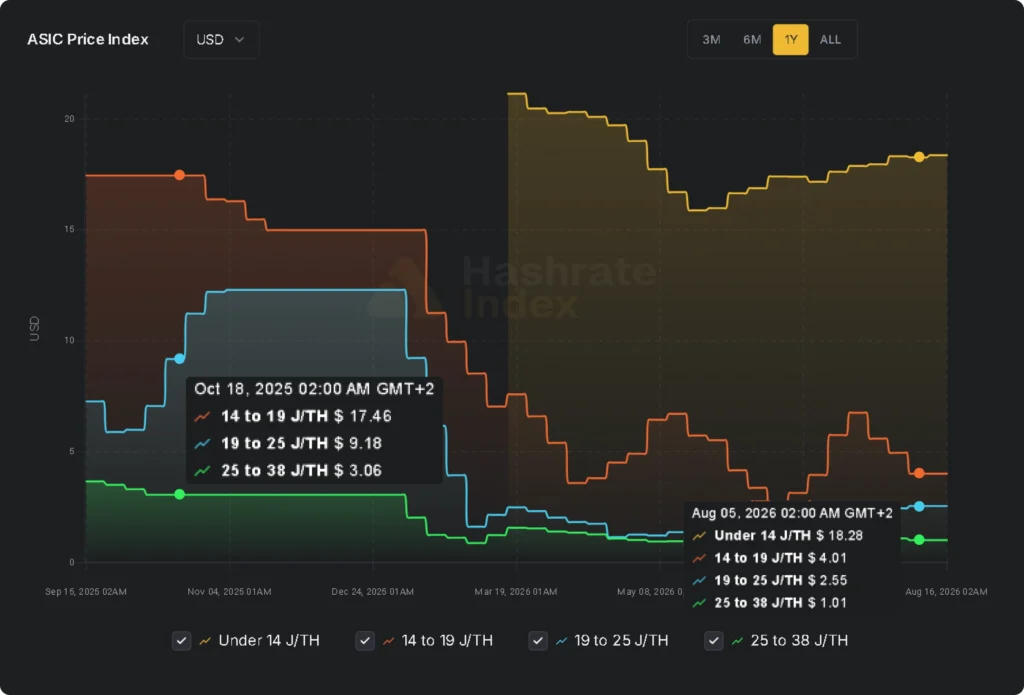
Above all, this snapshot stops before the shutdown of the Hyperscale Data site on September 1. It can therefore neither attribute the earlier decline to AI conversions, nor show the effect of hardware that may not have reached the secondary market yet. It will serve instead as a reference point for watching the months ahead.
| Observable signal | Confirmation needed |
|---|---|
| A fleet is classified as “held for sale” | The sale closes and its volume is known |
| A mining site is shut down or converted | The hardware is actually offered to buyers |
| An impairment is recognized | A price per model or per TH shows up in a transaction |
| ASIC capacity goes idle | The share genuinely available on the market is identified |
| Lots appear at brokers | Asking prices turn into completed sales |
A second wave of price drops would become more credible if the next index updates showed a fresh decline after these fleets actually arrive. That trend would then have to be cross-checked against the models and volumes disposed of, the prices obtained and the operators’ next reports.
A falling index would not be enough on its own, however, to prove that the AI pivot is the cause. In the same way, a drop in hashrate can come from a liquidation, but also from curtailment, maintenance or a relocation. Our analysis of the Bitcoin hashrate drop details these mechanisms.
Is this an opportunity for small operators?
Industrial fleets coming to market can create openings for small operators, but a steep discount is not enough on its own. An older unit can be cheap precisely because its efficiency no longer covers expensive electricity. So the reasoning has to be about total cost, delivered on site and back in service.
Before comparing two lots, work through the total cost delivered on site and recommissioned:
| Criterion | Question to check |
|---|---|
| Hardware price | What is the real price per TH, not just per unit? |
| Efficiency | How many J/TH does the ASIC draw in its intended configuration? |
| Electricity | Does the all-in cost per kWh leave enough margin against hashprice swings? |
| Technical condition | Have the hashboards, chips, fans and power supplies been tested? |
| History | Under what thermal conditions and with which firmware has the fleet run? |
| Logistics | Are shipping, customs, insurance and installation included? |
| Sale terms | Is there a minimum lot size, a warranty or any recourse in case of failure? |
| Economic life | How long can this generation stay competitive? |
Industrial provenance is no guarantee of quality: thousands of operating hours, uneven repairs or an incomplete thermal history can turn a discount into a maintenance bill. Conversely, an operator with suitable energy, reliable technical checks and controlled logistics can find value where a large group prefers to standardize its fleet. The opportunity therefore depends less on the majors pulling the plug than on your ability to run the right ASICs under better conditions.
Before you look at an offer from the secondary market, find the key checks in our guide: new or used Bitcoin ASIC miner: which should you buy?
Key takeaways
When a mining site pivots to AI, its infrastructure can be reused; its Bitcoin ASICs cannot. The hardware is sold, redeployed, stored or retired, and Cipher shows that a single fleet can even follow several paths at once.
Older generations remain heavily depreciated over twelve months, but the data as of August 9 shows a rebound from the first-half lows, not a continuous slide since June. For a small operator, the opportunity will therefore come down to the total cost of the ASIC delivered on site, tested, recommissioned and powered with energy compatible with its efficiency.
Passez à l'action
Ready to mine Bitcoin with Startmining?
Browse our ASIC shop or simulate your profitability in real time.