Bitcoin and Energy: Real Figures and ASIC Models (Part 1)

In early 2025, the Bitcoin network runs on 52.4% low-carbon energy, according to the Cambridge Centre for Alternative Finance (CCAF). This is a significant rise from 2022, when that share was only 37.6%.
In this energy mix:
- 9.8% comes from nuclear,
- and 42.6% from renewable sources such as wind and hydroelectric power.
With an estimated annual consumption of 138 TWh and an average electricity cost of $0.055/kWh, miners’ total energy spending would amount to around $7.6 billion per year — of which $3.2 billion goes to renewables.
But behind these figures lies a fascinating dynamic: that of a network actively funding low-carbon energy infrastructure.
In this article, we will:
- recalculate the network’s real consumption, starting from the distribution of active ASIC models,
- understand the link between efficiency, production cost and profitability,
- explore how this economic logic pushes miners to use renewable energy sources (in Part 2).
The Bitcoin mining ASIC models that make up the hashrate
The Bitcoin network’s power — called hashrate — is the sum of all the connected mining machines (ASICs). You can picture each ASIC model as a block: the total hashrate would then be an accumulation of these blocks over time, according to technological developments and successive ASIC generations.
Each machine has its own technical characteristics: its power consumption, its computing power, and therefore its energy efficiency (expressed in joules per terahash, J/TH).
The state of the network in October 2024
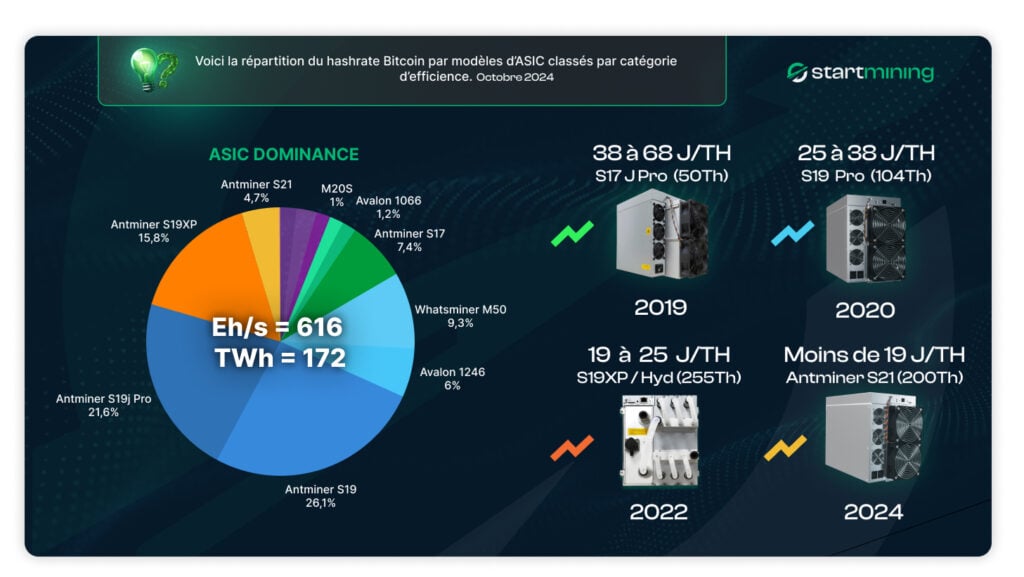
According to our analysis published in October 2024, the Bitcoin network had:
- a total computing power of 616 EH/s,
- around 6.5 million active ASICs,
- an estimated annual consumption of 172 TWh.
At that date, more than 60% of the hashrate was dominated by the Antminer S19 series, underlining the still-significant weight of the 2020–2022 generations in the network’s architecture.
The network’s evolution to August 2025: our assumptions
To assess the network’s current situation (August 2025), we made three assumptions:
- The hashrate growth between October 2024 and August 2025 (+335 EH/s) is entirely due to the addition of latest-generation machines (Antminer S21, S21 Pro, S21 XP).
- The distribution among these new models follows that of the previous generations (2019–2023), reflecting a logic of gradual fleet renewal.
- Machines older than 2020 (Antminer S17, Avalon 1066, M20S, etc.) have been removed from the network, replaced by recent ASICs with far better efficiency.
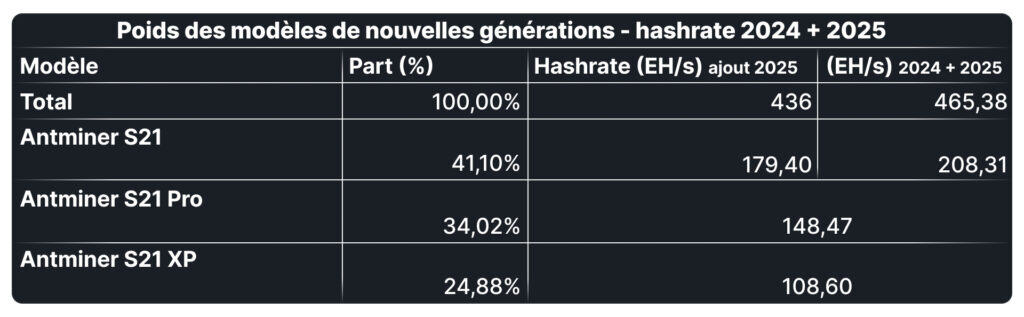
Between 2024 and 2025, replacing the old generations (20.3 EH/s) and adding new-generation ASICs (436 EH/s) totals 465 EH/s of hashrate.
A more powerful network, but not necessarily a hungrier one
Between October 2024 and August 2025, the hashrate rose from 615 to 950 EH/s — a +54.5% increase. Yet the number of connected ASICs stayed roughly stable, and energy consumption only rose slightly, by 11.63% (172 → 192 TWh).
Why? Because technological renewal plays a key role: a single Antminer S21 (200 TH/s for 3,550 W) replaces four Avalon 1066 units (50 TH/s for 3,250 W). The efficiency gain is such that the network can grow in power without needing more machines or more energy — all thanks to technological renewal.
In our scenario:
- 1.5 million old ASICs were disconnected,
- the hashrate increased by 456 EH/s,
- 2 million new-generation ASICs were connected to the network.
The network now has an estimated annual consumption of 192 TWh. At $0.055 per kWh, that amounts to $10.5 billion in annual spending — or a renewable investment of $4.5 billion per year (42.6% of the network).
We could have stopped there to show that Bitcoin mining subsidizes renewable infrastructure. But we will go further and dive deeper down the mining rabbit hole. To understand why old generations cannot indefinitely coexist with new ones — and why mining funds renewable infrastructure several times over — we need to look at the different production costs of ASIC models.
ASIC models, consumption, energy price and production cost
To understand the profitability of Bitcoin mining, you have to analyze the link between three key factors: the price of energy, the energy efficiency of the ASICs (the consumption/power ratio), and the production cost of the Bitcoin these machines generate.
Energy efficiency and production cost
An ASIC’s efficiency — expressed in J/TH — indicates how much energy is needed to produce a given volume of computation. The lower this value, the more profitable the model, at a constant energy price. For example, an ASIC consuming 30 J/TH will be 33% more profitable than one at 45 J/TH, all else being equal. So it is efficiency, combined with the price of electricity, that determines the production cost of the mined Bitcoin — and therefore the energy source to use.
Why some models have to be unplugged
A comparison table of production costs clearly shows that, at a fixed electricity price, some models quickly become unprofitable.
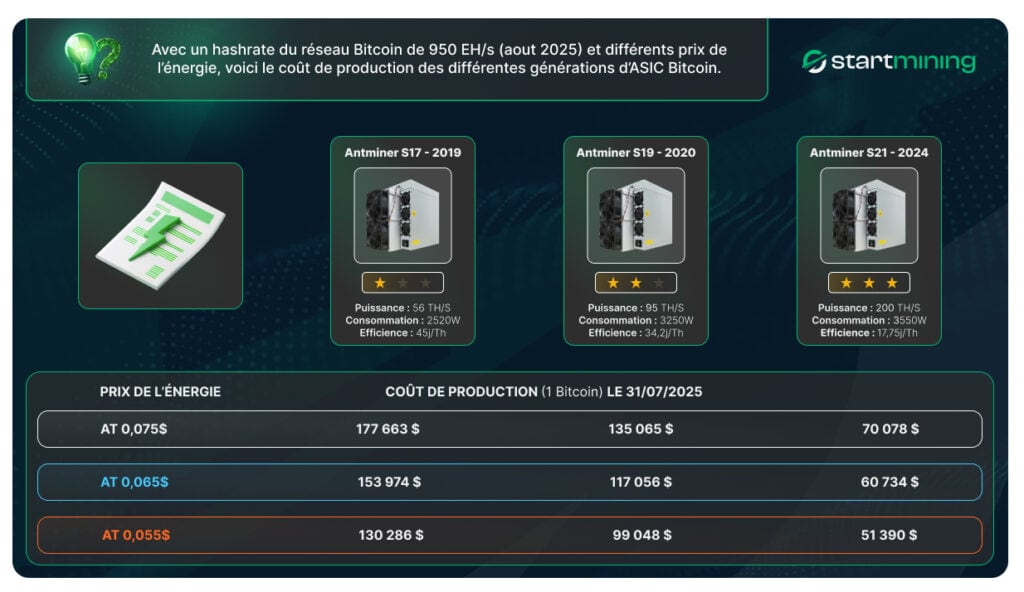
- An Antminer S17, with an estimated production cost of $130,000, is not profitable even with Bitcoin at $120,000.
- By contrast, an S19 remains slightly profitable, with a production cost around $100,000 under the same conditions ($0.055/kWh).
This explains why some ASICs have to be disconnected when Bitcoin’s price falls or electricity becomes too expensive.
What we will see next
In a second article, we will dig deeper into the link between energy efficiency, the need for cheap electricity, and the strategic use of renewable sources. In particular, we will see how the choice of an ASIC model automatically steers the type of energy used to ensure its profitability — read how Bitcoin mining funds the energy transition (Part 2).
Conclusion
The analysis of the ASIC distribution in the Bitcoin network clearly shows that technological improvement is at the heart of the sector’s energy transition. In under a year, the hashrate rose by more than 54% while annual consumption increased by only 11.6%. This efficiency gain is directly tied to the massive replacement of old generations by far more powerful machines, like the Antminer S21.
This renewal doesn’t just reduce the energy footprint per unit of computation: it redirects investment toward low-carbon energy sources, with more than $4.5 billion a year injected into renewables. So, far from being a mere consumer of electricity, Bitcoin mining acts as a catalyst for innovation and an indirect financier of green energy infrastructure.
Passez à l'action
Ready to mine Bitcoin with Startmining?
Browse our ASIC shop or simulate your profitability in real time.