Bitcoin Mining and the Energy Transition (Part 2)

Bitcoin mining: a quiet engine of the energy transition
Bitcoin mining is often criticized for its electricity use. Yet a closer analysis shows it already plays an important role in funding and developing low-carbon infrastructure — as we showed in Part 1 of this article. The Bitcoin network acts as a flexible consumer, able to absorb renewable-energy surpluses, make energy projects profitable, and stabilize power grids.
Why ASIC efficiency steers miners toward green energy
Miners favor the most efficient ASIC models on the market. The more efficient a machine (low J/TH), the lower the cost of producing one Bitcoin. When the price of electricity becomes the deciding factor, miners naturally turn to:
- areas with high renewable production (hydro, wind, solar),
- regions with under-valued energy surpluses,
- or long-term contracts with green-energy producers.
Key figure: 52.4% of the Bitcoin network’s energy mix is already low-carbon (see Part 1), including 42.6% from renewables.
ASIC efficiency and break-even
An ASIC’s efficiency directly determines its production cost, based on the price of electricity and the price of Bitcoin. Each machine therefore has a break-even point: the electricity price at which its revenue just covers its operating costs.
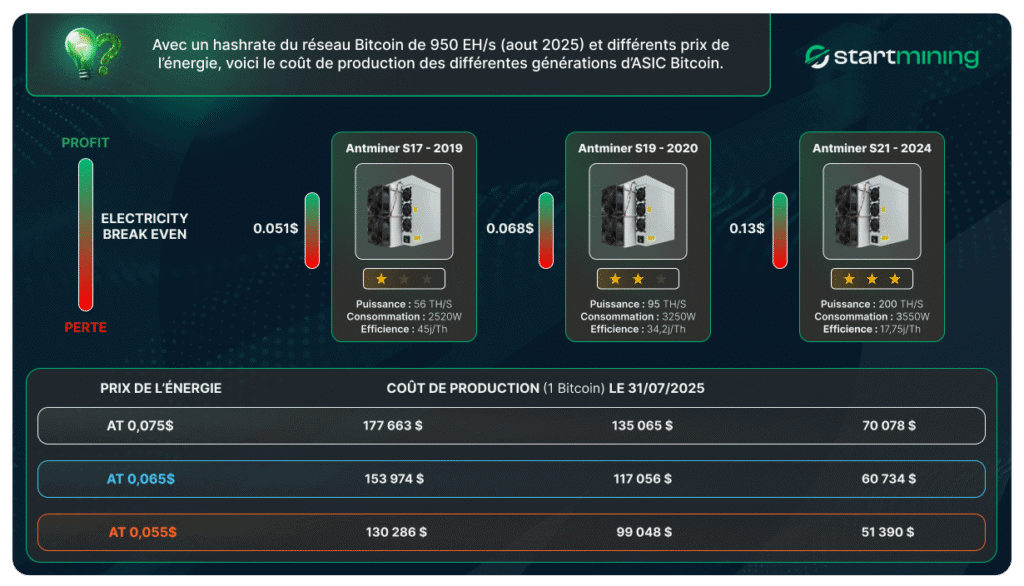
Break-even points as of August 1, 2025:
- S17: $0.051/kWh
- S19: $0.068/kWh
- S21: $0.13/kWh
This threshold determines which energy source can be used to make the operation profitable.
ASIC production cost and energy sources
Each energy source has its own operating profitability, which generally determines its market price. Here is a table of the average price of different energy sources.
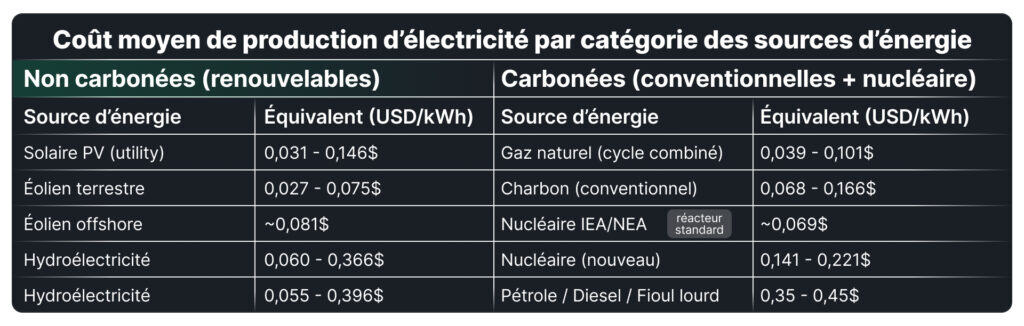
Fossil fuels, like coal or natural gas, now have far higher costs than most renewables. In many markets, their price exceeds $0.06/kWh, or even $0.10/kWh, making mining barely profitable even with the most efficient ASICs.
Energy-source advantages and an ASIC operating strategy
Beyond price, each energy source has its pros and cons. Some renewables come with constraints that mining knows how to turn to good use:
- Solar and wind: cheap but intermittent → ideal for running older-generation ASICs (S17, S19) already amortized and bought cheaply.
- Hydro and geothermal: more expensive but very reliable (uptime > 90%) → perfect to maximize the yield of latest-generation ASICs (S21), which must run continuously to amortize a high investment (> $4,000).
Theoretical operating table for the S17 and S19 with four renewable sources
Older-generation ASICs have already been amortized by their first owner. Their low price on the used market makes them viable in the medium term (1 to 2 years) only with very cheap electricity (< $0.05/kWh).
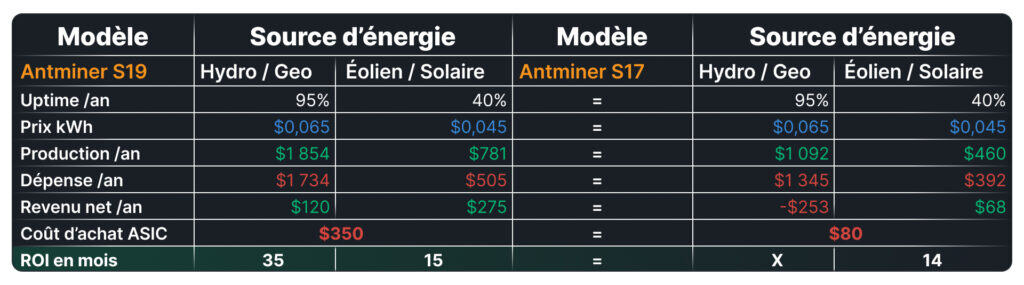
This shows that if electricity is too expensive, even with high uptime (hydro or geo), running an ASIC is not profitable or the ROI becomes too long.
Theoretical operating table for the S21
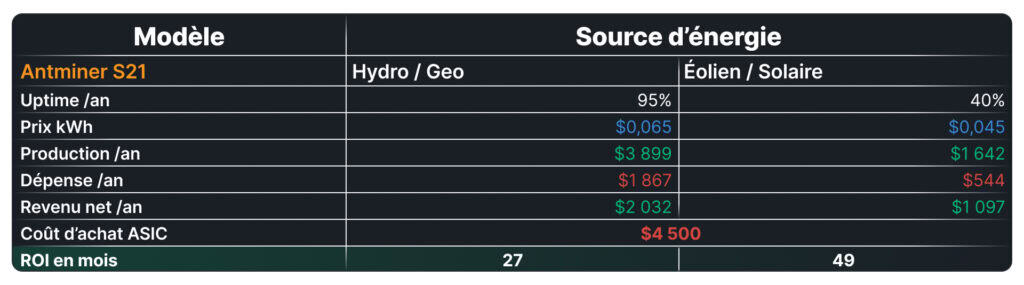
Latest-generation ASICs, very profitable at launch, require a large amortization (> $4,500). To achieve it, they must produce maximum value in a limited time, even if it means paying more for electricity.
The strategic role of flexible consumption
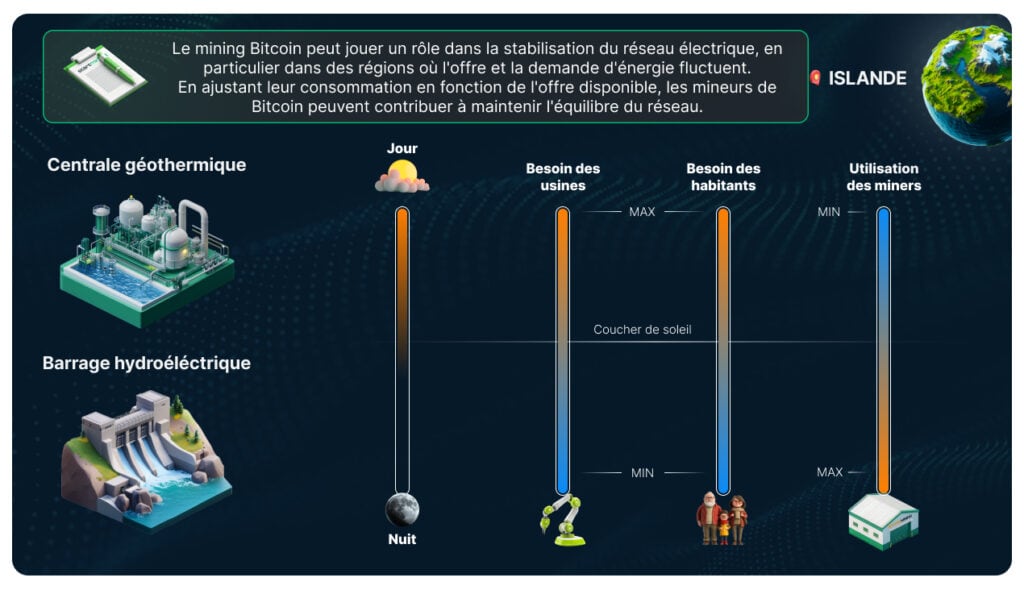
Unlike most industries, mining farms can adjust their consumption in near real time. They become ideal customers to absorb excess renewable production and contribute to grid stability.
A concrete example: in some regions, mining farms shut down their machines a few hours a day during electricity-demand peaks. In return, they benefit from preferential rates the rest of the time. This mechanism strengthens the economic viability of clean-energy producers, who can rely on stable, flexible revenue.
Bitcoin, a catalyst for energy investment
The revenue generated by mining encourages the development of new electricity-production capacity:
- Hydro: installing small plants in remote areas with low local demand.
- Wind and solar: funding additional farms thanks to mining revenue.
- Geothermal: making the most of low-cost energy available 24/7.
Key figure: in some regions of Texas, more than 1 GW of new solar and wind capacity was funded partly by revenue from mining.
A possible virtuous cycle
- Miners invest in more efficient machines → lower consumption per TH/s.
- Rising hashrate increases the production cost → search for even cheaper electricity.
- Renewable-energy producers find a flexible, creditworthy customer.
- The revenue funds new low-carbon infrastructure.
Over the long term, this mechanism could accelerate the energy transition in several regions of the world.
Mining as a development tool
Developed countries have the capital needed to invest in the newest, most efficient ASICs. After one or two mining cycles, even with cheap renewable energy, the price of electricity can become too high to run these machines profitably.
In many developing countries, by contrast, electricity — especially renewable — is even cheaper, though the infrastructure is sometimes less reliable. This makes running older ASICs, bought cheaply, economically viable while supporting local energy demand.
This cycle creates a form of technology transfer: when an ASIC is resold by an operator in a developed country, it can be used in a region where energy costs even less, helping fund new infrastructure. So developed countries invest in hardware that first funds their own energy projects, then — through resale — supports infrastructure development in emerging countries.
Conclusion: changing the perception of Bitcoin mining
Rather than seeing Bitcoin as a mere “energy sink,” it is more accurate to view it as a tool for the decentralized financing of clean energy infrastructure. Through its competitive structure, the Bitcoin network pushes players toward efficiency and the cheapest energy, which mechanically leads to greater adoption of renewables. By bringing this reality into the public debate, we open the way to better cooperation between mining and energy-sector players.
Passez à l'action
Ready to mine Bitcoin with Startmining?
Browse our ASIC shop or simulate your profitability in real time.