Bitcoin Hashrate: Understanding the Metric and the 1 ZH/s Milestone
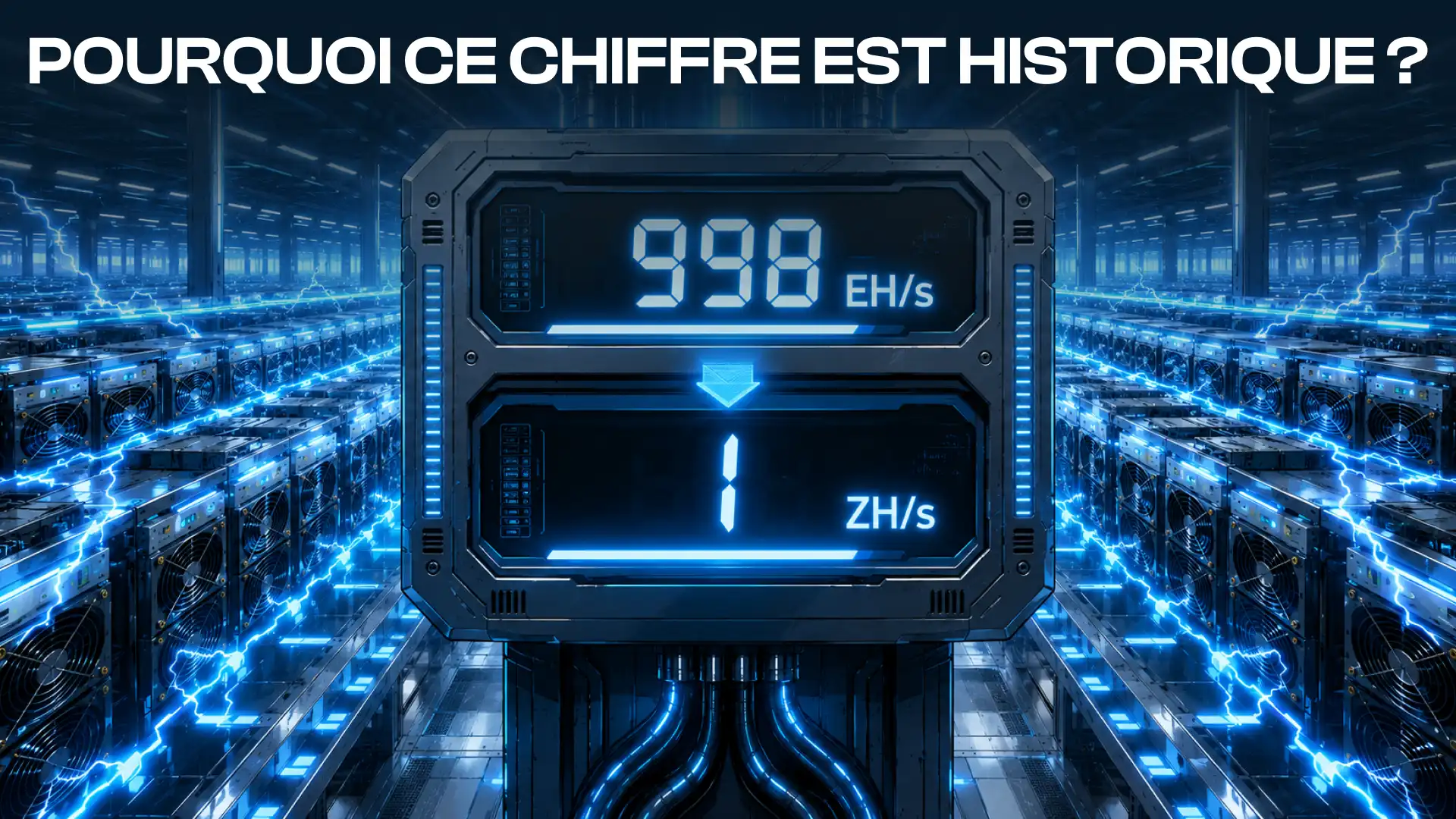
The Bitcoin network crossed the symbolic threshold of one zettahash per second, or 1 ZH/s, for the first time in 2025. It later dipped back below that level during the hashrate correction seen in early 2026.
For a miner, this has one direct consequence: the more global computing power grows, the smaller the relative share of each ASIC becomes. Understanding Bitcoin hashrate therefore lets you assess network security, but above all anticipate the future output of a unit.
Short answer: Bitcoin hashrate estimates the number of SHA-256 computations performed every second by all miners combined. A hashrate of 1 ZH/s corresponds to 1021 attempts per second, or 1,000 EH/s. On 20 July 2026, Startmining’s Bitcoin Core node estimated the network at 904 EH/s over the last 144 blocks.
What is Bitcoin hashrate and how is it calculated?
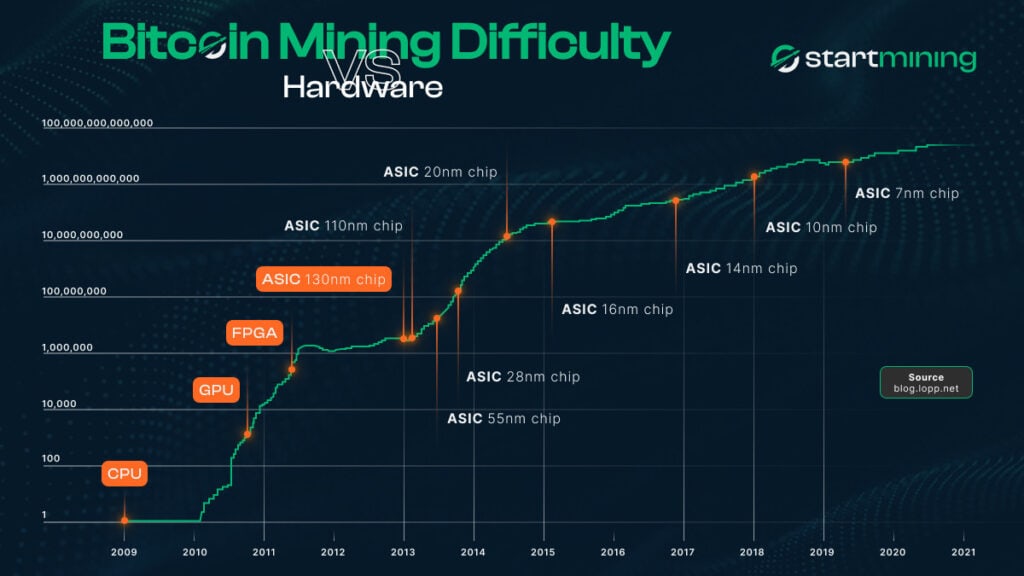
Hashrate measures the number of hash computations performed every second by mining hardware.
These units, known as ASICs, run the SHA-256 algorithm to search for a result below a target defined by the protocol. When a miner finds a valid solution, it can propose a new block. Bitcoin nodes then verify that the block complies with the network’s rules.
Mining can be compared to a global lottery. Each hash is a ticket. An ASIC rated at 358 TH/s generates 358 trillion attempts per second, but it competes against every other active unit.
The more hashrate a miner controls, the higher its probability of finding a block. Within a pool, its rewards depend on the share of computing power it contributes.
Global hashrate cannot be measured directly, however. No central counter knows the exact output of every ASIC. It is therefore estimated from two observable data points:
- mining difficulty;
- the time actually needed to produce blocks.
If blocks are found faster than expected at a given difficulty, this suggests that more computing power is active. If they are produced more slowly, the estimate falls.
A 24-hour measurement reacts quickly but is more exposed to randomness. A 7-day or 30-day average is more stable but reflects recent changes more slowly. A hashrate figure should therefore always come with its date and its measurement window.
TH/s, PH/s, EH/s and ZH/s: how to read the units
The output of an ASIC and that of the network use the same base unit, but at very different scales.
| Unit | Computations per second | Equivalent |
| 1 TH/s | 1012 | 1 trillion |
| 1 PH/s | 1015 | 1,000 TH/s |
| 1 EH/s | 1018 | 1,000 PH/s |
| 1 ZH/s | 1021 | 1,000 EH/s |
A modern ASIC delivers several hundred TH/s. An industrial farm is usually measured in PH/s, while the Bitcoin network is now counted in hundreds of EH/s.
One zettahash is a 1 followed by 21 zeros, or 1,000,000,000 TH/s.
What does a hashrate of 1 ZH/s actually represent?

Take the example of an Antminer S21+ Hydro delivering 358 TH/s.
In theory, it would take roughly 2.79 million of these ASICs to reach 1 ZH/s. A single unit would then represent only 0.0000358% of global hashrate.
This equivalence does not describe the real composition of the network, which combines several ASIC generations. It does, however, help visualise the scale now involved.
In 2021, the network hovered around 150 EH/s. At 1 ZH/s, its computing power is 6.7 times higher. A miner therefore has to deploy far more hashrate to keep the same share of the network.
What the same hashrate would theoretically produce in 2021 and at 1 ZH/s
The table below compares 358 TH/s in two environments. This is a theoretical exercise: the S21+ Hydro did not exist in 2021.
| Metric | Network at 150 EH/s | Network at 1 ZH/s |
| Network hashrate | 150 EH/s | 1,000 EH/s |
| Share of the network for 358 TH/s | 0.000239% | 0.0000358% |
| Block subsidy, excluding fees | 6.25 BTC | 3.125 BTC |
| Theoretical daily output* | 0.002148 BTC | 0.000161 BTC |
*Startmining calculation based on 144 blocks per day, excluding transaction fees, uptime and pool fees.
At identical computing power, theoretical output is divided by roughly 13.3 between these two configurations:
- a factor of 6.7 comes from network growth;
- a factor of 2 comes from the 2024 halving.
The figure printed on an ASIC’s spec sheet is therefore not enough. What matters is its power relative to the rest of the network.
A hashrate of 1 ZH/s produced entirely by hardware rated at 15 J/TH would require roughly 15 GW of continuous electrical power, or close to 131 TWh over a year at full availability.
That figure is not an estimate of Bitcoin’s actual consumption. It describes a theoretical, homogeneous fleet running exclusively on 15 J/TH hardware.
How are hashrate, difficulty and block time connected?
Bitcoin targets an average interval of about ten minutes between two blocks. Yet the computing power connected to the network varies continuously.
To maintain that pace, the protocol adjusts difficulty every 2,016 blocks, or roughly every two weeks.
The mechanism works as follows:
- new ASICs join the network;
- hashrate increases;
- blocks are temporarily found faster;
- difficulty rises at the next adjustment;
- average block time returns to around ten minutes.
The opposite happens when hardware is switched off. Blocks slow down temporarily, then difficulty falls.
Three indicators must therefore be distinguished:
- hashrate estimates the active computing power;
- difficulty defines how hard the work required to find a block is;
- block time reveals the temporary imbalance between the two.
Bitcoin’s technical documentation confirms that difficulty is recalculated every 2,016 blocks in order to stabilise block production. See the Bitcoin Developer Guide.
Network status on 20 July 2026
| Metric | Value |
| Hashrate estimated over the last 144 blocks | 904 EH/s |
| Difficulty | 127.17 T |
| Hashprice | $31.8 /PH/day |
Source: Startmining simulator, fed directly by a self-hosted Bitcoin Core node. These figures are a dated snapshot.
Does a higher hashrate make Bitcoin more secure?
More computing power increases the resources needed to compete with the honest network. An attack against transaction history therefore becomes more expensive in hardware, energy and infrastructure.
Hashrate alone does not measure decentralisation, however. That also depends on pool concentration, on who actually owns the ASICs, on their geographic distribution and on the nodes that verify blocks.
A pool can aggregate a large share of hashrate without owning the hardware connected to it. Miners can generally redirect their computing power to another pool.
Finally, a rising hashrate does not guarantee a rising Bitcoin price. It mainly indicates that more computing power is being deployed or that hardware is becoming more efficient. A temporary decline, on the other hand, can come from higher energy prices, weather events or unprofitable ASICs being switched off.
How does hashrate affect the profitability of an ASIC?
An ASIC’s theoretical share of the blocks produced depends on its weight in the network:
Miner’s share = ASIC hashrate ÷ network hashrate
When new hardware joins the network, your ASIC’s relative share falls immediately. But as long as difficulty stays the same, blocks are also produced faster: its expected output per unit of time remains theoretically stable.
It is only after difficulty adjusts upwards that lasting output per TH/s declines.
If hashrate rises durably by 10% and difficulty adjusts in the same proportion, theoretical output per TH/s falls by about 9.1%, all else being equal. It does not fall by exactly 10%, because the new share equals 1 ÷ 1.10 = 0.909, a decrease of 9.1%.
This is summarised by hashprice, which measures the revenue generated by one unit of computing power, in BTC or in dollars per PH/s per day.
On 20 July 2026, the Startmining dashboard showed a hashprice of roughly $31.8 /PH/day. At that level, an S21+ Hydro rated at 358 TH/s, or 0.358 PH/s, theoretically generated 0.358 × 31.8 = $11.38 per day.
This is gross revenue, before uptime, pool fees, electricity, hosting and maintenance. This dated snapshot is not a promise of returns.
To dig deeper into that relationship, read our analysis of Bitcoin mining profitability in 2026.
How should you analyse hashrate before buying an ASIC?
Hashrate should never be studied in isolation. Before buying, you also need to look at:
- difficulty and its next estimated adjustment;
- hashprice in BTC and in dollars;
- the price of Bitcoin;
- the ASIC’s efficiency in J/TH;
- electricity price, uptime and fees.
A 24-hour swing can simply be statistical noise. A trend confirmed over several weeks is far more meaningful.
Above all, avoid projecting profitability over several years with a frozen hashrate. A serious simulation should test at least a flat scenario, moderate growth and a sharp rise in network power.
You can compare these assumptions in our Bitcoin mining profitability calculator and read our comparison to find out which Bitcoin ASIC to choose.
Performance also depends on operating conditions. Find the criteria to check in our Bitcoin mining hosting guide, or explore Startmining’s hosting solutions.
Bitcoin hashrate FAQ
How can I check Bitcoin’s current hashrate?
Hashrate should always be read together with its estimation window. The Startmining dashboard measures it over the last 144 blocks, or about 24 hours. Other trackers use 7-day or 30-day averages, which can produce different results.
Why does Bitcoin hashrate keep rising?
It rises when new hardware is connected, when existing ASICs are optimised, or when more powerful models replace older generations. Improving profitability can also encourage operators to deploy more computing power.
Is a falling hashrate dangerous for Bitcoin?
A decline temporarily reduces the computing power needed to compete with the network, but it does not automatically mean Bitcoin is under threat. If it lasts, difficulty falls after 2,016 blocks in order to bring average block time back to around ten minutes.
Bitcoin hashrate measures the intensity of the competition between miners. Crossing the 1 ZH/s mark is not a technical break: it reveals the level of industrialisation the network has reached.
At that scale, owning a powerful ASIC is no longer enough. Its profitability depends on its efficiency, on the price of energy and on how difficulty evolves.
So the right question is not only: “how many TH/s does this unit deliver?”
It is: what share of the network will it keep, at what cost, and for how long?
Test your assumptions in the Bitcoin mining profitability calculator before you buy or host an ASIC.
Passez à l'action
Ready to mine Bitcoin with Startmining?
Browse our ASIC shop or simulate your profitability in real time.