Buy or Mine Bitcoin in 2026: The Comparison

In 2026, buying Bitcoin remains the simplest strategy for capturing a rise in the price. Mining Bitcoin with an ASIC offers another approach: producing BTC over time, paying the OPEX with part of the production, and keeping a residual value on the hardware.
The best option depends mainly on three variables:
- the future price of Bitcoin;
- the evolution of the network hashrate;
- the resale value of the ASIC.
In this article, we compare two strategies with an equal starting capital: $3,300.
On one side, the spot purchase of Bitcoin at the market price.
On the other, the purchase of an Antminer S21+ Hydro 358 TH/s hosted in Iceland, with the OPEX paid by the production.
The goal: to answer a simple question.
Should you buy Bitcoin directly or mine Bitcoin before the halving in 2028?
This article is an educational simulation. It does not constitute investment advice. Buying Bitcoin and mining carry risks: BTC volatility, hashrate evolution, operating costs, infrastructure availability, hardware liquidity, applicable taxation, and the risk of capital loss.
Spot purchase vs Bitcoin mining: summary of the results
Before getting into the detail, here are the results of the simulations.
- BTC $61,652 / 1,045 EH/s — spot purchase: $3,300; mining excluding ASIC resale: $1,789; mining after ASIC resale: $4,099; winning strategy after resale: Mining.
- BTC $100,000 / 1,203 EH/s — spot purchase: $5,353; mining excluding ASIC resale: $4,700; mining after ASIC resale: $7,010; winning strategy after resale: Mining.
- BTC $150,000 / 2,003 EH/s — spot purchase: $8,029; mining excluding ASIC resale: $3,707; mining after ASIC resale: $6,017; winning strategy after resale: Spot purchase.
- BTC $200,000 / 2,003 EH/s — spot purchase: $10,705; mining excluding ASIC resale: $6,717; mining after ASIC resale: $9,027; winning strategy after resale: Spot purchase.
Quick read:
- without reselling the hardware, the spot purchase performs better in every scenario;
- with an ASIC residual value estimated at 70%, mining becomes superior in the $61,652 and $100,000 scenarios;
- at $150,000 and $200,000, the spot purchase stays ahead, because the BTC were bought from the start at $61,652;
- the $150,000 scenario shows that the rise in hashrate can sharply reduce mining profitability.
You can test your own assumptions with the Startmining Bitcoin mining profitability simulator: BTC price, network hashrate, energy cost, uptime, and resale value.
Buying or mining Bitcoin: two very different strategies
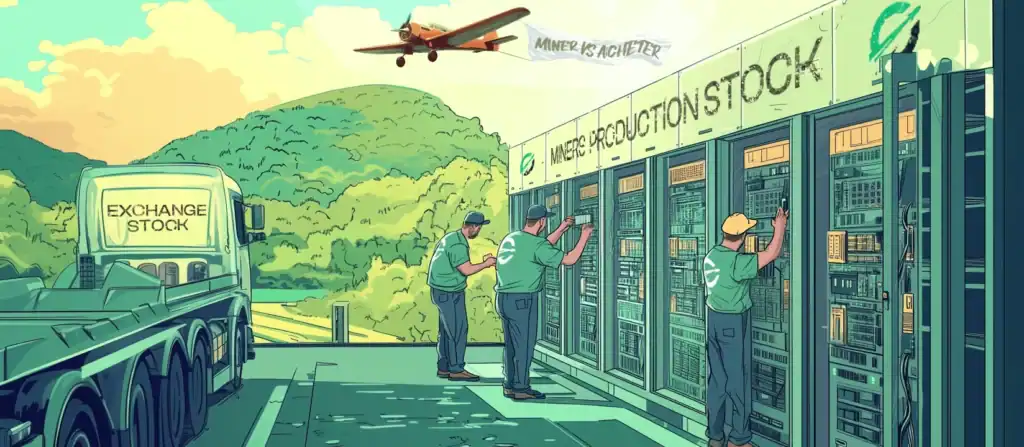
Buying Bitcoin is simple. You buy a fixed quantity of BTC, you hold it, and then your outcome depends solely on the future price.
Mining Bitcoin works differently. You don’t buy BTC directly. You buy production capacity. This capacity generates Bitcoin over time, but part of that production must pay the operating costs: energy, hosting, pool fees.
The central difference is therefore the following: Buying Bitcoin means holding a fixed quantity of BTC. Mining Bitcoin means producing BTC over time.
Our simulation assumptions in June 2026
Spot Bitcoin purchase scenario
Assumptions used:
- capital invested: $3,300;
- BTC purchase price: $61,652;
- BTC bought: about 0.0535 BTC;
- no OPEX;
- no hardware;
- no additional production.
The formula is simple:
Final value = quantity of BTC bought × future price of Bitcoin
Mining scenario with the S21+ Hydro ASIC
Assumptions used:
- ASIC: Antminer S21+ Hydro;
- hashrate: 358 TH/s;
- ASIC price: $3,300;
- power: 5,370 W;
- efficiency: 15 J/TH;
- electricity: $0.061/kWh;
- uptime: 97%;
- pool fees: 2%;
- hosting: $10/month;
- OPEX paid by the production;
- horizon: about 22 months until the 2028 halving.
In this strategy, part of the mined BTC is sold to pay the fees. The rest is kept.
The formula becomes: Gross BTC production − BTC sold to pay the OPEX = net BTC kept after paying the OPEX
The mining results used in this article are extrapolated over about 22 months from the annualized data of the simulator. This duration corresponds to the horizon chosen between June 2026 and the next halving estimated in 2028.
Which Bitcoin ASIC to mine with?
ASIC residual value: an important variable
At the end of the simulation, we use an assumption of an ASIC residual value equal to 70% of its purchase price.
That is: $3,300 × 70% = $2,310
This assumption is not guaranteed. It will depend in particular on:
- the price of Bitcoin;
- the network hashrate;
- the price of energy;
- the condition of the hardware;
- demand on the secondary market;
- the generation of ASIC available at that time.
The price of an ASIC depends largely on its future profitability. When mining profitability is squeezed, the price of miners tends to fall.
If Bitcoin rises and mining profitability improves, the resale value of ASICs can theoretically be revalued upward.
But the opposite is also true: if a new generation of more efficient ASIC reaches the market, if the hashprice falls, or if secondary demand contracts, the resale value may be lower than the assumption used.
For this reason, the residual value should be read as a simulation variable, not as a guarantee.
- 30% of the purchase price — estimated amount: $990
- 50% of the purchase price — estimated amount: $1,650
- 70% of the purchase price — estimated amount: $2,310
What resale value is needed to beat the spot purchase?
The decisive question is not only: “how much does the ASIC produce?”
You also have to ask:
At what price must the ASIC be resold for mining to beat the spot purchase?
- BTC $61,652 / 1,045 EH/s — mining excluding ASIC resale: $1,789; spot BTC purchase: $3,300; ASIC resale needed to beat the spot purchase: $1,511; assumption used: $2,310.
- BTC $100,000 / 1,203 EH/s — mining excluding ASIC resale: $4,700; spot BTC purchase: $5,353; ASIC resale needed to beat the spot purchase: $653; assumption used: $2,310.
- BTC $150,000 / 2,003 EH/s — mining excluding ASIC resale: $3,707; spot BTC purchase: $8,029; ASIC resale needed to beat the spot purchase: $4,322; assumption used: $2,310.
- BTC $200,000 / 2,003 EH/s — mining excluding ASIC resale: $6,717; spot BTC purchase: $10,705; ASIC resale needed to beat the spot purchase: $3,988; assumption used: $2,310.
Read:
- at $61,652 and $100,000, the resale assumption of $2,310 is enough to push mining ahead of the spot purchase;
- at $150,000, you would have to resell the ASIC for about $4,322, that is more than its initial purchase price;
- at $200,000, you would have to resell it for about $3,988, that is roughly 121% of its initial purchase price.
These last two scenarios are not impossible in theory if mining profitability improves strongly, but they require a significant revaluation of the hardware on the secondary market.
Why this simulation remains deliberately simplified
The mining scenarios presented in this article are static. This means that the Bitcoin price and the network hashrate are set at the start of each simulation.
In reality, these two variables would probably evolve gradually. This point is important.
If the hashrate rises gradually, the miner can produce more BTC in the first months, when network competition is still lower. Conversely, if the Bitcoin price rises gradually, the first BTC produced are worth less when they are generated, and a larger share of the production must be sold to pay the OPEX.
Our scenarios are therefore not forecasts. They are simplified models to compare several market environments.
The correct read is the following: The faster the Bitcoin price rises relative to the hashrate, the more favorable mining becomes. The faster the hashrate rises relative to the Bitcoin price, the more the miner’s profitability is squeezed.
Can the Bitcoin hashrate still rise in 2026?
Scenario 1: Bitcoin at $61,652 and hashrate at 1,045 EH/s
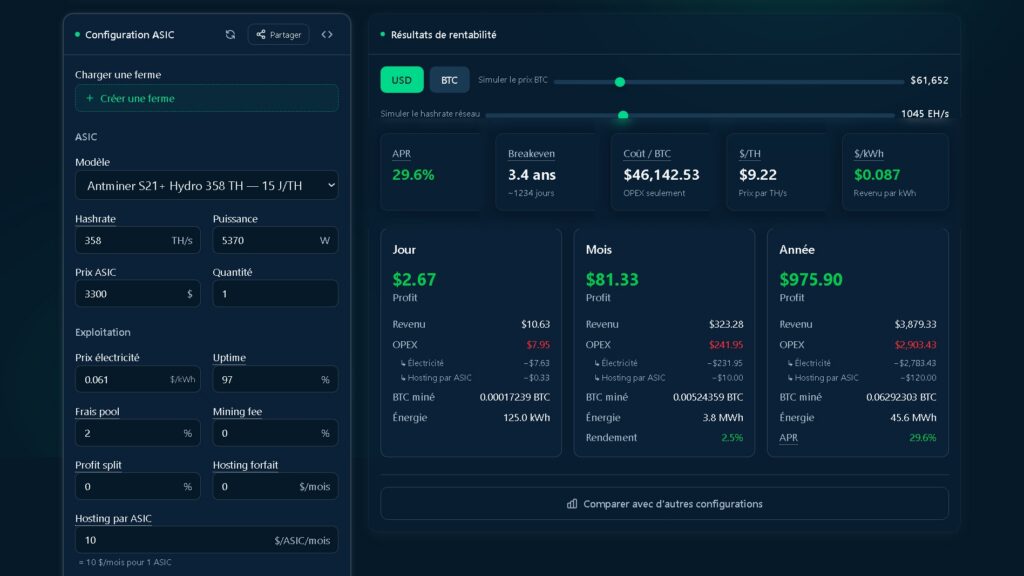
Startmining simulation of the S21+ Hydro with Bitcoin at $61,652 and a network hashrate of 1,045 EH/s.
In this first scenario, the Bitcoin price stays stable around $61,652, with a network hashrate of 1,045 EH/s.
- Initial capital — spot BTC purchase: $3,300; mining S21+ Hydro: $3,300.
- Scenario BTC price — spot: $61,652; mining: $61,652.
- Network hashrate — spot: —; mining: 1,045 EH/s.
- BTC held / net BTC kept after OPEX — spot: 0.0535 BTC; mining: 0.0290 BTC.
- BTC value at the halving — spot: $3,300; mining: $1,789.
- ASIC payback — spot: —; mining: 54.2%.
- Real ROI excluding ASIC resale — spot: 0%; mining: -45.8%.
- ASIC residual value — spot: —; mining: $2,310.
- Estimated final result — spot: $3,300; mining: $4,099.
- Overall return after ASIC resale — spot: 0%; mining: +24.2%.
With a stable Bitcoin price, the spot purchase simply keeps its value.
Mining, for its part, does not produce enough BTC to fully pay off the ASIC before the halving. Excluding resale, the operation therefore remains negative.
But if we factor in a 70% residual value on the ASIC, the result changes: the mining strategy reaches about $4,099, that is an overall return of +24.2% after resale.
In this scenario, the resale value of the ASIC therefore plays a decisive role.
Scenario 2: Bitcoin at $100,000 and hashrate at 1,203 EH/s
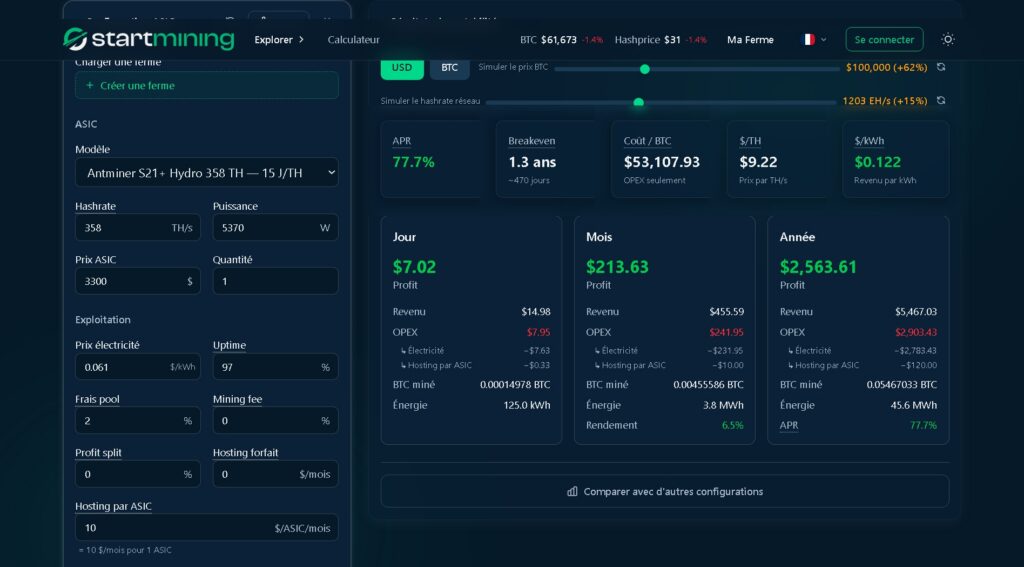
Startmining simulation of the S21+ Hydro with Bitcoin at $100,000 and a network hashrate of 1,203 EH/s.
In this scenario, Bitcoin rises to $100,000, while the network hashrate climbs to 1,203 EH/s.
- Initial capital — spot BTC purchase: $3,300; mining S21+ Hydro: $3,300.
- Spot BTC purchase price — spot: $61,652; mining: —.
- Scenario BTC price — spot: $100,000; mining: $100,000.
- Network hashrate — spot: —; mining: 1,203 EH/s.
- BTC held / net BTC kept after OPEX — spot: 0.0535 BTC; mining: 0.0470 BTC.
- BTC value at the halving — spot: $5,353; mining: $4,700.
- Gross gain vs initial capital — spot: +$2,053; mining: +$1,400.
- ASIC payback — spot: —; mining: 142.4%.
- Real ROI excluding ASIC resale — spot: +62.2%; mining: +42.4%.
- ASIC residual value — spot: —; mining: $2,310.
- Estimated final result — spot: $5,353; mining: $7,010.
- Overall return after ASIC resale — spot: +62.2%; mining: +112.4%.
With Bitcoin at $100,000, the spot purchase delivers a solid performance: about +62%.
But mining becomes very competitive. The ASIC pays back its purchase price through its production, then keeps a significant residual value.
With a resale estimated at 70% of the purchase price, the mining strategy reaches about $7,010, that is +112.4% overall return.
In this scenario, mining takes the lead, because the rise in BTC is enough to improve profitability, while the hashrate does not yet rise excessively.
Scenario 3: Bitcoin at $150,000 and hashrate at 2,003 EH/s
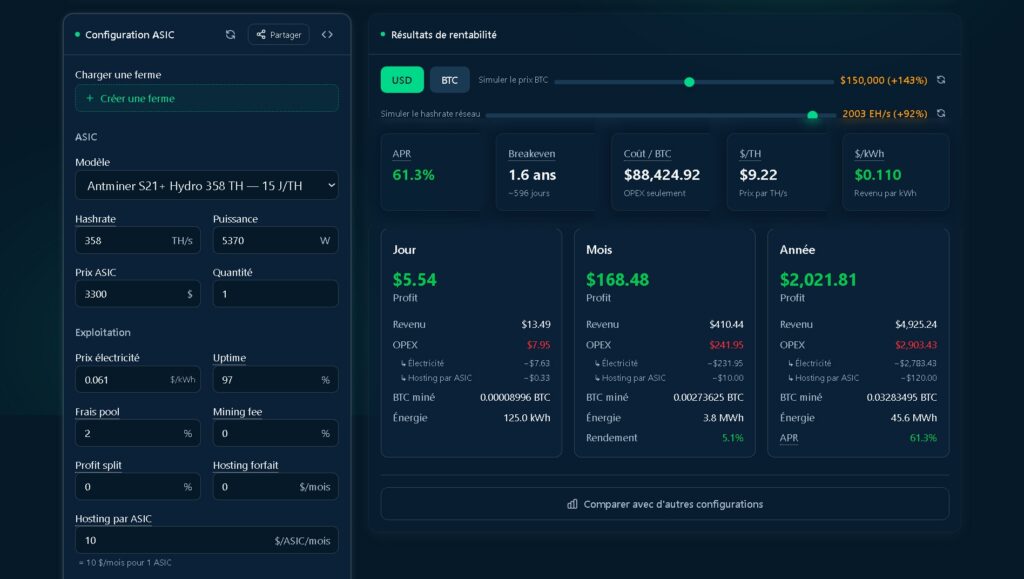
Startmining simulation of the S21+ Hydro with Bitcoin at $150,000 and a network hashrate of 2,003 EH/s.
This scenario is the most important for understanding Bitcoin mining profitability.
Bitcoin rises strongly, but the network hashrate also rises very sharply.
- Initial capital — spot BTC purchase: $3,300; mining S21+ Hydro: $3,300.
- Spot BTC purchase price — spot: $61,652; mining: —.
- Scenario BTC price — spot: $150,000; mining: $150,000.
- Network hashrate — spot: —; mining: 2,003 EH/s.
- BTC held / net BTC kept after OPEX — spot: 0.0535 BTC; mining: 0.0247 BTC.
- BTC value at the halving — spot: $8,029; mining: $3,707.
- Gross gain vs initial capital — spot: +$4,729; mining: +$407.
- ASIC payback — spot: —; mining: 112.3%.
- Real ROI excluding ASIC resale — spot: +143.3%; mining: +12.3%.
- ASIC residual value — spot: —; mining: $2,310.
- Estimated final result — spot: $8,029; mining: $6,017.
- Overall return after ASIC resale — spot: +143.3%; mining: +82.3%.
Despite Bitcoin at $150,000, the rise in hashrate sharply compresses the ASIC’s production.
Mining stays positive, especially after reselling the ASIC, but it underperforms the spot purchase in this case.
This is the central educational point of the article:
Mining does not depend only on the price of Bitcoin. It also depends on the competition between miners.
When the hashrate rises strongly, each ASIC receives a smaller share of the new BTC produced.
In this scenario, the spot purchase therefore stays ahead, because it allowed BTC to be bought from the start at $61,652.
Scenario 4: Bitcoin at $200,000 and hashrate at 2,003 EH/s
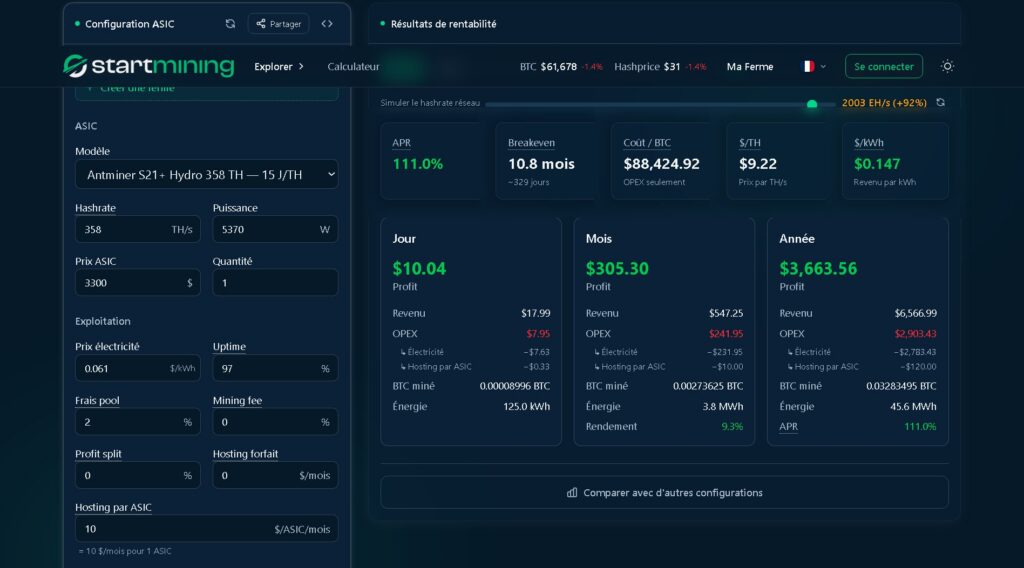
Startmining simulation of the S21+ Hydro with Bitcoin at $200,000 and a network hashrate of 2,003 EH/s.
In this scenario, Bitcoin rises to $200,000, but the network hashrate stays the same as the previous scenario: 2,003 EH/s.
- Initial capital — spot BTC purchase: $3,300; mining S21+ Hydro: $3,300.
- Spot BTC purchase price — spot: $61,652; mining: —.
- Scenario BTC price — spot: $200,000; mining: $200,000.
- Network hashrate — spot: —; mining: 2,003 EH/s.
- BTC held / net BTC kept after OPEX — spot: 0.0535 BTC; mining: 0.0336 BTC.
- BTC value at the halving — spot: $10,705; mining: $6,717.
- Gross gain vs initial capital — spot: +$7,405; mining: +$3,417.
- ASIC payback — spot: —; mining: 203.5%.
- Real ROI excluding ASIC resale — spot: +224.4%; mining: +103.5%.
- ASIC residual value — spot: —; mining: $2,310.
- Estimated final result — spot: $10,705; mining: $9,027.
- Overall return after ASIC resale — spot: +224.4%; mining: +173.5%.
With Bitcoin at $200,000, mining becomes very profitable in absolute value.
The ASIC is largely paid off, generates more than 100% real ROI excluding resale, and keeps a residual value estimated at $2,310.
Despite this, the spot purchase stays ahead in this simulation, because the BTC were bought from the start at $61,652.
But the gap narrows sharply once the resale value of the ASIC is factored in.
In a real scenario, if the rise in hashrate were gradual rather than immediate, mining could benefit from several months of more favorable production before reaching 2,003 EH/s.
Buying or mining Bitcoin: which strategy fits your profile?
- You want simple exposure to BTC — generally best suited: spot purchase.
- You want to maximize liquidity — generally best suited: spot purchase.
- You want to avoid any operational risk — generally best suited: spot purchase.
- You want to produce BTC over time — generally best suited: mining.
- You accept a less liquid strategy — generally best suited: mining.
- You think the hashrate is going to explode — generally best suited: spot purchase.
- You think BTC will rise faster than the hashrate — generally best suited: mining.
- You value the potential resale of the hardware — generally best suited: mining.
This table does not replace a personalized simulation. It only serves to clarify the decision logic.
Should you buy or mine Bitcoin before the 2028 halving?
If your goal is to capture as much as possible of a strong rise in the Bitcoin price, the spot purchase remains the most direct strategy.
You buy today. You hold. If Bitcoin rises, your capital follows immediately.
Mining answers a different logic.
You don’t buy Bitcoin directly. You buy an ASIC that produces Bitcoin.
This ASIC must first pay back its own cost. Only then does it generate a real ROI.
But unlike a spot purchase, the ASIC can keep a residual value. In our simulation, we use a resale value of 70% of the purchase price, that is $2,310.
This point strongly changes the comparison. Without reselling the hardware, the spot purchase dominates in our scenarios.
With ASIC resale, mining becomes competitive, even superior, in certain scenarios.
The real question is therefore not only:
Will the price of Bitcoin rise?
You also have to ask:
Will the price of Bitcoin rise faster than the network hashrate?
And: What will the residual value of my ASIC be at the end of the period?
Buying Bitcoin means exposing yourself directly to the price.
Mining Bitcoin means exposing yourself to the production, the energy cost, the network hashrate, and the value of the hardware.
Before choosing, you therefore have to simulate both.
Discover the S21+ Hydro offer in Iceland and simulate your profitability before choosing between spot purchase and mining.
FAQ — Buying or mining Bitcoin
Is it more profitable to buy or to mine Bitcoin in 2026?
It depends on the future price of Bitcoin, the network hashrate, the energy cost, and the residual value of the ASIC. The spot purchase maximizes direct exposure to the BTC price. Mining lets you produce BTC over time, but it depends heavily on the network difficulty and on operational profitability.
Why does the hashrate reduce Bitcoin mining profitability?
The more the global hashrate rises, the stronger the competition between miners. Each ASIC then represents a smaller share of the network’s total power, which reduces the quantity of BTC produced per ASIC.
Can you pay for electricity with the mined BTC?
Yes. This is the assumption used in this article. Part of the BTC produced is sold to pay the OPEX, in particular electricity, hosting, and the fees related to operation. The remainder corresponds to the net BTC kept.
Does an ASIC keep a resale value?
Yes, but this value is not fixed. It depends on the secondary market, the condition of the hardware, the price of Bitcoin, mining profitability, and the availability of new ASIC generations. In this article, we use an assumption of a residual value of 70% of the purchase price.
Should you mine Bitcoin before the 2028 halving?
Mining can be relevant if the production cost stays below the Bitcoin price, if the network hashrate does not rise too quickly, and if the ASIC has time to pay off. Before investing, you need to simulate several scenarios.
Passez à l'action
Ready to mine Bitcoin with Startmining?
Browse our ASIC shop or simulate your profitability in real time.