Can Bitcoin Hashrate Keep Rising in 2026?
The Bitcoin hashrate has gone through a historic climb. 150 EH/s in April 2021, more than 1000 EH/s in April 2026, with a peak at 1150 EH/s in October 2025. In five years, the network’s computing power has been multiplied by nearly 7. But this growth raises a key question: can it continue at the same pace?
Because contrary to popular belief, hashrate does not depend solely on the power of the hardware. It depends on a far more complex industrial balance:
- mining profitability
- ASIC (chip) innovation
- access to energy
- the real-world ability to deploy infrastructure
And in 2026, this balance is shifting.
PART 1 – What fueled the hashrate explosion (2021–2025)
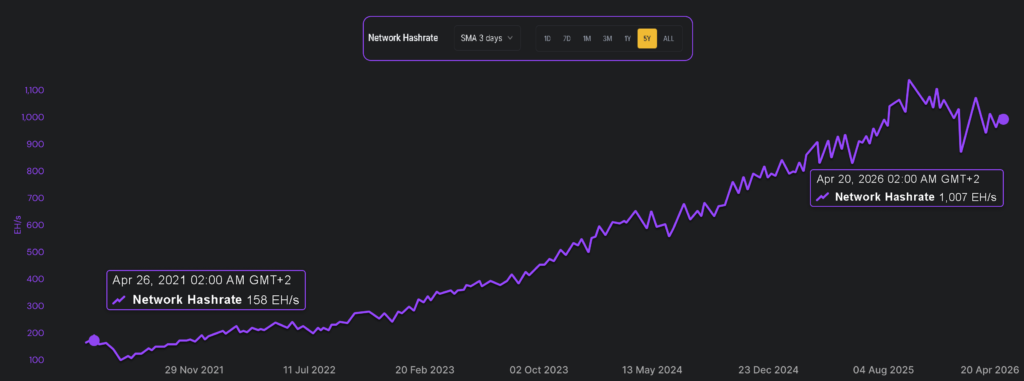
To understand what will happen next, we need to look back at what actually happened. Three engines drove the massive growth in hashrate.
1. The price of Bitcoin and market leverage
The first engine is purely economic. When the price of Bitcoin rises:
- margins explode
- miners reinvest
- new entrants arrive, but it takes time
So as long as profitability is high, capital flows into mining. The number of ASICs increases, and the hashrate therefore rises mechanically.
This reduces the profitability of the hashrate already in operation, which lowers investment and, in turn, future hashrate growth.
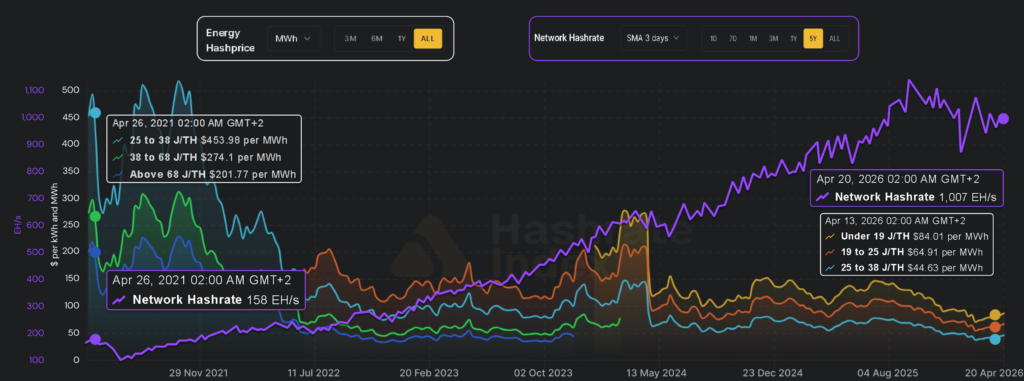
Between 2021 and 2026, Bitcoin mining went from a still relatively accessible activity to a highly competitive industry.
The hashrate was multiplied by roughly 6 (from ~158 EH/s to ~1000 EH/s). The result: revenue per unit of computing power has sharply deteriorated. Where energy was “worth” up to ~$450/MWh in 2021, we are now closer to ~$45 to $85/MWh in 2026 for comparable efficiency levels, a drop by a factor of 5 to 10.
On top of that, events such as the halving (visible around 2024) add even more pressure by abruptly cutting revenue in half. Mining therefore now operates as a low-margin industry, where operational performance matters far more than easy opportunities.
The rise in hashrate is thus a direct consequence of the sector’s overall profitability.
2. The technological leaps of ASICs
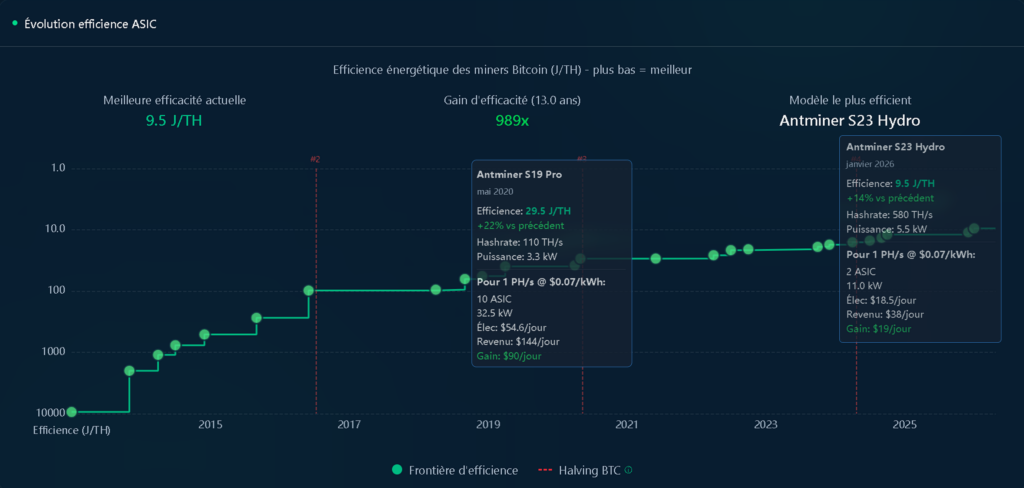
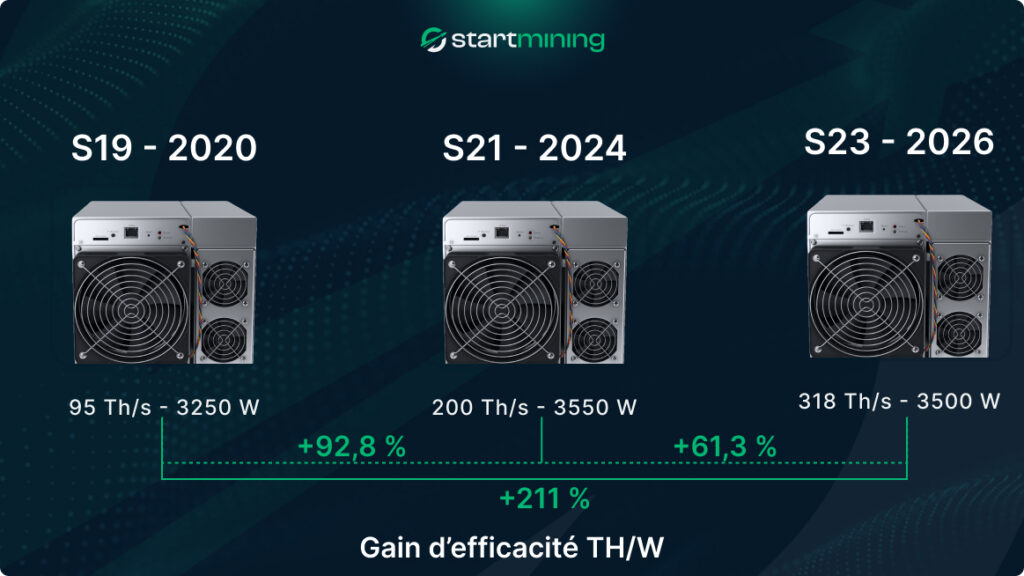
The second engine is technological. ASIC generations have followed one another with massive gains:
- more hashrate per ASIC (S19 = 100 TH vs S21 = 200 TH).
- lower consumption per TH (S19 = 34 J/TH vs S23 = 11 J/TH).
- a lower BTC production cost
Key result: the network was able to grow strongly without a proportional explosion in energy consumption. We wrote an article on this topic, available at the following link: Bitcoin Mining: Energy and ASIC Models. In other words: more power for similar energy and profitability.
3. The massive build-out of energy capacity
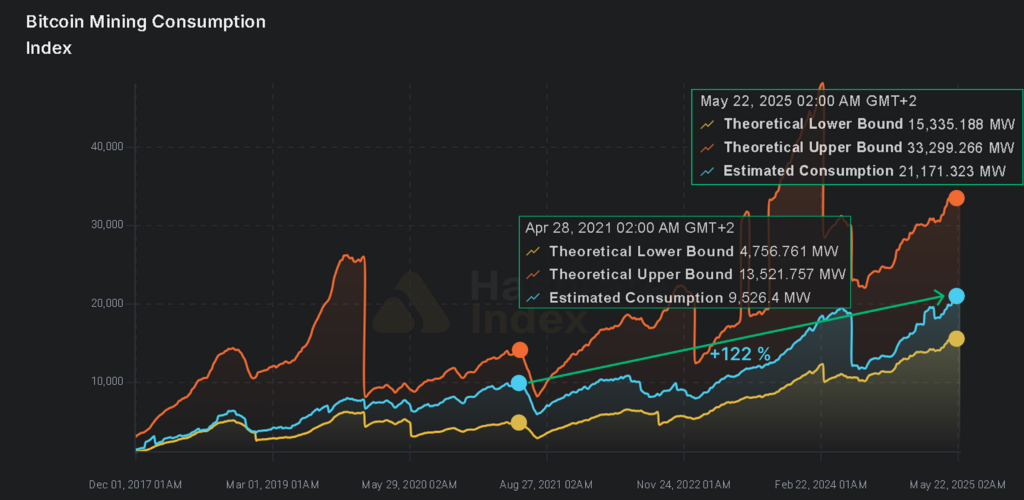
The third engine is often underestimated: the creation of new mining sites. Since April 2021, the estimated consumption of the Bitcoin network has “only doubled” (+122%) to reach 200 TWh/year, or less than 1% of global consumption (200/30,000). This capacity was able to emerge thanks to:
- the multiplication of industrial farms
- massive deployment in the USA (40% of global hashrate).
- expansion in Latin America
- the monetization of energy surpluses
The hashrate was not just optimized, it was industrialized. An extra 10,000 MW is the typical equivalent of:
- ~10 nuclear reactors (≈ 1 GW each)
- ~3,000 to 5,000 modern wind turbines (depending on power and load factor)
- ~100 km² of solar panels (order of magnitude)
- ~8 to 10 million households (depending on country and average consumption)
This growth rested on a simple balance: fast ASIC innovation + massive deployment capacity = profitability + investment. But in 2026, both of these levers are becoming more constrained.
PART 2 – ASIC innovation is slowing down (but not disappearing)
Innovation continues. But its nature has changed.
1. Efficiency gains that are smaller and smaller
For more than a decade, energy efficiency exploded.
But today:
- the gains are becoming marginal
- new generations optimize more than they revolutionize
We are moving from a logic of disruption to a logic of constant optimization.
Discover how Bitcoin mining has evolved since its creation.
2. A direct consequence: less “free” growth
Before: a new generation could double performance and therefore raw hashrate. Today: it improves things gradually. Refreshing the fleet still increases hashrate, but much less violently. Yet this slowdown is not the main limiting factor. The real bottleneck lies elsewhere. It sits in the ability to produce new chips and deploy these ASICs.
PART 3 – The real bottleneck: industrial capacity
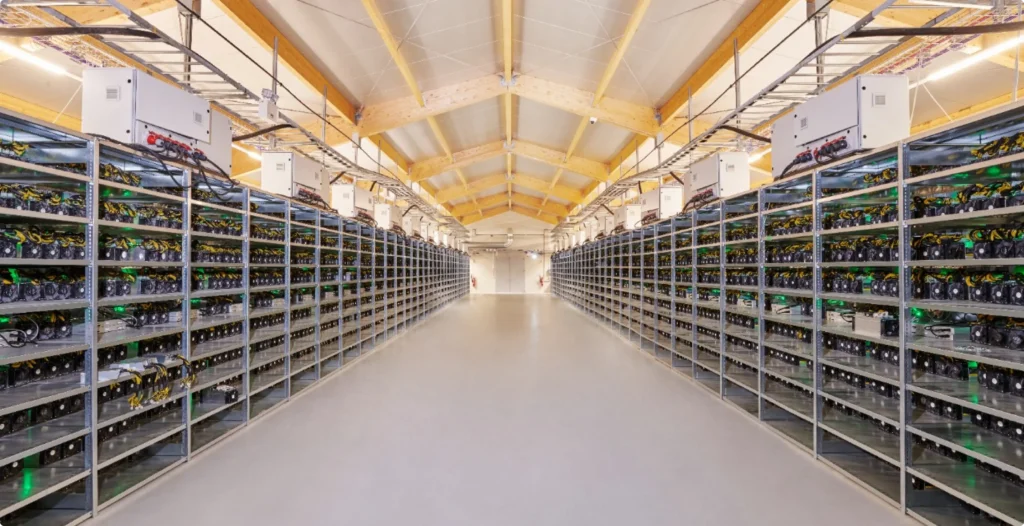
Hashrate does not depend on ASICs alone. It depends on the ability to line up simultaneously:
- chips
- energy
- infrastructure
- capital
1. Substitution vs expansion
We need to distinguish two types of growth:
Substitution: Replacing old ASICs with new ones → more hashrate → stable consumption.
Expansion: Adding new ASICs → new MW → new sites and new investments.
Since 2019, hashrate growth has rested mainly on expansion, but since the 2024 halving it has increasingly come through substitution.
2. Heavy and complex infrastructure
Deploying hashrate in 2026 involves:
- access to stable, cheap energy that is increasingly scarce
- high-voltage transformers and cooling systems
- land and permits
- international logistics
Mining has become a heavy industry. And this industrialization completely changes the rules of the game. Because this industry is no longer alone. It is now in direct competition with a far better-capitalized player: artificial intelligence!
To learn everything about hosting, read our hosting guide
PART 4 – AI: a new direct competitor to mining
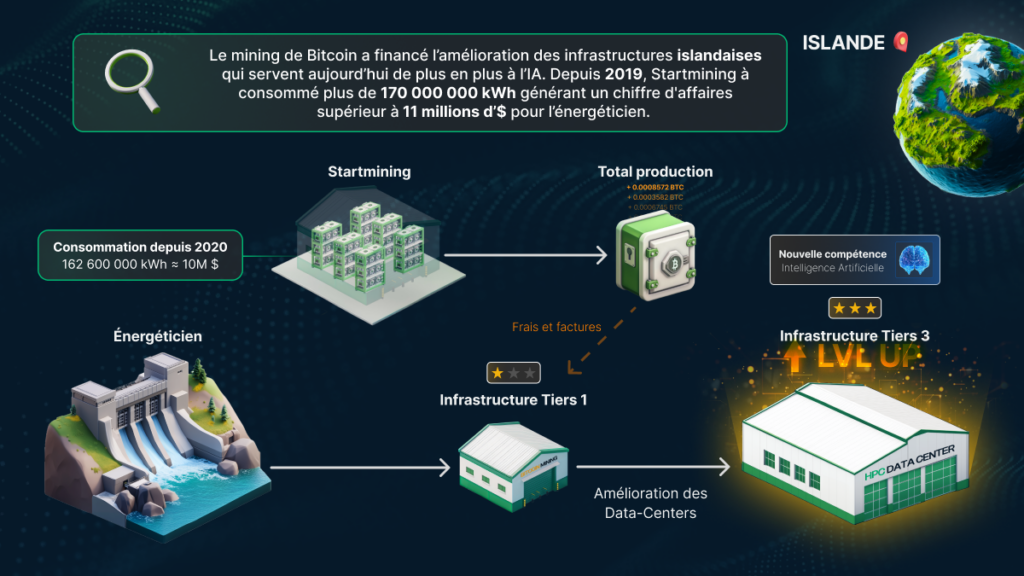
AI does not compete with mining on the single axis of profitability. It competes with mining over all of its critical resources.
1. Competition over semiconductors
- strong demand on foundries
- pressure on advanced capacity
- prioritization of AI chips
Less capacity available to produce new ASIC chips, plus pressure on costs and lead times. Even if mining profitability picks back up, production capacity may not keep pace with demand, as in 2021 (the Covid logistics crisis). If that happens, it will allow already-positioned miners to keep their margins a little longer.
2. Competition over infrastructure
Many mining players are moving toward operating HPC and AI data centers. Why? Revenue is more stable, the clients are institutional, and the value of each MW is higher.
Several mining players, including Core Scientific, have begun converting part of their infrastructure toward HPC and AI uses, directly repurposing their existing data centers.
Aggregated estimates point to several hundred megawatts already reallocated, although the precise figures remain limited and are often mixed in with future projects.
3. Competition over energy
AI data centers consume enormous amounts of power, run continuously, and demand high reliability. They capture the best energy sites. So mining does not disappear, but it has to share its resources.
PART 5 – The 3 scenarios for future hashrate
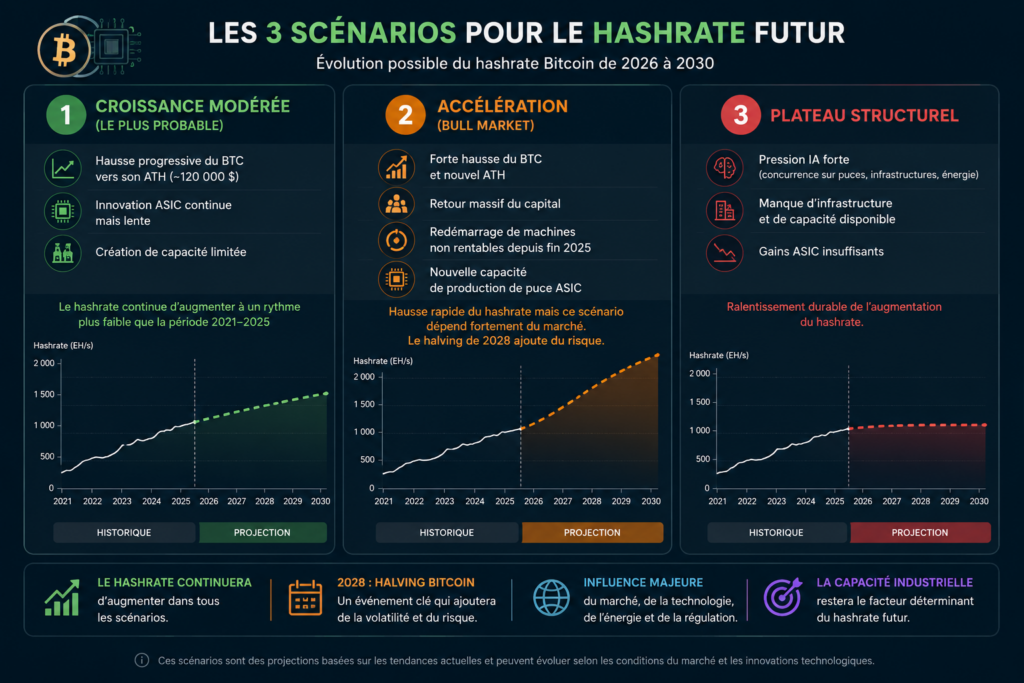
Scenario 1 – Moderate growth (the most likely)
- a gradual rise in BTC toward its ATH ($120,000)
- continued but slow ASIC innovation
- limited capacity build-out
The hashrate keeps rising, but at a slower pace than the 2021–2025 period.
Scenario 2 – Acceleration (bull market)
- a sharp rise in BTC and a new ATH
- a massive return of capital
- the restart of ASICs that have been unprofitable since late 2025
- new ASIC chip production capacity
A rapid rise in hashrate, but this scenario depends heavily on the market. On top of that, the 2028 halving adds risk in addition to Bitcoin’s volatility.
Scenario 3 – Structural plateau
- strong AI pressure
- a lack of infrastructure
- insufficient ASIC gains
A lasting slowdown in hashrate growth.
Conclusion
The Bitcoin hashrate can still rise in 2026. But for different reasons than in the past. It is no longer a simple technological race. It is a global industrial trade-off between AI needs and mining profitability. The hashrate will probably keep climbing, but its pace now depends on constraints that go beyond the mere price of Bitcoin.
Startmining’s takeaway
In this context, one thing becomes essential: understanding your production cost and simulating your scenarios is a must to anticipate the cycles. In the era of modern mining, performance is no longer guessed, it is calculated.
Test your assumptions with our simulator
Discover the ASICs available with hosting
Passez à l'action
Ready to mine Bitcoin with Startmining?
Browse our ASIC shop or simulate your profitability in real time.