New or Used Bitcoin ASIC Miner: Which Should You Buy?
Introduction
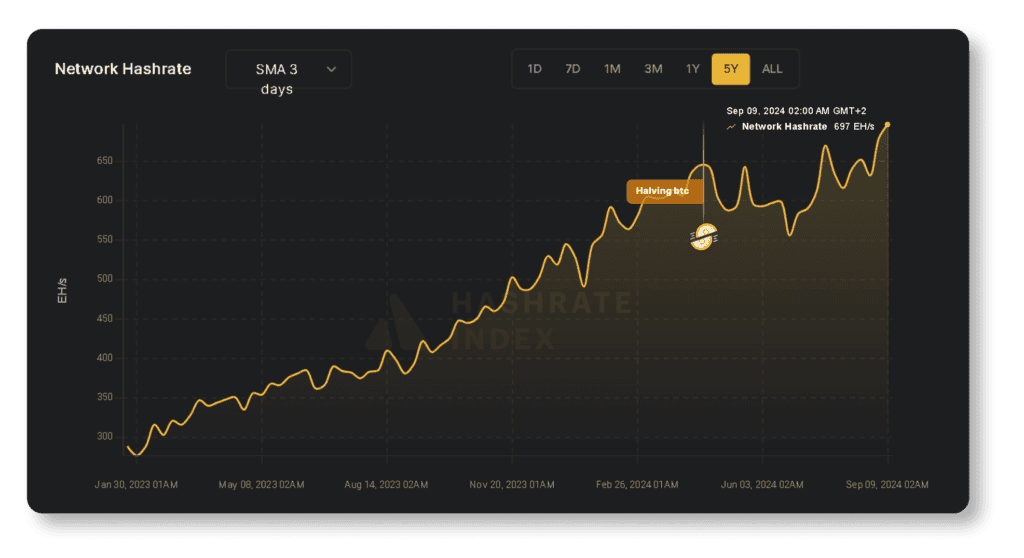
Ahead of a future bull market, should you buy new or used Bitcoin ASICs? According to Hashrate Index, Bitcoin’s hashrate reached an all-time high despite the reward cut from the April 2024 halving. This significant rise in hashrate further reduces miners’ revenue. Older Bitcoin ASIC generations (S19) are being replaced by newer ones (S21) while the future remains uncertain. That raises a key question.
Still finding the world of crypto and mining a little blurry? See how we got here in our article on the history of money, from barter to Bitcoin. And if you are wondering whether it is better to mine other proof-of-work coins, this guide is for you.
To achieve a positive return on investment and outpace the rise in Bitcoin’s price, miners build different strategies for acquiring mining power. Those strategies are directly tied to their operating environment.
Mining strategy: the role of ASIC efficiency, price and energy
The most profitable Bitcoin ASIC miners on the market
ASIC mining machines evolve quickly. With every mining cycle (halving), manufacturers announce new, more efficient models (more power for the same consumption). Releasing these new generations reduces the profitability of the previous ones. For miners paying around the industry-average energy price, their fleet quickly becomes obsolete — which energizes the used market.
Below are Bitmain’s ASIC models ranked by daily profit at an electricity price of $0.07/kWh. The early S19 series are barely profitable anymore (used ASICs), while the latest S21 models (with better efficiency) are profitable (new ASICs).
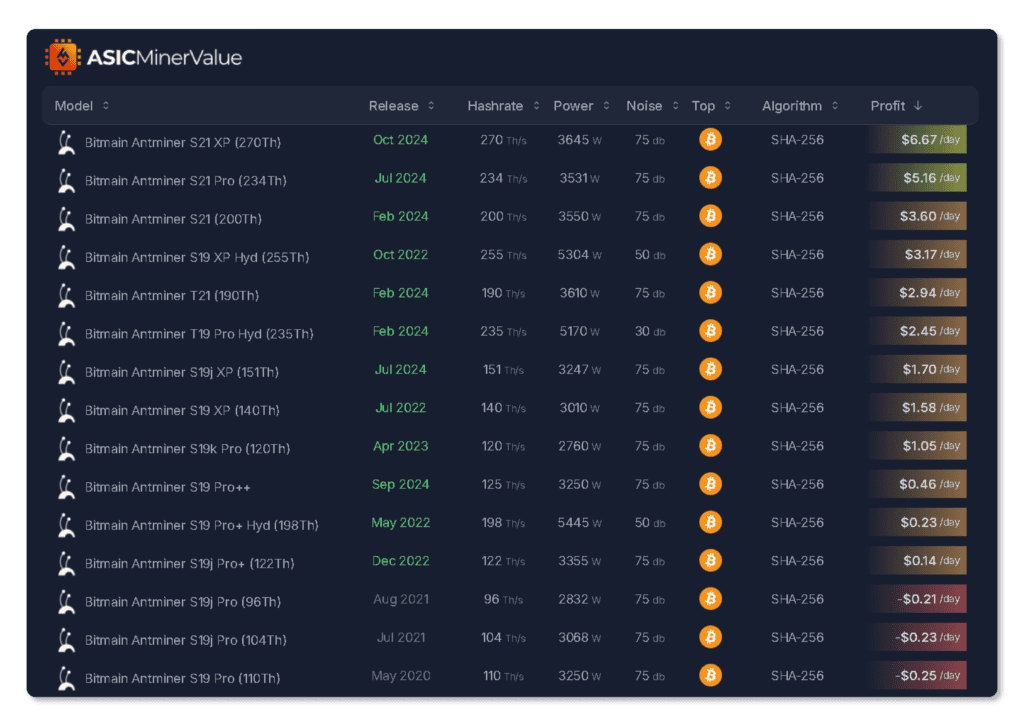
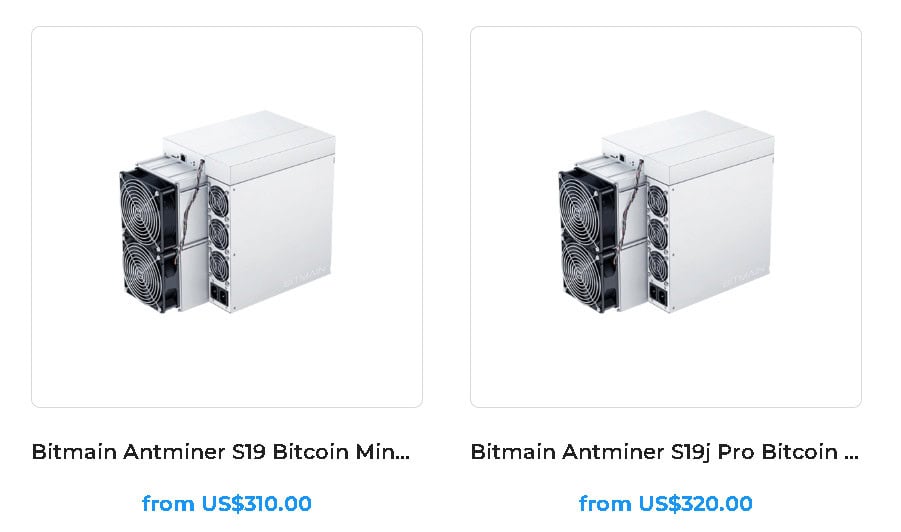
This ranking, built using asicminervalue, shows that older-generation mining machines are about to stop being profitable and are losing their appeal for a large category of Bitcoin miners. This is reflected on the used market by a considerable drop in the acquisition cost of the S19 series. According to the U.S. site BTminer, S19 ASICs were selling for under $500 in October 2024. So, new or used Bitcoin ASIC — which is the right choice?
The role of energy price in the profitability of new and used Bitcoin ASICs
Before looking at the used market in anticipation of a future bull run pushing Bitcoin to new highs (above $100,000), let’s compare how energy cost affects the daily profits of the ASICs above.
The table below, from asicminervalue.com, compares the daily profits of the same ASICs at an energy cost of $0.07/kWh and $0.02/kWh:
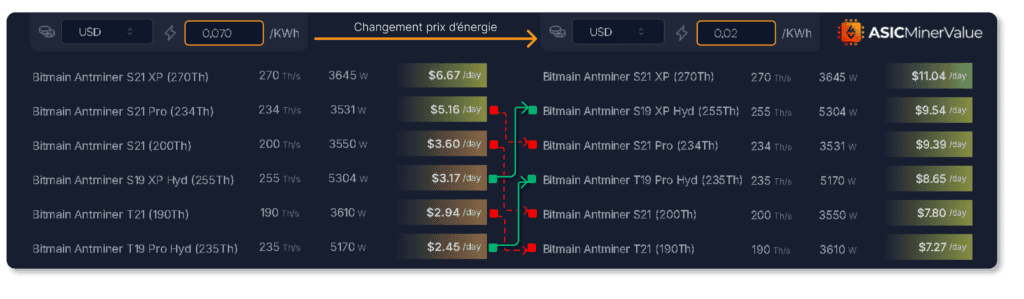
With a very low energy price, we can see that the used T19 Pro Hydro ASIC climbs two places in the ranking of the most profitable miners per day, overtaking a latest-generation model, the S21. The lower the energy price, the less an ASIC’s efficiency matters — and the more raw hashrate is what counts.
However, generating profit does not mean achieving a return on investment. The purchase price of a new or used Bitcoin ASIC matters just as much, because it determines how long the ROI takes given the daily profits earned. In our example ($0.02/kWh), where we deliberately extrapolate a very low energy price, a miner would be far better off buying older-generation used models. According to Bitmain’s site, they would benefit from a much lower purchase price per TH/s: $16 for the T19 Hydro versus $27 for the S21.
The role of upfront investment in ROI time
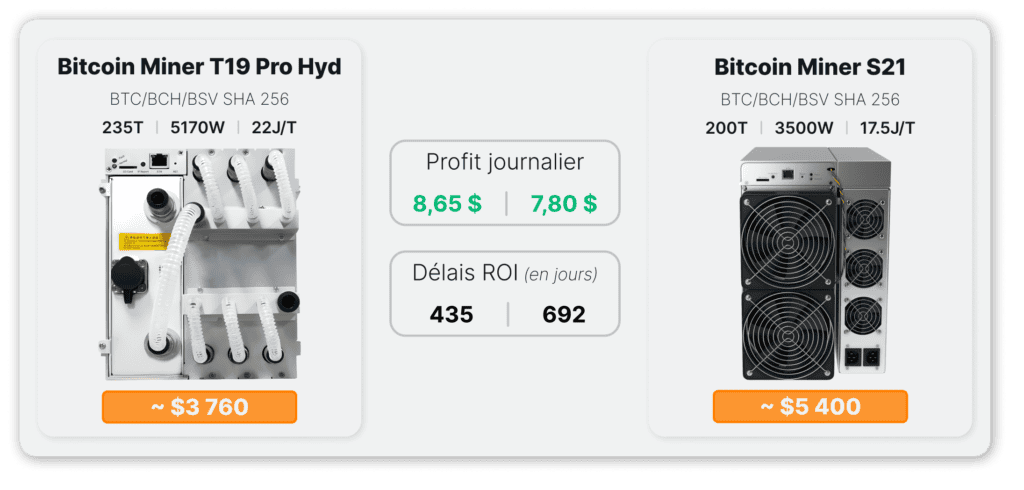
The lower the purchase price of mining power, the faster the ROI — provided the ASIC is actually profitable. We have seen that under current conditions (Bitcoin below $70k + an average energy price of $0.07/kWh), older-generation ASICs are barely profitable anymore. That explains the prices seen on the used market. Wondering whether it makes sense to boost an ASIC’s hashrate through overclocking — or to improve its efficiency with downclocking instead? Our guide on ASIC overclocking vs. downclocking is for you.
Bitcoin miners are, above all, investors betting on the success and price growth of Bitcoin, which they see as a next-generation asset. So what does the ROI of different ASIC generations look like in a bull market?
Which Bitcoin ASIC miner should you buy in a bull market?
Comparing the profits of the S19j Pro, S19k and S21 in a bull market
When a miner chooses an ASIC model, many factors come into play, in particular:
- Electricity cost: how much will it cost to run the ASIC each month?
- Hashrate: how much BTC can I produce given its power? Higher difficulty = lower revenue.
- Efficiency: how many watts does the ASIC draw to produce one hash? The lower the W/TH, the more efficient the ASIC.
- Price: how much does the ASIC cost to buy? What ROI will it deliver under given conditions?
- Lifespan: how long will the machine last? How long will it stay competitive before becoming obsolete?
- Profit: revenue − costs = profit. What is this machine’s break-even and production threshold, and at what energy price?
Each change in one of these criteria affects the production estimates of an ASIC, and a miner must factor that into their investment strategy.
To imagine a used-hardware acquisition strategy, we will compare three mining machines released in 2021, 2023 and 2024. For this simulation, we will pretend we bought all the miners at the same time, in September 2024.
We will project the value of their monthly output at an energy price of $0.07/kWh, for two scenarios: Bitcoin at $62k and Bitcoin at $150k. We do not account for any possible increase in difficulty between the two scenarios.
Profitability analysis of new and used Bitcoin ASICs
Here is a table comparing the profitability of three Bitcoin ASICs across two price scenarios:
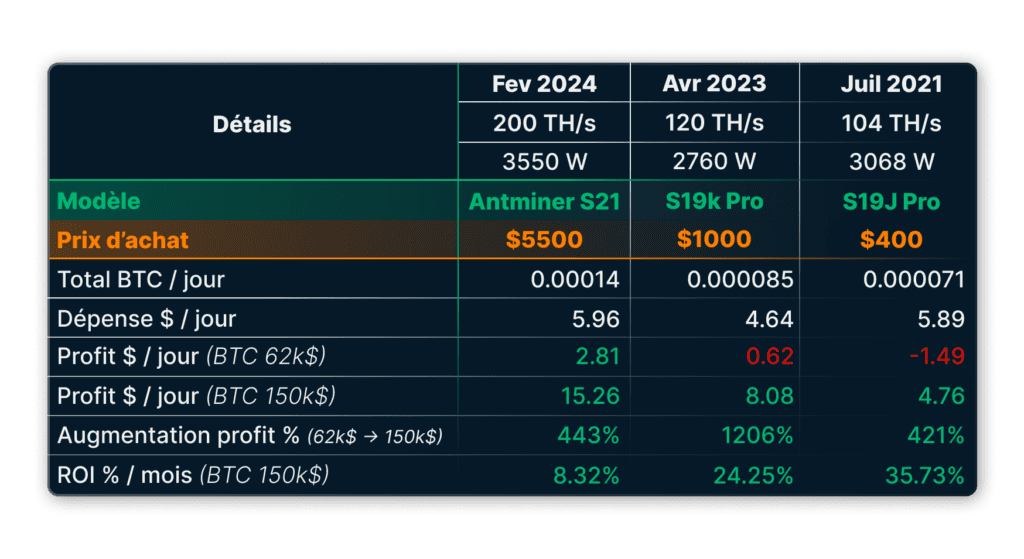
The first thing we notice is that the S19j Pro is unprofitable: in the $62k Bitcoin scenario, its production cost is far too high. In the $150k scenario, however, miner profits rise exponentially. With Bitcoin’s price multiplied by a little under 300%, the S19k Pro’s profits increase by around 1,200%.
The most interesting observation is the monthly return on investment in the $150k scenario. Miners with a very low acquisition cost quickly become highly profitable: the S19j Pro delivers a return four times higher than the S21, and the S19k Pro a return three times higher.
This table shows the role that an ASIC’s purchase price plays in a used-hardware investment strategy. That said, remember this scenario is hypothetical and depends on a strong bull market. One question remains: new or used, is it better to buy or to mine Bitcoin? Find out in our dedicated article.
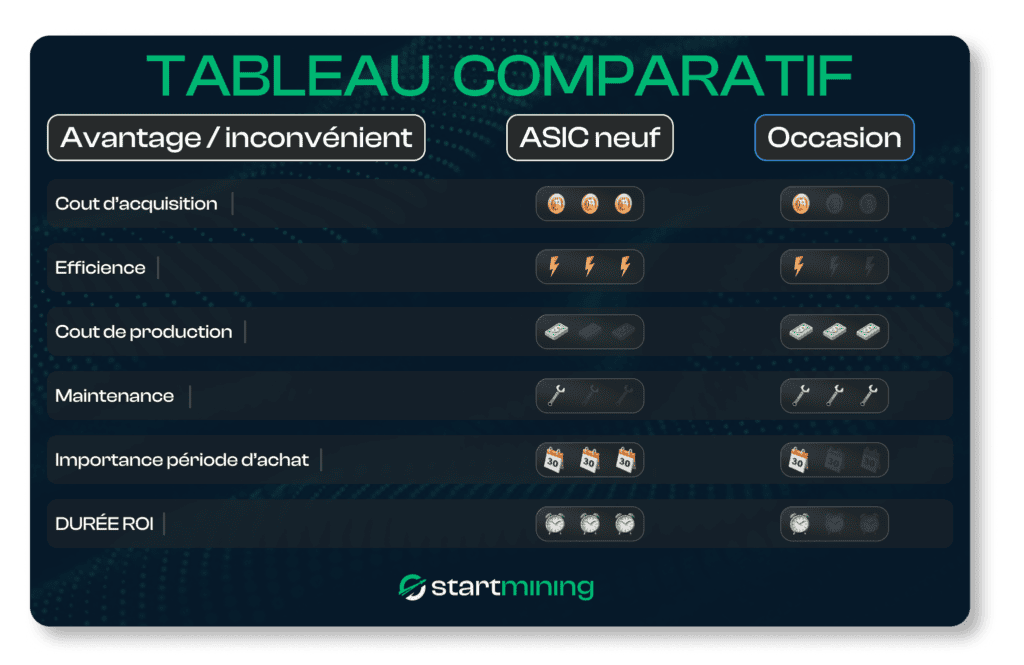
Pros and cons of a used Bitcoin ASIC
Pros:
- Low investment
- Faster ROI during profitable periods
- Most advantageous in a bullish environment
Cons:
- Unprofitable when hashprice is low
- Less efficient
- Higher risk of failure and repairs
Pros and cons of a new Bitcoin ASIC
Pros:
- Withstands an unfavorable market
- Fewer repairs and greater efficiency
- Longer ROI
Cons:
- High investment
- The timing of the purchase has a major impact on profitability
Conclusion
It is hard to be certain about the scale of a future bull market. The least risky investment is profitable over a longer period.
That means the most efficient hardware: latest-generation mining machines. Such an investment requires a compromise on upfront capital, but it stays profitable under current conditions.
We have seen that there are many variables and risks to factor in when setting up a profitable mining strategy. The simplest approach is to bet on efficient hardware. On the other hand, selling your older-generation equipment into a saturated used market means risking the loss of potential future profits.
The Startmining team is on hand to help you set up your mining strategy with a turnkey offer.
If you are interested in investing in this industry, our team is here to support you. Find our expertise on our website and discover our products and services.
Passez à l'action
Ready to mine Bitcoin with Startmining?
Browse our ASIC shop or simulate your profitability in real time.