H200 Server Profitability: Results from Two Startmining AI Servers
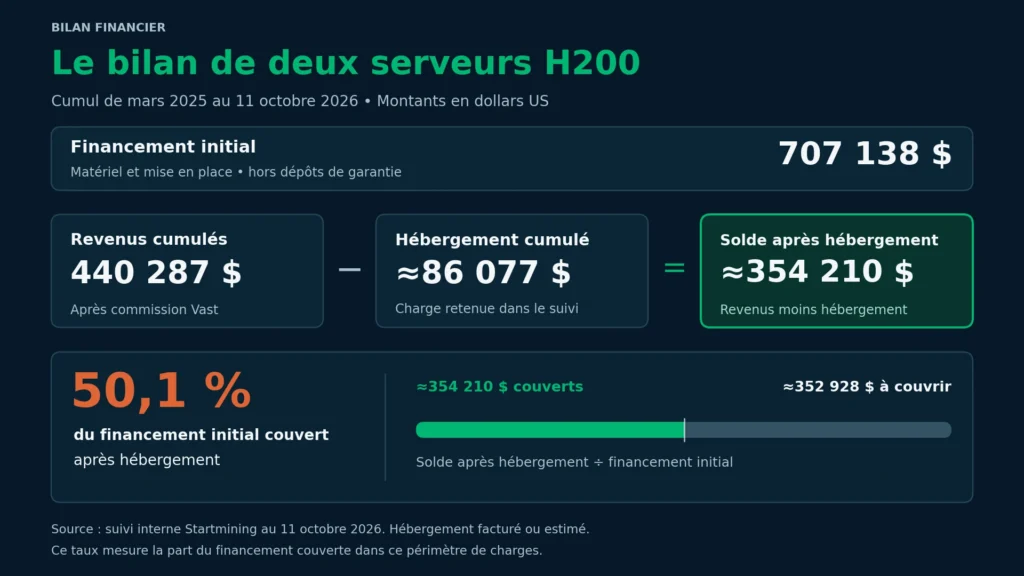
Two H200 AI servers deployed with Startmining generated $440,287 after platform commission from March 2025 to October 11, 2026. After the hosting costs included in the records, approximately $354,210 remained, covering 50.1% of the initial funding. These observed results depend on rentals, operating costs and the hardware’s remaining value.
In 2025, Startmining developed an AI computing offering with its existing clients and deployed a fleet of H200 servers. The first online AI server rental marketplaces provided benchmarks for building the project. Those assumptions still had to be tested against actual rentals.
This case study covers two servers owned by the same long-standing client, each equipped with eight H200 GPUs.
From March 2025 to October 11, 2026, they generated $440,287 in revenue after the platform’s commission. After deducting the hosting costs included in the financial records, the balance was approximately $354,210, or 50.1% of the initial funding. These results allow us to examine rental growth, operating costs and the hardware’s remaining value.
Why Startmining chose H200 servers
The conversion of an Icelandic data center from mining to AI created an opportunity to diversify. Startmining helped its existing clients finance and commission servers for this market. This transition concerns the site’s infrastructure: as we explain in our article on the shift from mining to AI, a Bitcoin ASIC cannot be turned into a GPU server.
When the project launched, H200s belonged to a generation of GPUs that had recently entered the market. Their appeal to renters during that period drove the choice. The team sought to offer hardware for which it was already seeing user interest.
The client in this case study financed two Dell PowerEdge XE9680 servers with eight H200s each, for a total of 16 GPUs. These graphics processors provide the computing capacity offered to renters on Vast.ai.
Startmining handled project planning, supplier sourcing and quotes, followed by ordering and logistics. Its support also covered installation, configuration and turnkey hosting, along with ongoing client support.
The initial funding for the hardware and setup totaled $707,138 for the two servers, excluding security deposits, or $353,569 per server on average. The averages presented in this article are the combined results of these two servers divided by two.
On a marketplace such as Vast.ai, revenue depends on the rental rate achieved, the time actually rented and service reliability. Simply bringing a server online does not guarantee regular revenue.
Why users rent GPUs
GPUs can be used for training, which adjusts a model using data, or inference, which uses a trained model to produce a response, image or prediction. Pretraining is the initial phase in which a model learns general capabilities. These workloads require computing power, which users can rent without buying servers.
These examples explain the appeal of renting; the records examined do not detail the tasks performed by each renter.
The initial challenge was turning demand into sustained rentals
The prices and offerings visible on marketplaces provided a basis for comparison. However, our own track record was still too limited to confidently estimate the rental time and revenue we would achieve over the long term.
Competition added uncertainty: rising demand could be outpaced by new capacity entering the market. If too many servers were offered at once, rental rates or utilization could fall. The launch therefore needed to establish the prices at which H200s would attract users, and how consistently.
Revenue and costs for the two servers
Revenue includes GPU rentals, storage and bandwidth. It is recorded in the Vast.ai tracking data after the platform’s commission and before hosting, which is invoiced or estimated in the financial records.
| Metric as of October 11, 2026 | Both servers studied | Average per server |
| Initial funding and setup | $707,138 | $353,569 |
| Cumulative revenue after Vast’s commission | $440,287 | $220,143 |
| Cumulative hosting costs included | ≈$86,077 | ≈$43,039 |
| Cumulative balance after these hosting costs | ≈$354,210 | ≈$177,105 |
| Initial funding still to be recovered through operations | ≈$352,928 | ≈$176,464 |
The balance after hosting is revenue minus that cost. It represented 50.1% of the initial funding as of October 11, 2026.
Rental income had therefore covered approximately half the funding within this cost scope. This percentage measures capital recovery; it is neither an annual return nor net profit after recovering the initial investment.
Monthly revenue is growing
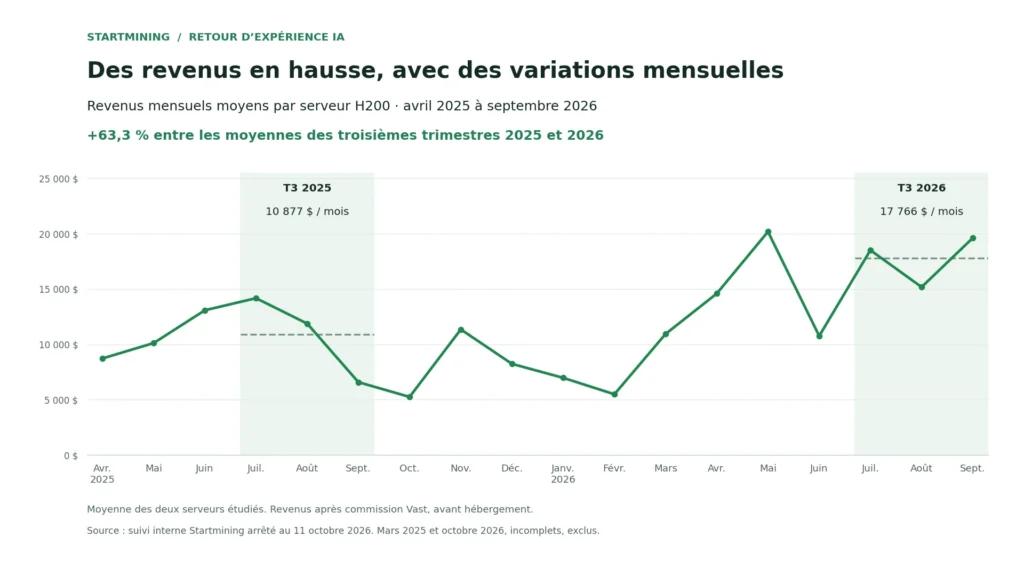
Average monthly revenue per server rose from $10,877 in the third quarter of 2025 to $17,766 in the third quarter of 2026, an increase of 63.3%. The comparison covers two complete July-to-September periods.
| Monthly average per server | July to September 2025 | July to September 2026 |
| Revenue after Vast’s commission | $10,877 | $17,766 |
| Hosting costs included | ≈$2,319 | ≈$2,258 |
| Balance after these hosting costs | ≈$8,558 | ≈$15,508 |
Over the same periods, average monthly hosting costs remained similar, while the balance after hosting increased by 81.2%. The improvement therefore came mainly from higher recorded revenue. In the third quarter of 2026, the two servers together generated approximately $31,016 per month after these hosting costs.
Average monthly revenue per Startmining H200 server
Average monthly revenue per server, after Vast’s commission and before hosting. The shaded areas identify the two quarters being compared. March 2025 and October 2026 are excluded from the chart because they are incomplete.
Growth remained uneven: average revenue per server reached approximately $18,508 in July 2026, fell to $15,178 in August, then rose to $19,612 in September.
These fluctuations show why several months need to be tracked. Total revenue alone cannot distinguish the effects of rental rates, time rented and server availability.
Consistent rentals remain essential
From July 21 to October 11, 2026, the average share of GPUs rented reached approximately 79.7% across the two servers studied, weighting daily rates by the number of available readings. This indicator describes the documented period and complements the revenue figures.
AI and mining revenue depend on different markets
For an investor familiar with mining, the common ground is tangible: financing hardware, paying operating costs and tracking revenue retained after expenses. Our ASIC comparison explains this distinction between operating margin and capital recovery.
The revenue mechanism differs: an ASIC contributes to Bitcoin mining, often through a pool, whereas an AI server generates revenue when a user rents its resources.
| Factor | Bitcoin mining | AI computing rentals |
| Revenue basis | Quantity of BTC received, then valued at the market price | Resources actually rented and rates charged |
| Effect of competition | A sustained increase in network hashrate can raise difficulty and reduce expected output per unit of computing power | New competing servers can put pressure on prices and utilization |
| Demand to monitor | Demand for BTC influences its price; transactions contribute to the fees miners receive | Computing needs influence rentals, depending on hardware, pricing and service |
In both activities, rising demand does not guarantee a better margin for every operator. This study quantifies the AI case; comparing payback periods with mining would require an ASIC investment observed over the same period, with a comparable budget and costs.
How hardware value affects the financial picture
After revenue and hosting costs, approximately $176,464 per server remains to be recovered. This amount is the break-even threshold in the calculation including hardware value, before other excluded costs and obligations: $353,569 committed per server, minus approximately $177,105 in cumulative operating balance.
The value to estimate is that of a complete Dell PowerEdge XE9680 with eight H200s. It depends on factors including configuration, condition and sale terms.
As a reference point, a RegenTech IT listing on Tradeloop, accessed on October 13, 2026, advertises $217,000 per Grade A server, with a minimum order of ten units. Published approximately seven months earlier, it is not a buyback offer for the two servers studied.
Server-parts.eu gives a range of €120,000 to €160,000 depending on configuration. These references, quoted in different currencies and without confirmed transactions, do not establish a reliable market average.
Several assumptions in dollars illustrate how this value affects the financial picture. The $217,000 listing reference is included among these scenarios, with no guarantee of resale and no future rental revenue added.
| Assumed value of the complete server | Balance after hosting + hardware value, per server | Difference from the $353,569 committed |
| $150,000 | ≈$327,105 | ≈−$26,464 |
| ≈$176,464 — calculation threshold | ≈$353,569 | ≈$0 |
| $200,000 | ≈$377,105 | ≈+$23,536 |
| $217,000 — listing reference | ≈$394,105 | ≈+$40,536 |
| $250,000 | ≈$427,105 | ≈+$73,536 |
The financial picture is therefore sensitive to the hardware’s realizable value. The differences shown in the table remain theoretical, before other costs and obligations not included; they are neither realized profit nor funds immediately available to the client.
What this experience taught us
The project turned rental assumptions into observable revenue. For Startmining, the main lesson is to track hardware appeal, actual rentals and operating costs together. Choosing a recent generation addressed user interest identified at launch; the consistency of revenue then had to be assessed over time.
Operations covered approximately half the initial funding within the scope studied. Revenue in recent months has accelerated this progress, but its variability and the servers’ future value remain decisive for the final outcome.
Our next article will explore where AI server revenue comes from, from pretraining to inference: who rents this computing power, for which workloads and under what constraints?
Would you like to explore a GPU server project? Talk to the Startmining team about hardware, hosting and operating conditions.
Method: internal Startmining data through October 11, 2026, for two servers owned by the same long-standing client. Revenue after the rental platform’s commission reconciled against monthly totals; hosting invoiced or estimated according to the records. Currencies converted according to the file’s conventions; calculations performed before rounding, with amounts shown to the nearest dollar. The chart covers complete months from April 2025 to September 2026 only. Used-hardware references accessed on that same date, without a confirmed sale or buyback offer.
Passez à l'action
Ready to mine Bitcoin with Startmining?
Browse our ASIC shop or simulate your profitability in real time.