Bitcoin Mining Difficulty Is Falling: Why It Is Dropping and What It Changes for Miners

As of 31 August 2026, Bitcoin mining difficulty stands at 125.81 T, roughly 19.3% below its all-time high of 155.97 T reached on 29 October 2025. For a network whose computing power and difficulty had risen almost continuously for years, that decline is unusual: according to Hashrate Index, 2026 is only the second period in Bitcoin’s history in which difficulty has fallen year over year, after the 2021 China ban.
A falling difficulty does not mean Bitcoin is “working less well”. It means the protocol is adapting to computing power that is lower, or more intermittent. For miners who stay connected, that adjustment directly changes how much BTC a given TH/s can expect to produce.
Since late 2025 the network has been absorbing both temporary energy-driven curtailments and deeper economic pressure on the least efficient hardware. We analysed the drop in computing power itself separately, in “Bitcoin hashrate down 25%: just a dip, or a real signal?”. The question here is a different one: how does difficulty react to that contraction, and who benefits from the adjustment?
In brief
- Bitcoin difficulty is about 19.3% below its October 2025 record as of 31 August 2026.
- At an unchanged individual hashrate, moving from the record difficulty to 125.81 T corresponds in theory to roughly 24% more BTC produced per TH/s, all else being equal.
- That production gain does not automatically make mining profitable: ASIC efficiency, the price per kWh, uptime and the remaining costs still decide the outcome.
Bitcoin difficulty: where the network stands on 31 August 2026
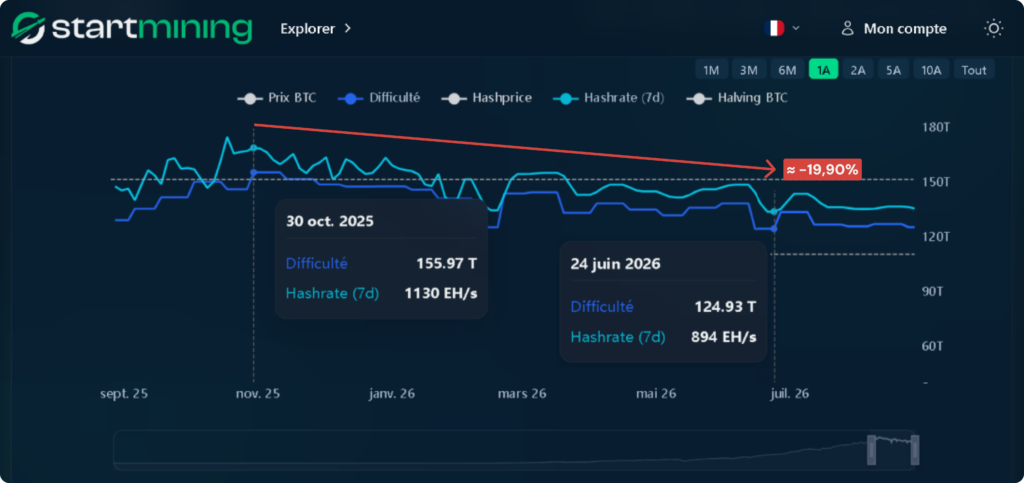
On 29 October 2025, Bitcoin difficulty hit a record 155.97 T, documented in Luxor’s October 2025 Hashrate Lookback. After several negative adjustments during 2026, the 23 August retarget brought it down to 125.81 T, a further 1.31% decline versus the previous epoch.
Measured against the October record, the decline observed on 31 August therefore reaches roughly 19.34%:
(125.81 / 155.97 − 1) × 100 = −19.34%
The T in 125.81 T stands for trillion, so roughly 125.81 trillion on the difficulty scale. Difficulty is not a power figure and has no physical unit comparable to hashrate. It should therefore not be confused with TH/s, which measures a computing speed.
Difficulty is also a steadier thing to track than an instantaneous hashrate estimate. Computed hashrate varies with block luck and with the measurement window. Difficulty, by contrast, stays fixed for an epoch of 2,016 blocks before being readjusted.
A decline does not necessarily mean that every affected ASIC has been switched off for good, however. Part of the hashrate can disappear temporarily during periods of voluntary power curtailment, then return. A run of negative adjustments spread over several months is a more structural signal.
How does the Bitcoin difficulty adjustment work?
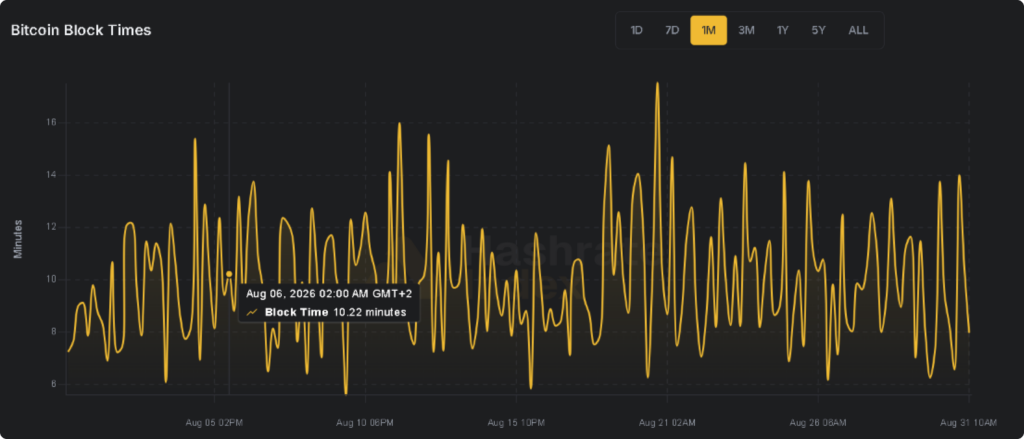
Bitcoin targets an average pace of roughly one block every ten minutes. To hold that pace, the protocol periodically readjusts proof-of-work difficulty.
After each interval of 2,016 blocks, Bitcoin compares the time actually taken to produce that sequence with the target time. If blocks were found too quickly, difficulty rises. If they were found too slowly, it falls. The mechanism and its limits are implemented directly in Bitcoin Core.
Difficulty is therefore not the cause of a hashrate decline. It is the response to it.
When a significant amount of computing power leaves the network, blocks tend to be produced more slowly. At the next retarget, Bitcoin lowers difficulty. At an unchanged individual hashrate, each TH/s then represents a larger share of the global competition.
Three notions need to be kept apart:
- hashrate measures the computing power deployed on the network;
- difficulty determines how hard it is to find a block;
- hashprice measures the revenue a unit of hashrate can generate over a given period.
A falling difficulty can improve hashprice denominated in BTC, but it guarantees neither higher dollar revenue nor net profitability. The bitcoin price, transaction fees, electricity, hosting, ASIC efficiency and uptime all remain decisive.
Why is Bitcoin difficulty falling so much in 2026?
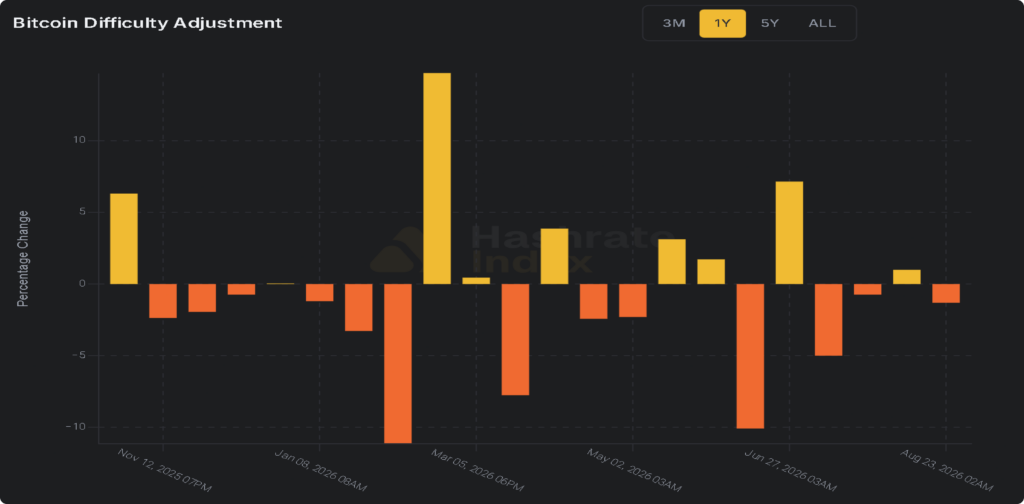
What makes 2026 exceptional is not a single retarget, but their repetition.
In February, difficulty fell by 11.16%. In March, another negative adjustment of 7.76% followed. On 14 June the network took a 10.09% drop, from 138.96 T to 124.93 T. In July, difficulty fell again by 5.00%, then by 0.74%. After a 0.99% rebound on 8 August, the 23 August retarget cut it once more by 1.31%.
That sequence is documented in Hashrate Index’s February, June and July 2026 analyses.
Two phenomena overlap.
The first is temporary: miners can voluntarily cut consumption when the power grid is under strain, then reconnect. The 4CP events in Texas encouraged that kind of load reduction over the summer, as Hashrate Index explains in its July analysis.
The second is economic. With hashprice hitting new lows, some ASICs become marginal. Hashrate Index noted in June that fleets in the 25 to 38 J/TH range were particularly exposed to economic shutdowns under its average power-cost assumptions.
J/TH measures the energy needed to produce one terahash of computation. The lower the figure, the more efficient the ASIC.
The 2026 difficulty decline therefore reflects both MW temporarily curtailed and TH/s leaving because their economics no longer hold.
Difficulty drops in 2021 and 2026: same mechanism, very different causes
The comparison with the China ban is useful precisely because the protocol responds in the same way to two very different industrial shocks.
| China ban, 2021 | Contraction, 2026 |
| Political and geographic shock | Economic, energy and industrial pressure |
| Farms have to leave China | ASICs become marginal, or MW are repurposed |
| Most of the hardware remains economically viable | Less efficient generations are hit directly by low hashprice |
| Main goal: relocate and reconnect the hardware | Trade-off between mining, ASIC renewal and sometimes AI/HPC |
| Record difficulty adjustment of −27.94% | A run of negative adjustments over several months |
In July 2021 the network went through the largest negative difficulty adjustment in its history: −27.94%. For miners who stayed connected, Hashrate Index estimates that hashprice denominated in BTC rose by roughly 69% after that adjustment.
The essential difference lies elsewhere. In 2021, most of the hardware mainly needed to be relocated. In 2026, some ASICs are leaving the network because their economics no longer work, while certain operators now have another potential destination for their infrastructure and their access to power: AI and high-performance computing.
Bitcoin’s adjustment mechanism is the same. The industrial cause is not.
What a difficulty drop really changes for an ASIC
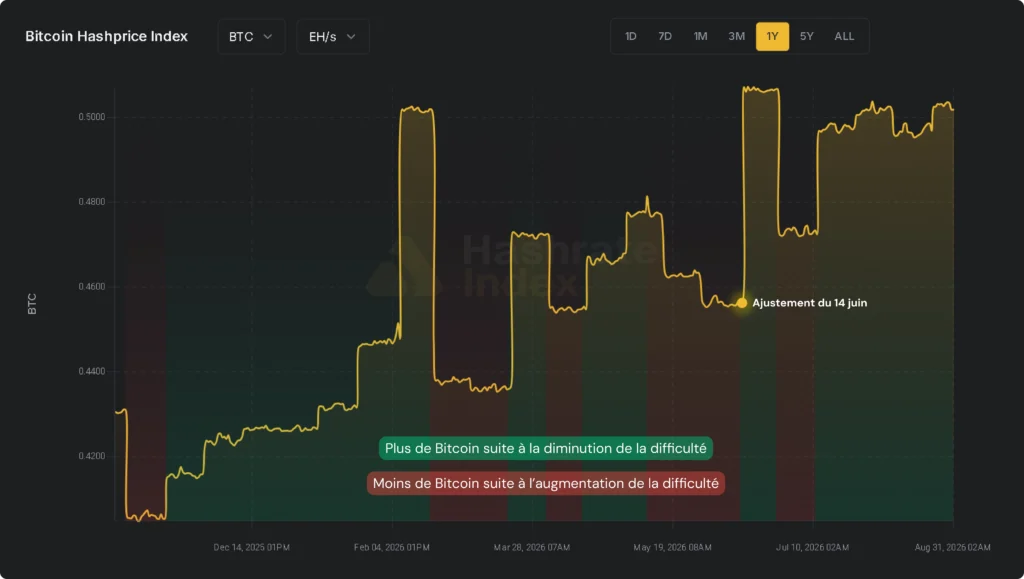
This is where a difficulty drop becomes concrete.
At constant block rewards, transaction fees, uptime and individual hashrate, a miner’s expected production moves roughly inversely to difficulty. If difficulty falls, the same TH/s represents a larger share of the power competing for blocks.
Take the 14 June adjustment: difficulty fell by 10.09%. The theoretical improvement in production per TH/s is not 10.09%, but: 1 / (1 − 0.1009) − 1 = +11.22%
A miner keeping exactly the same hashrate after that adjustment could therefore expect, all else being equal, roughly 11.2% more BTC per unit of computation.
Between the 155.97 T record and the 125.81 T level observed on 31 August 2026: 155.97 / 125.81 − 1 = +23.98%
At that difficulty level, a TH/s can therefore in theory produce roughly 24% more BTC than if the network had stayed at the record difficulty of October 2025.
| Difficulty drop | Theoretical increase in BTC produced per TH/s |
| −5% | +5.3% |
| −10% | +11.1% |
| −15% | +17.6% |
| −20% | +25.0% |
Methodology note. These calculations isolate the effect of difficulty alone. They assume constant block rewards, fees, individual hashrate and uptime. They measure a theoretical change in BTC production, not a change in net profit.
Better production per TH/s can therefore still fall short of covering costs if the bitcoin price drops or if the ASIC draws too much power.
Why hardware and the price per kWh decide who really benefits
Two miners can benefit from the same difficulty adjustment and end up with very different economics.
A modern ASIC and an older generation gain the same relative advantage per TH/s when difficulty falls, but they do not consume the same amount of electricity to produce that TH/s.
The critical variable therefore becomes: ASIC efficiency × real price per kWh.
On top of that come uptime, pool fees, hosting, maintenance and the cost of capital. Our analysis “Is Bitcoin mining profitable in 2026?” breaks those variables down, while our Bitcoin ASIC comparison lets you weigh hardware generations against their energy efficiency.
In June 2026, Hashrate Index observed that fleets in the 25 to 38 J/TH range were particularly fragile under its average energy-cost assumptions.
A difficulty drop therefore acts as a redistribution: it does not turn a bad production cost into a good one, but it improves the relative position of those able to stay online while other ASICs drop off.
Can AI/HPC slow the return of difficulty and hashrate?
This is probably the most important structural difference from previous cycles.
Through much of mining’s industrialisation, an operator with capital, transformers, a grid interconnection and land had one obvious destination for that capacity: adding ASICs.
In 2026, that is no longer automatic.
CoinShares estimates that more than 70 billion dollars of AI/HPC contracts have been announced across the listed mining sector. In its scenario, some players could draw up to 70% of their revenue from AI by the end of 2026. That figure is a projection, not revenue already booked, but it illustrates the potential shift in capital allocation.
Figures published by TheEnergyMag point the same way. Across the cohort of listed miners it tracks, realised hashrate fell from 368.3 EH/s in Q4 2025 to 319.0 EH/s in Q2 2026, a 13.4% decline. Excluding Bitdeer, whose capacity grew sharply, the rest of the cohort is down 21.2%.
Riot Platforms is a particularly visible example. In August 2026, the group officially announced a 20-year data centre lease covering 191 MW of IT capacity in Rockdale, Texas, for roughly 9.1 billion dollars of contracted revenue over the initial term. Riot does not publicly name the customer; Bloomberg identified it as Anthropic, as also reported by The Block.
That kind of deal changes the equation. A MW already connected is no longer necessarily a future MW of SHA-256. It can become a MW of AI compute.
Not every mining farm can be converted easily into an AI data centre: redundancy, networking, cooling, building and capital requirements all differ. But the existence of a credible economic alternative now changes investment trade-offs.
Would a bitcoin rally automatically push difficulty back up?
A rising bitcoin price is still probably the most direct lever for improving mining economics. If BTC recovers far enough, marginal hardware can reconnect, operators can accelerate ASIC purchases, and new energy projects can become financeable again.
But “the price goes up, so hashrate and difficulty immediately go parabolic again” has become too simple a conclusion.
Growth also depends on ASIC availability and efficiency, on access to competitive MW, on infrastructure lead times, on the cost of capital and, for some sites, on competition from AI/HPC.
That is what we set out in “Can the Bitcoin hashrate still rise in 2026?”.
A rise in BTC can therefore reverse the contraction and, with a lag, push difficulty back up. It does not guarantee an immediate return to the growth rate seen through much of the 2021–2025 industrialisation phase.
Falling difficulty: opportunity or false signal for a miner?
The difficulty drop observed on 31 August 2026 favours miners who stay connected, but on its own it is not a sufficient buy signal.
The right reasoning is not: “difficulty fell 19%, so mining is profitable”.
It is rather: “network competition is weaker than at the peak; do my ASIC and my energy cost let me take advantage of it?”
The choice of infrastructure therefore matters as much as the choice of hardware. Our guide to Bitcoin miner hosting details the main criteria to examine when comparing hosting options.
The 2026 situation can thus open an interesting window for some operators: network competition is weaker than at the peak, several ASIC generations are under heavy economic pressure, and part of the industry’s capital is moving towards other forms of computation.
But the real advantage does not come from betting on difficulty. It comes from positioning: the right hardware, at the right energy price, with infrastructure able to stay online when others no longer can.
That reasoning follows directly from our comparison “Buy or mine Bitcoin in 2026?”.
To test that positioning with your own assumptions, the Startmining simulator lets you compare your ASIC, your power cost, your fees and network conditions across different scenarios. A simulation does not predict future returns; it shows which variables actually make your ASIC’s economics hold up, or not.
Passez à l'action
Ready to mine Bitcoin with Startmining?
Browse our ASIC shop or simulate your profitability in real time.