How to Mine Bitcoin in 2026: A Complete Beginner’s Guide
Bitcoin mining fascinates as much as it intrigues. Since the network was created in 2009, millions of computers around the world have taken part in securing the blockchain while generating new bitcoins. But in 2026, mining bears no resemblance to the early days when you could mine from a simple personal computer.
Today, the activity has professionalized: specialized machines (ASICs), industrial mining farms and a global competition for access to the cheapest electricity. Yet it’s still possible for an individual to understand, join and even take part in this ecosystem.
In this complete guide, you’ll learn how to mine Bitcoin, understand how Bitcoin mining works, and learn how to launch your first mining machine. Whether you want to mine Bitcoin at home or understand how modern Bitcoin mining works, this guide explains everything step by step:
- what Bitcoin mining really is
- what hardware you need to start
- the concrete steps to launch your first miner
- how to calculate mining profitability
- the difference between mining at home or in a hosting farm
What is Bitcoin mining, and how do you mine Bitcoin?
Bitcoin mining is the process that secures the Bitcoin network and validates the transactions made between users. In concrete terms, computers perform billions of calculations per second to solve a cryptographic problem. The first miner to find the solution validates a new block of transactions and receives a reward in bitcoins.
This mechanism is the core of how Bitcoin works. Without miners, there would be neither transaction validation nor the creation of new bitcoins.
The role of mining in the Bitcoin network
Mining serves three essential functions.
Validating transactions
The transactions sent on the Bitcoin network are grouped into blocks. It’s the miners who verify that these transactions are valid before including them in a block added to the blockchain (the set of valid blocks).
Securing the blockchain
Thanks to the computing power mobilized by miners, it becomes extremely hard to alter the transaction history. At the end of 2025, the Bitcoin network’s power represented billions of euros of investment in computer hardware and as much again in electricity to run it. This security rests on a mechanism called Proof of Work.
Creating new bitcoins
Mining is also the process by which new bitcoins enter circulation. With each validated block, a reward is given to the winning miner. Just like gold, you must consume energy (to solve the cryptographic problem) to extract Bitcoin by validating a block. That’s what gave the activity the name “mining.”
How Proof of Work works
Proof of Work is the consensus mechanism used by Bitcoin. For each new block, miners must solve a mathematical problem: finding a valid hash for a given block. To do so, the machines constantly test different combinations of numbers called nonces. Each attempt produces a hash. If that hash meets the conditions imposed by the network (the difficulty), the block is considered valid.
The higher a miner’s computing power (measured in hashrate — the number of hashes calculated per second), the better their chances of finding the solution before the other participants.
The block reward and the halving
When a miner validates a block, they receive a block reward made of two parts: the fixed bitcoin reward distributed by the protocol, and the transaction fees (paid by users) contained in the block. However, with the Bitcoin protocol, this reward decreases over time through a mechanism called the halving. Roughly every four years, the block reward is cut in half. This mechanism limits the issuance of new bitcoins and guarantees that the total supply of Bitcoin will never exceed 21 million units.
Today, mining profitability therefore depends on a balance between several factors: the power of the machines used, the cost of electricity, network difficulty and the price of Bitcoin.
Can you still mine Bitcoin in 2026?
The question comes up often: is it still possible to mine Bitcoin today? The answer is yes, but under very different conditions from the network’s early days. In the early 2010s, you could mine Bitcoin with a simple personal computer. Competition was low and network difficulty very low. Over time, the ecosystem structured itself and competition between miners intensified.
Today, mining has become a true global industry resting on three key elements:
- extremely powerful specialized machines (ASICs)
- access to cheap electricity (which determines an ASIC’s production cost)
- constant optimization of the mining infrastructure (cooling, maintenance, etc.)
How mining has evolved since 2010
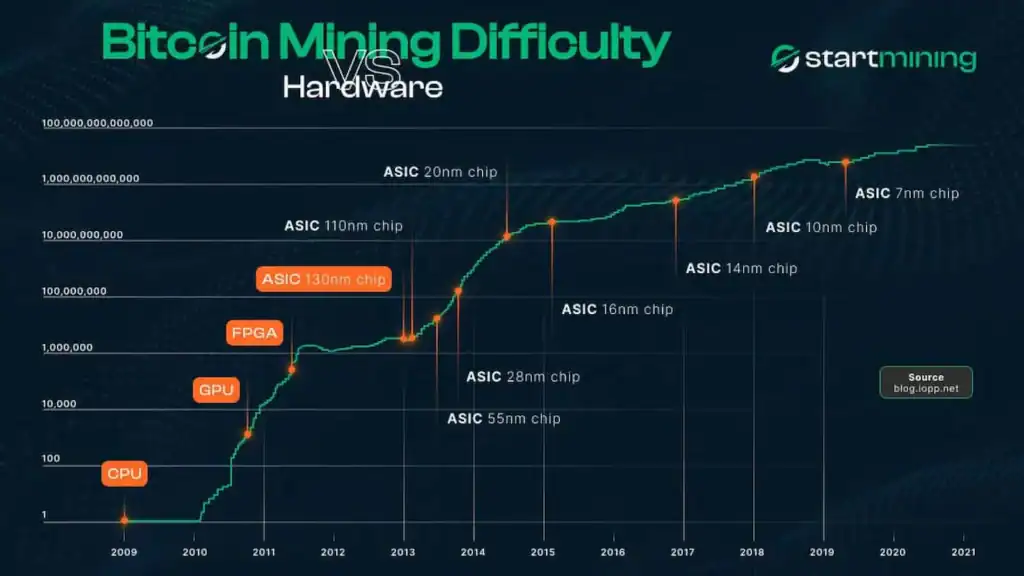
The hardware used to mine Bitcoin has evolved a great deal over the years:
- CPU (2009–2010): the first bitcoins were mined with ordinary computer processors.
- GPU (2010–2013): graphics cards then replaced CPUs thanks to their superior computing power.
- ASIC (since 2013): today, mining relies almost exclusively on specialized machines designed solely to mine Bitcoin.
Each hardware generation multiplied the computing power available on the network, gradually making the previous technologies obsolete.
Why mining became industrial
The Bitcoin network’s difficulty adjusts automatically so that creating a block takes about 10 minutes, regardless of the network’s total power. As a result, if the activity is profitable, more miners join and competition rises. To stay competitive, miners therefore constantly seek to:
- use the most efficient machines (consumption / computing-power ratio)
- access the cheapest possible electricity (the operating cost of hashrate)
- deploy their machines in optimized mining farms (uptime, security, maintenance)
This is how the large industrial farms able to run thousands of ASICs simultaneously appeared.
Who mines Bitcoin today?
In 2026, three main types of players take part in Bitcoin mining.
Industrial farms: large companies run infrastructure able to host thousands of machines in regions where electricity is abundant and cheap.
Individuals with ASICs: some individuals own their own machines and run them at home as long as they have a good energy price (a utility employee in France, a solar-panel owner, etc.).
Professional and individual miners grouped at hosts like Startmining colocation: we offer a colocation model for crypto mining, letting individuals and companies benefit from high-quality mining infrastructure while minimizing costs (electricity at competitive prices). The service includes hosting the mining machines, managing the fixed hosting and maintenance costs, and technical support.

What hardware do you need to mine Bitcoin?
To mine Bitcoin in 2026, a simple computer is no longer enough. Mining now relies on specialized hardware, designed to perform a huge number of cryptographic calculations while consuming as little electricity as possible. A typical mining setup generally includes:
- an ASIC mining machine
- a suitable power supply
- a stable internet connection
- an effective cooling system
- a Bitcoin wallet to receive the rewards
In most cases, the mining machine is the main investment. Choosing the right ASIC is therefore one of the most important elements for mining Bitcoin profitably, and the hardware choice will have a direct impact on the activity’s profitability.
ASICs: the specialized machines of Bitcoin mining
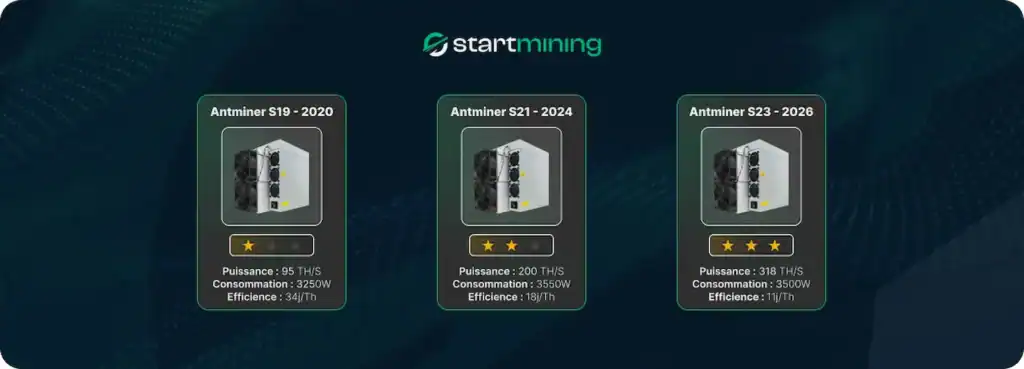
ASICs (Application-Specific Integrated Circuits) are machines designed specifically to mine a given cryptocurrency. Unlike ordinary computers or graphics cards, they do only one thing: calculate, as fast as possible, the hash used by Bitcoin’s algorithm (SHA-256). This specialization lets them reach very high performance. Modern ASICs can produce several hundred terahashes per second (TH/s), i.e. hundreds of trillions of calculation attempts each second.
However, this computing power comes with significant power consumption. That’s why an ASIC’s energy efficiency is often measured in joules per terahash (J/TH). The lower this figure, the more efficient the machine. Put simply, an efficient machine consumes fewer watts for a given power. For example, 12 J/TH means it takes about 12 watts to produce 1 terahash per second.
ASIC vs. GPU vs. CPU
Historically, Bitcoin mining went through three major hardware generations:
CPU (processors): at the very start of the network, you could mine with a simple personal computer. Today, this method is completely obsolete.
GPU (graphics cards): GPUs then strongly increased the available computing power. They are still used to mine some cryptocurrencies but are no longer competitive for Bitcoin.
ASIC: ASICs now totally dominate Bitcoin mining. Their power and energy efficiency far surpass other hardware types.
In practice, anyone wanting to mine Bitcoin today must use a dedicated ASIC. To understand the history of Proof of Work and the evolution of computing power, here is a dedicated article: From CPU to ASIC: the evolution of Bitcoin mining.
The important characteristics of an ASIC
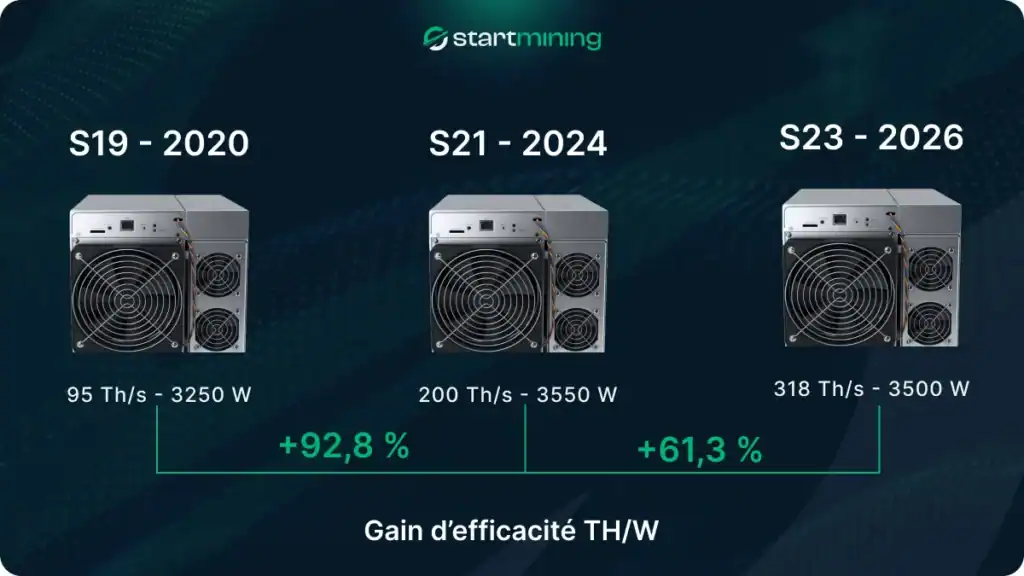
When choosing a mining machine, several technical characteristics must be considered:
- Hashrate (TH/s): the machine’s computing power. The higher the hashrate, the better the miner’s chances of finding a block.
- Power consumption (W): ASICs generally consume between 2,500 and 4,000 watts. This parameter is crucial because electricity is a miner’s main expense.
- Energy efficiency (J/TH): this ratio measures the energy needed to produce one unit of computing power. The most recent machines are generally the most efficient.
- The machine’s price: the purchase cost of an ASIC can range from a few thousand to several tens of thousands of euros depending on the model and market conditions.
How to mine Bitcoin: launching your first miner, step by step
Once the hardware is chosen, launching your first miner is actually much simpler than you’d think. Modern machines are designed to be relatively easy to install and configure. Here are the main steps to start mining Bitcoin.
Step 1: buy an ASIC
The first step is to choose and buy an ASIC machine suited to your budget and goals. When choosing, it’s important to compare the hashrate (TH/s), power consumption (W), energy efficiency (J/TH) and the machine’s price. These parameters will directly determine your setup’s potential profitability.
Step 2: choose a mining pool
Mining Bitcoin solo is now extremely difficult. The network’s total power is so high that a lone miner could wait several years before finding a block. That’s why most miners join a mining pool. A pool combines the computing power of thousands of miners. When the pool finds a block, the reward is then shared among participants according to their contribution to the total hashrate. This approach provides more regular, more predictable income.
Step 3: connect and configure the ASIC
Once you receive your machine, installation is generally simple: plug in the power supply, connect the machine to the internet via an Ethernet cable, and access the ASIC’s web interface from your browser. In this interface, you’ll enter the details of your chosen mining pool (server address and miner ID).
Step 4: connect your Bitcoin wallet
To receive mining rewards, you need a Bitcoin wallet. The pool will use this wallet’s address to send the payments corresponding to your share of hashrate.
Step 5: start mining
Once configuration is complete, the machine automatically starts calculating and sending its computing power to the mining pool. You can then track your ASIC’s performance directly from the machine’s interface and the pool’s dashboard. Wondering how to choose the right ASIC with a simulator? See our guide on choosing the right ASIC with a mining simulator.
Is it profitable to mine Bitcoin in 2026?
Yes, Bitcoin mining can still be profitable in 2026. The network is still running and has never been so powerful — proof that thousands of players continue to invest heavily. However, mining profitability constantly evolves with the price of Bitcoin and miners’ production costs.
During market downturns, some companies can find themselves in difficulty when their production cost approaches Bitcoin’s spot price. In these situations, the least efficient miners may be forced to switch off their machines. But this mechanism is part of the network’s economic balance: when some ASICs are unplugged, competition decreases and the profitability of still-active miners can improve. So, as long as the Bitcoin network keeps running and participants contribute to its security, mining remains economically viable for miners with a competitive infrastructure.
How much does Bitcoin mining earn?
Bitcoin mining profitability depends on several economic and technical variables. Contrary to a common belief, there’s no fixed guaranteed income: a miner’s earnings constantly evolve with the state of the network and the price of Bitcoin. To understand how much an ASIC can earn, you have to analyze four main factors.
The price of Bitcoin
A miner’s revenue is directly tied to the price of Bitcoin. Since mining rewards are paid in BTC, their value in euros or dollars varies with the market. When Bitcoin’s price rises, miners’ revenue mechanically increases. Conversely, a price drop can sharply reduce a setup’s profitability — and this directly affects ASIC resale prices.
Network difficulty
Mining difficulty adjusts automatically about every two weeks to maintain an average pace of one block every 10 minutes. If new miners join and the total computing power rises, difficulty increases. Each machine then receives a smaller share of the rewards. Difficulty evolution also affects ASIC resale prices.
Your machine’s power (hashrate)
The hashrate is an ASIC’s computing power. The more terahashes per second (TH/s) your machine produces, the more it contributes to the pool’s hashrate and the larger its share of rewards. The most recent machines generally have an advantage because they combine high power and better energy efficiency.
The cost of electricity
Electricity is a miner’s main expense. In many setups, it can represent more than 70% of operating costs. That’s why large mining farms set up in regions where electricity is abundant and cheap.
A simplified profitability calculation example
Take a simplified example to understand the economics of mining. Imagine an ASIC with the following characteristics: 200 TH/s of computing power, 3,500 W of consumption, and an electricity cost of €0.06/kWh. Depending on network conditions (difficulty, global hashrate and BTC price), this machine can generate a certain amount of bitcoin revenue each day.
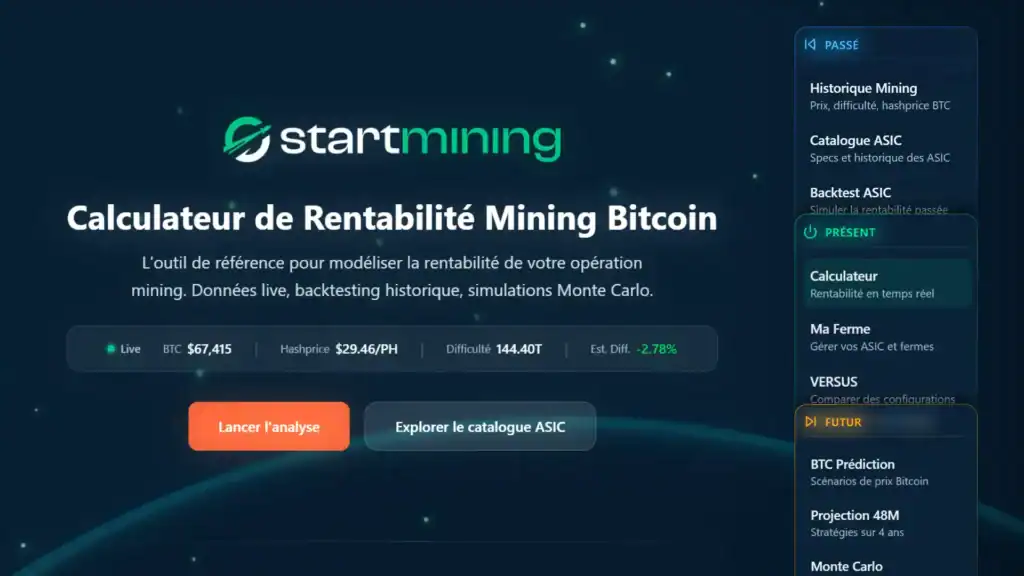
To estimate this profitability precisely, miners generally use mining simulators that account for all these variables. Test our simulator for free at pro.startmining.io. These tools let you estimate daily revenue, calculate the energy cost, and project a machine’s return on investment.
We wrote an article on the most profitable Bitcoin ASICs of all time that lets you step back and examine the activity’s past and present profitability.
Mining at home vs. farm hosting
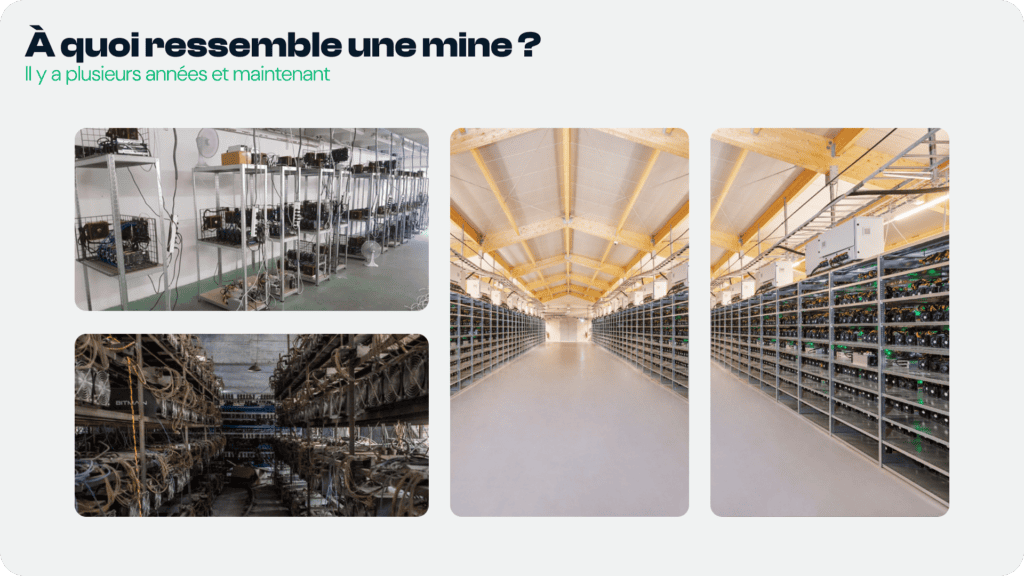
When an individual wants to mine Bitcoin, there are two main options: installing the machine at home or hosting the ASIC in a specialized mining farm. Each solution has advantages and constraints worth understanding before investing.
Mining Bitcoin at home
Installing an ASIC at home may seem like the simplest solution. You keep full control over your machine and can monitor it directly. However, several constraints quickly appear:
Noise: ASICs use very powerful fans to cool the components. A machine can easily produce 70 to 80 decibels — the equivalent of a running vacuum cleaner.
Heat: an ASIC consumes several thousand watts and turns much of that energy into heat. Without a suitable ventilation system, a room’s temperature can rise quickly.
Electricity cost: in many European countries, residential electricity is relatively expensive, which can strongly reduce mining profitability.
Maintenance: dust, temperature, restarts… a machine running 24/7 needs regular monitoring.
For these reasons, home mining remains possible but is often reserved for people with very cheap electricity or a suitable setup.
Hosting in a mining farm
Another solution is to host your ASIC in a professional mining farm. These infrastructures are specially designed to run mining machines in optimal conditions. Farms generally offer several advantages:
Cheaper electricity: mining centers are often located in regions where electricity is abundant and competitive (e.g., Startmining farms in Iceland, the US, Canada).
Optimized infrastructure: industrial cooling, suitable ventilation and stable power help optimize the machines’ lifespan.
Professional maintenance: technicians monitor the machines and can intervene quickly in case of failure.
Security and availability: farms are designed to run 24/7 with a very high level of security and availability.
For many miners, hosting therefore maximizes profitability while avoiding the technical constraints of home mining.
The 5 mistakes 90% of beginner miners make
Getting into Bitcoin mining can seem simple: buy a machine, plug it in and start generating bitcoins. Yet many beginners make mistakes that can strongly reduce — or even cancel out — their investment’s profitability. Here are the most common mistakes to avoid.
Underestimating the cost of electricity. The most common mistake is focusing solely on the machine’s price without accounting for electricity. An ASIC can consume between 2,500 and 4,000 watts continuously — the equivalent of several appliances running 24/7. In countries where electricity is expensive, this can quickly make mining unprofitable. Before buying, it’s essential to calculate the monthly energy cost and compare it to the potential mining revenue.
Buying an inefficient or obsolete ASIC. Not all mining machines are equal. Some older models consume a lot of electricity for relatively low computing power. An inefficient ASIC may seem cheaper to buy but can prove far less profitable over the long term. It’s therefore generally better to favor recent, energy-efficient machines.
Not joining a mining pool. Mining solo may seem attractive, since the miner keeps the entire reward if they find a block. But with Bitcoin’s current network power, this strategy is extremely risky for an individual. Without a pool, a miner could wait years to find a block. Pools, on the contrary, provide more regular income by pooling computing power.
Neglecting installation conditions. An ASIC must run in a suitable environment. Poor ventilation, too-high temperatures or dust buildup can cause failures and reduce the machine’s lifespan. It’s therefore important to provide sufficient ventilation, a clean environment and a stable power supply.
Not using simulation tools. Finally, many beginners get into mining without using a profitability simulator. These tools let you estimate an ASIC’s potential revenue, the energy cost and the return on investment. Before investing in a machine, it’s strongly recommended to run these calculations to evaluate the project’s profitability.
FAQ: frequently asked questions about Bitcoin mining
Can you mine Bitcoin with an ordinary computer? Not really — today, mining Bitcoin with a personal computer (CPU) or even a graphics card (GPU) is no longer profitable. The Bitcoin network’s power has become so high that only specialized ASICs can stay competitive.
How much does a Bitcoin miner consume? It depends on the machine model. Modern ASICs generally consume between 2,500 and 4,000 watts continuously. Over a full month, that’s a significant amount of electricity, which is why the cost of electricity is a decisive factor in mining profitability.
How much does an ASIC earn per day? An ASIC’s revenue varies with several parameters: the price of Bitcoin, network difficulty, the machine’s power and the cost of electricity. It’s therefore hard to give a fixed figure. Miners generally use profitability simulators to estimate their potential earnings.
Is mining Bitcoin legal? In most countries, Bitcoin mining is perfectly legal. However, some local regulations may govern the use of large amounts of electricity or the operation of industrial farms. It’s therefore advisable to check the regulations in force in your country.
How long does it take to pay off an ASIC? The payback time depends on the machine’s purchase price, the cost of electricity and market conditions. In good conditions (competitive electricity and efficient machines), profitability can be reached in a few years (on average 2 to 3 years). However, this can vary with the evolution of Bitcoin’s price and network difficulty.
Should you mine solo or join a pool? Almost all miners now join a mining pool. Pools combine the computing power of many miners and provide more regular income, rather than waiting to find a block alone — which can take decades or even centuries.
Conclusion
This guide has presented the essentials for mining Bitcoin in 2026: how the network works, the hardware needed, the installation steps and the profitability factors. Whether you want to mine Bitcoin at home or use a professional infrastructure, understanding the basics of Bitcoin mining is indispensable before investing in a machine.
Today, success in mining rests mainly on three elements: choosing the right ASIC, a competitive energy cost and reliable infrastructure. Before getting started, it’s strongly recommended to use simulation tools to precisely estimate a mining project’s profitability for your situation.
Useful resources to get started in Bitcoin mining: explore our ASICs with integrated hosting in the Startmining store, understand how ASIC prices evolve, and learn whether to buy a new or used ASIC.
Passez à l'action
Ready to mine Bitcoin with Startmining?
Browse our ASIC shop or simulate your profitability in real time.