The Profitability of Other PoW Coins: A Kaspa Analysis

Introduction
Crypto mining is often associated with giants like Bitcoin and Ethereum (when its consensus was still Proof of Work). But many other cryptocurrencies can be mined and offer interesting opportunities. This article explores the profitability of other PoW coins through the Kaspa blockchain and what it means for miners.
Still finding the world of crypto and mining a little blurry? See how we got here in our article on the history of money, from barter to Bitcoin.
What is cryptocurrency mining?
Mining is the process by which crypto transactions are verified and added to the blockchain. By taking part in mining, users secure the network and, in return, are rewarded with cryptocurrency. There are different consensus mechanisms, the most common being Proof of Work (PoW), used by Bitcoin.
Popular alternative PoW cryptocurrencies
Several cryptocurrencies can be mined, such as Litecoin and Dogecoin (via merged mining), or Monero, Zcash, Ethereum Classic, Kaspa, and more. Each has its own value proposition addressing a clearly identified need.
For example, Litecoin offers fast transactions, Monero focuses on anonymity, and Zcash offers a mix of transaction speed and optional anonymity. It is this point of differentiation, based on their unique features, that will shape each project’s future. Other factors, such as marketing and a project’s ability to rally a community of users, play an equally important role.
Mining profitability
The profitability of PoW crypto mining depends on various factors, notably operating costs versus potential revenue. To assess it, it is essential to factor in electricity costs, hardware and block rewards. Online calculators like Braiins can help estimate these parameters. That said, estimated profitability is never fixed — it changes with key metrics.
Factors influencing PoW crypto mining profitability
Mining difficulty changes over time, and crypto prices can be very volatile. Local regulations can also affect the cost and legality of mining. It is very important to assess the risks tied to such an investment strategy.
How the profitability of PoW mining machines evolves
We have seen that the evolution of PoW mining profitability is mainly driven by the price of the mined asset and by difficulty, which generally adjusts according to how profitable the activity is. Another metric to consider is the purchase price of the computing power (the manufacturer’s price), which also moves with the asset’s profitability.
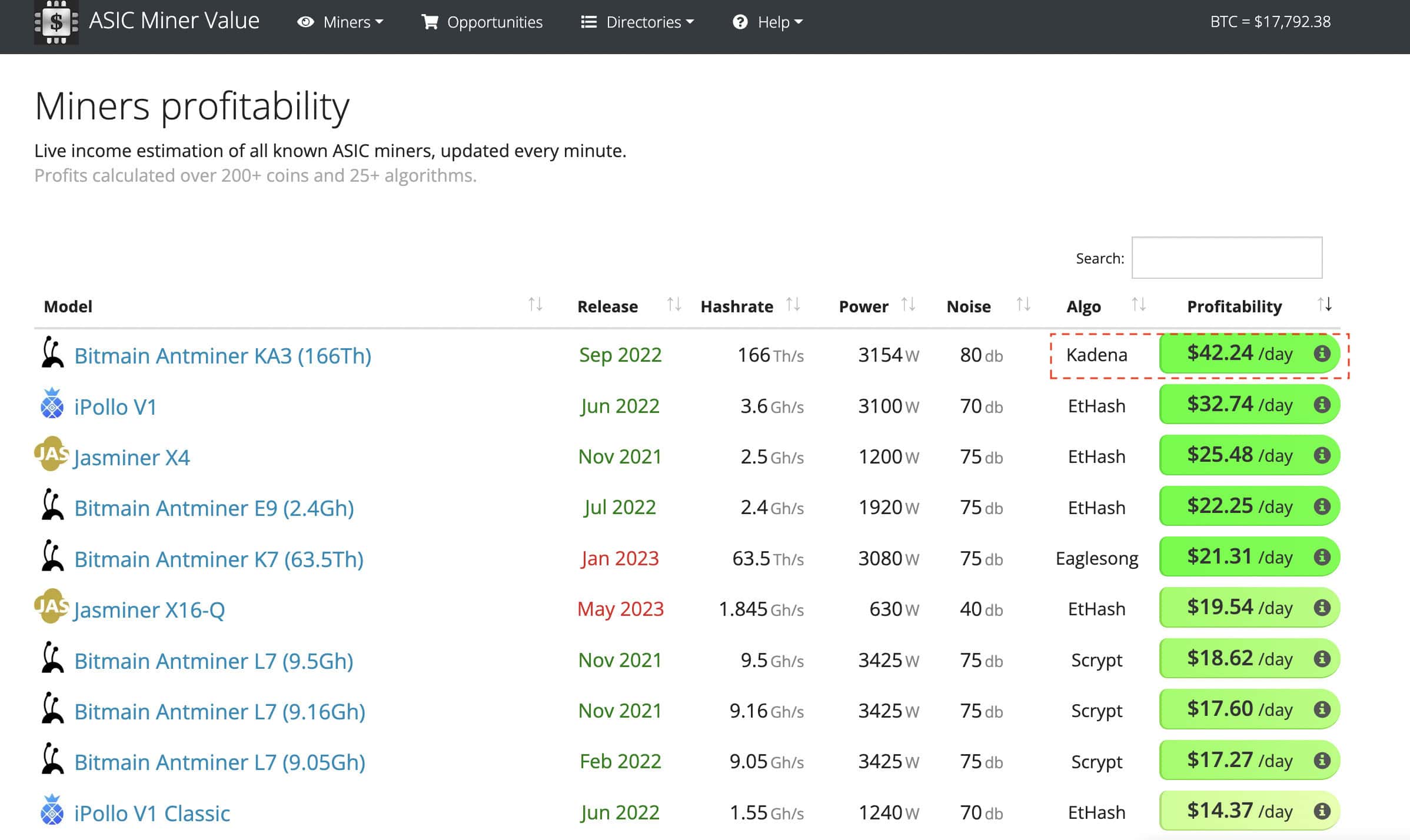
Here is the list of the most profitable miners (ASICs) as of December 2022, according to asicminervalue:
And here is the same list updated in October 2024:
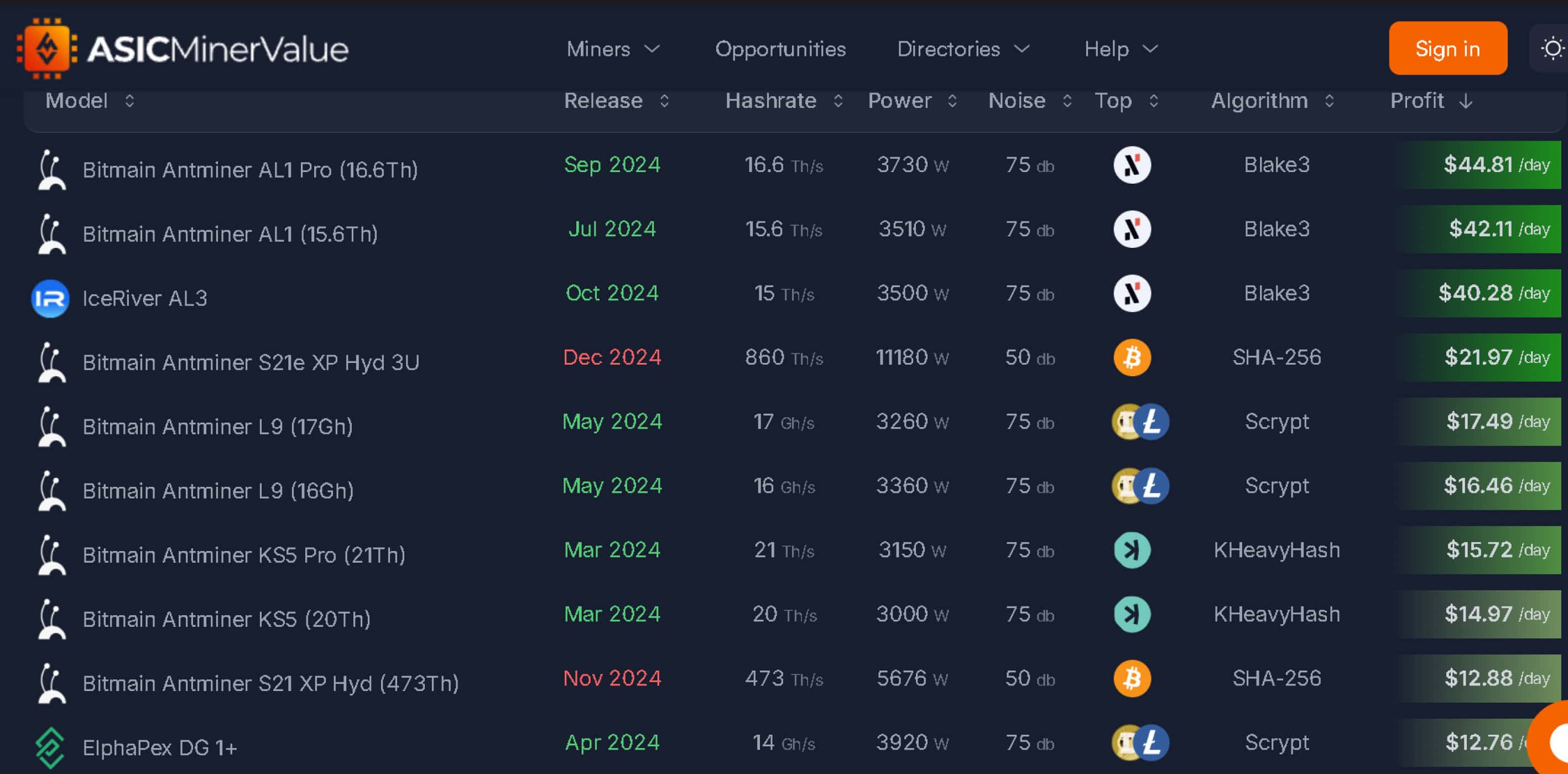
Comparing the two lists shows that none of the most profitable miners of 2022 appear on the 2024 list. New PoW coins have emerged offering better profitability.
How a Kaspa ASIC’s profitability evolves
A unique feature of Kaspa: it stands out for its Directed Acyclic Graph (DAG) architecture, enabling near-instant block confirmations and high scalability. Its Proof-of-Work consensus favors decentralization while ensuring strong security. According to the development team, if Bitcoin is the store of value, or “gold 2.0,” Kaspa wants to become the silver of the blockchain ecosystem. That defines the project’s vision.
Analysis of the KS3 model’s profitability between October 2023 and 2024, according to asicminervalue’s estimate:
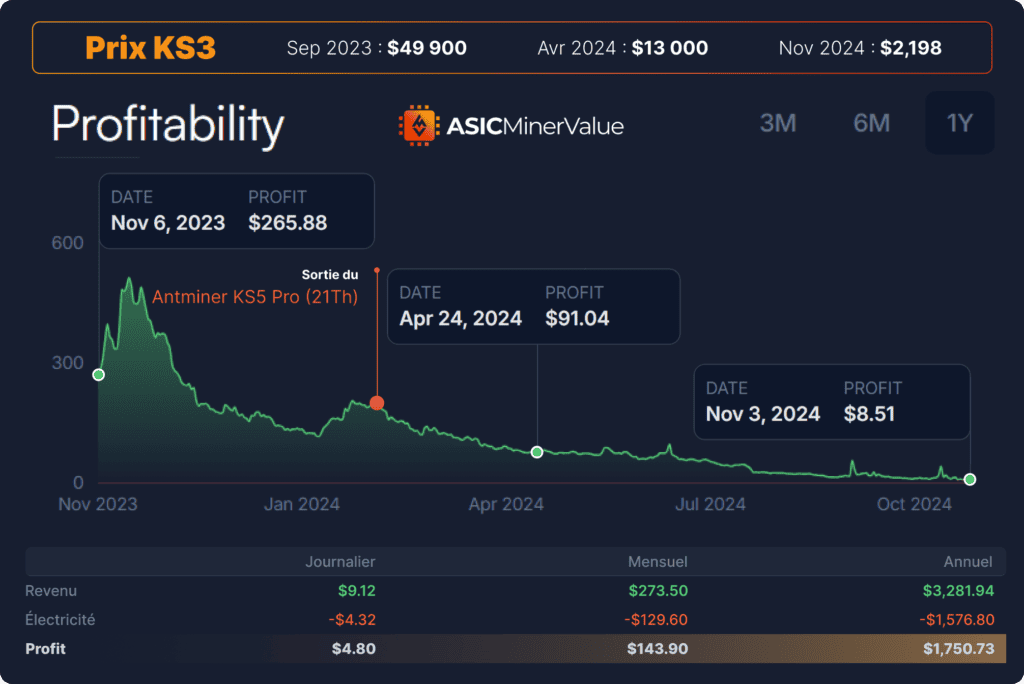
At its launch in September/October 2023, the KS3’s purchase price was around $50k. The miner produced a reward equivalent to €160 per day, or $58k a year. Of course, its profitability fell as the hashrate rose with the addition of new KS3 units to the network. A year later, the KS3’s purchase price is $1,700, and the ASIC produces more than $8 of profit per day.
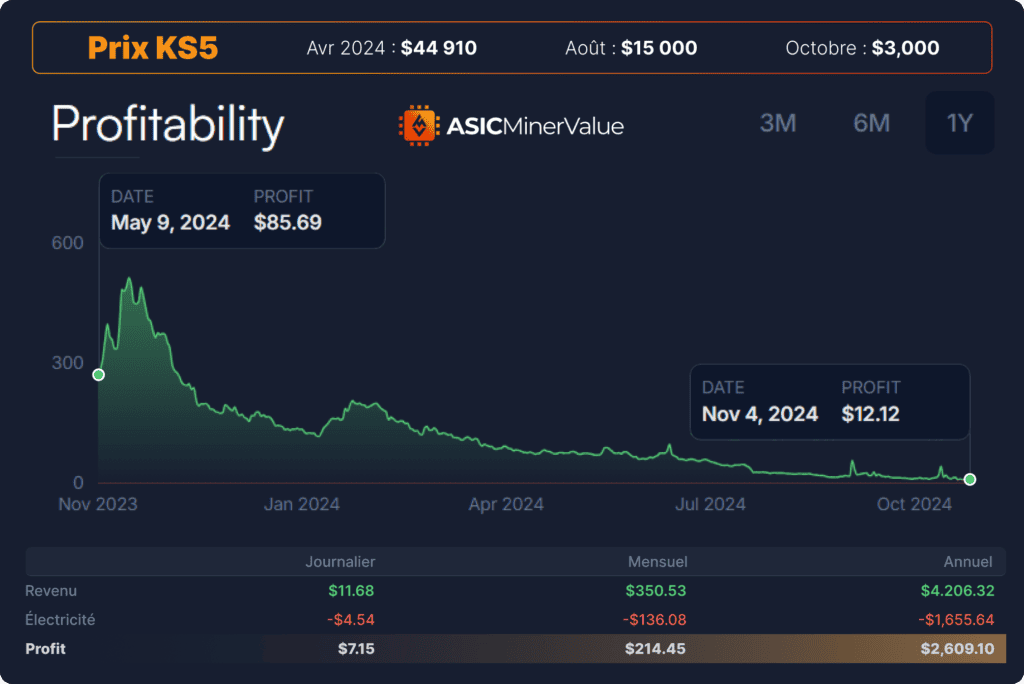
Meanwhile, a more powerful model appeared: the KS5 Pro. At its launch in March 2024, the ASIC produced $132 of profit per day. Six months later, it produces $15 of profit per day — ten times fewer rewards. In the meantime, its price went from $44k to $3,000. Here is the estimated profitability of the KS5 model in 2024:
The decline in Kaspa ASIC profitability
The drop in the daily rewards of Kaspa ASICs is mostly explained by two factors:
- The increase in network difficulty (more ASICs, more hashrate, fewer rewards per miner).
- Its emission policy (−8% per month).
Tempted to boost your ASIC’s hashrate, or to underclock it ahead of the next bear market? See our article on ASIC overclocking vs. underclocking.
Here is a chart showing the correlation between the evolution of the KAS price and the rise in network difficulty (correlated with hashrate):
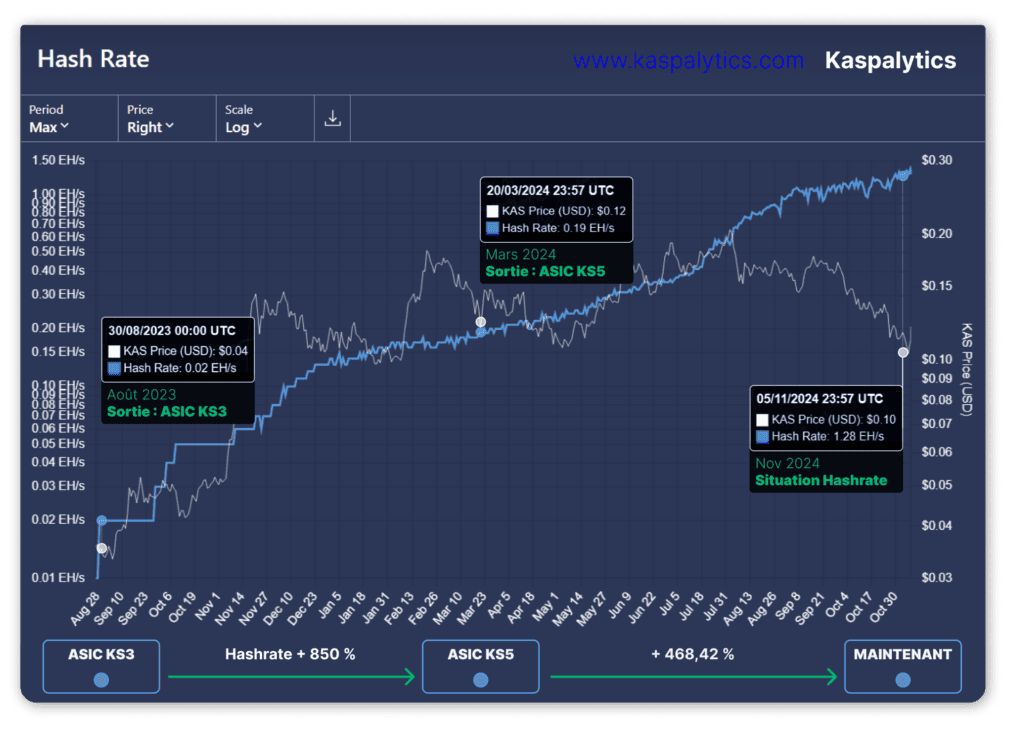
We can see that with each rise in the KAS price, difficulty rises with a slight lag. When the price goes up, mining becomes “too profitable.” Many investors, betting on the project’s ability to deliver its vision, find it increasingly attractive to produce the coin rather than buy it at the market (spot) price.
On this basis, many miners invest in mining machines — until they have driven profitability down to a risk level too high to keep growing their operation. At that point, the rise in network power (hashrate) slows. Miners then have two options:
- Wait for the release of a new, more powerful and efficient — and therefore more profitable — mining machine that will replace the older generation.
- Wait for the asset’s price to rise again.
Should you buy a new or used mining ASIC? See our article on new vs. used Bitcoin ASIC miners.
Is mining Kaspa profitable?
Yes and no — or at least not for everyone. We have seen that the price of Kaspa mining machines drops sharply after their release, correlated with the fall in profitability, which is quickly divided by large multiples (10 to 50) over a short period.
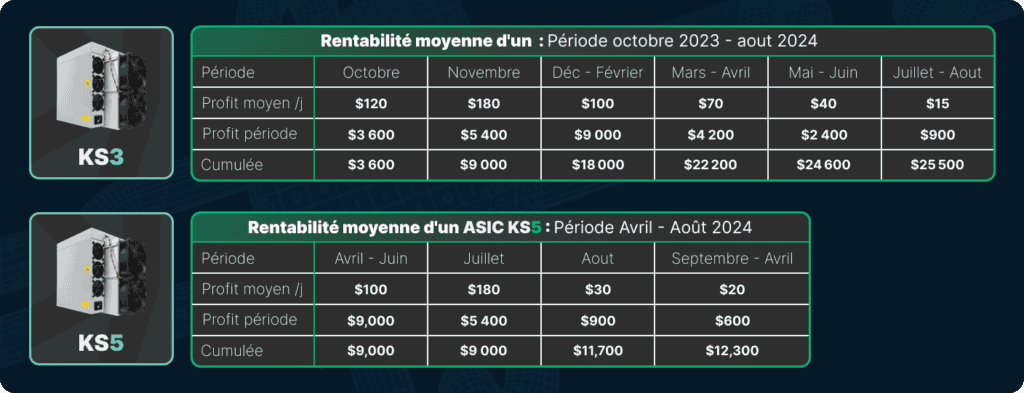
Kaspa miners produced an enormous amount of value over a short period (more than $10,000). However, since the network is not yet mature (the Kaspa protocol is young), difficulty rises very easily after a new mining ASIC is released.
On the other hand, the value of KAS appreciates noticeably when spot demand rises. For example, in one year the KAS price rose 270% (Sept 24, 2023 – Sept 16, 2024) while the network hashrate rose 5,850%! These variables heavily influence ASIC profits — and therefore their resale price, which easily drops from tens of thousands of dollars to a few thousand.
Conclusion
Analyzing the profitability of mining Kaspa highlights the complex dynamics that govern this sector. While mining alternative cryptocurrencies like Kaspa can offer interesting opportunities, it also presents significant challenges. Rapid price swings and rising network difficulty are crucial factors to consider.
The profitability of mining alternative cryptocurrencies varies considerably with the evolution of technology and market conditions. Mining machines often see their profitability fall quickly after launch, due to the increase in network computing power. Despite this, the potential for gains remains significant for those who manage to navigate this changing landscape.
Buy or mine Bitcoin? Find the answer in our article on buying vs. mining Bitcoin.
Passez à l'action
Ready to mine Bitcoin with Startmining?
Browse our ASIC shop or simulate your profitability in real time.