The Patoshi Miner: Is the Miner of 1 Million Bitcoins Satoshi Nakamoto?

Introduction
The “Patoshi miner” is one of the greatest mysteries in Bitcoin’s history. Discovered by Sergio Demian Lerner, this miner — believed to be Satoshi — mined around 1 million bitcoins during the network’s early years. Patoshi is often suspected of being Satoshi Nakamoto because of the scale and timing of the activity. This article is a synthesis of Jameson Lopp’s research, translated and transcribed by the site Bitcoin.fr.
The origin of the discovery: the “Patoshi Pattern”
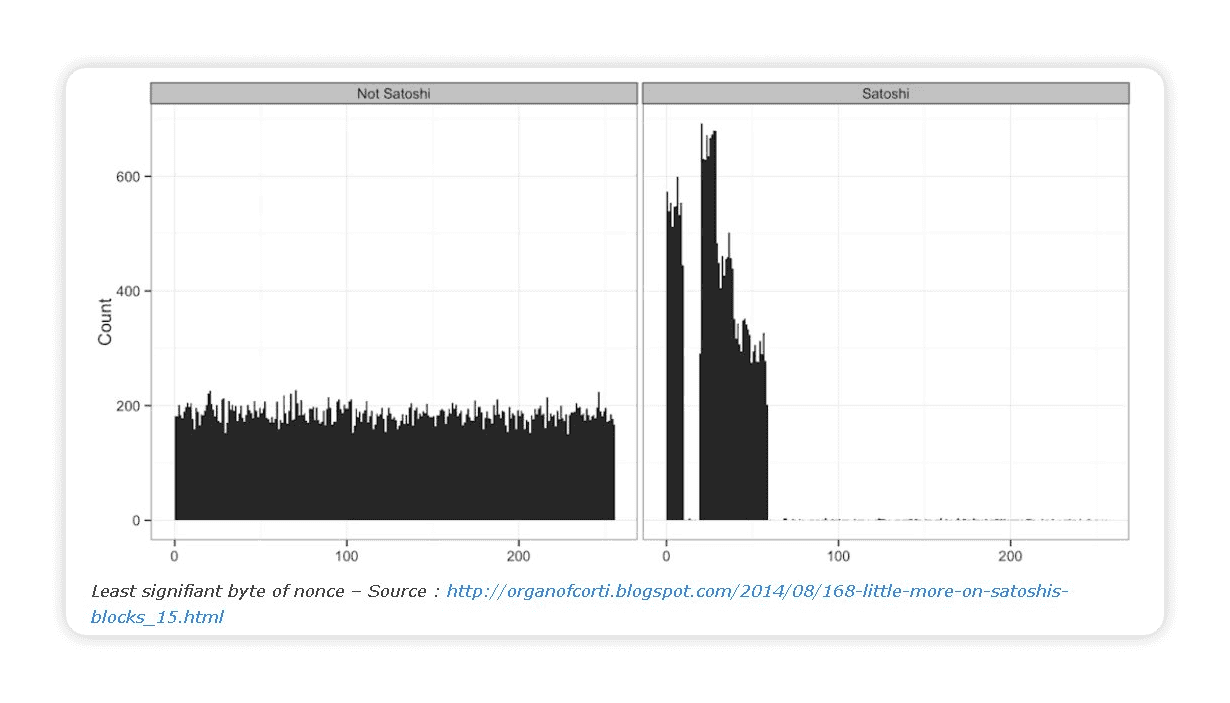
In 2013, Sergio Demian Lerner carried out an in-depth study of the Bitcoin blockchain and identified a specific pattern in the nonces of blocks mined between 2009 and 2010. This pattern identifies the “Patoshi” miner, who mined more than a million Bitcoin. He noticed that a single miner — whom he named Patoshi — used a particular mining software. That software produced a distinctive wave-like pattern in the timestamps of the mined blocks, suggesting a different approach from the other miners of the time.
To dig deeper into Satoshi Nakamoto’s potential identity, see our dedicated article on who is Satoshi Nakamoto.
The “Patoshi miner”
The “Patoshi Pattern” is a key discovery. It shows a miner who appears to control a large share of the network’s computing power while leaving enough blocks for other miners — a kind of self-regulation. This behavior, combined with the efficiency of his software, shows that Patoshi’s main goal was not to maximize mining profitability, but rather to secure the network.
A unique mining software?
To try to create a valid block, a miner must increment a nonce until its hash value matches the difficulty target. In Bitcoin’s early blocks, miners added the extra nonce to the mining process to keep searching for a solution to the cryptographic problem after exhausting the traditional nonces. They did not reset the extra nonce between mined blocks. The Patoshi miner is the exception to this rule and increments a particular ExtraNonce.
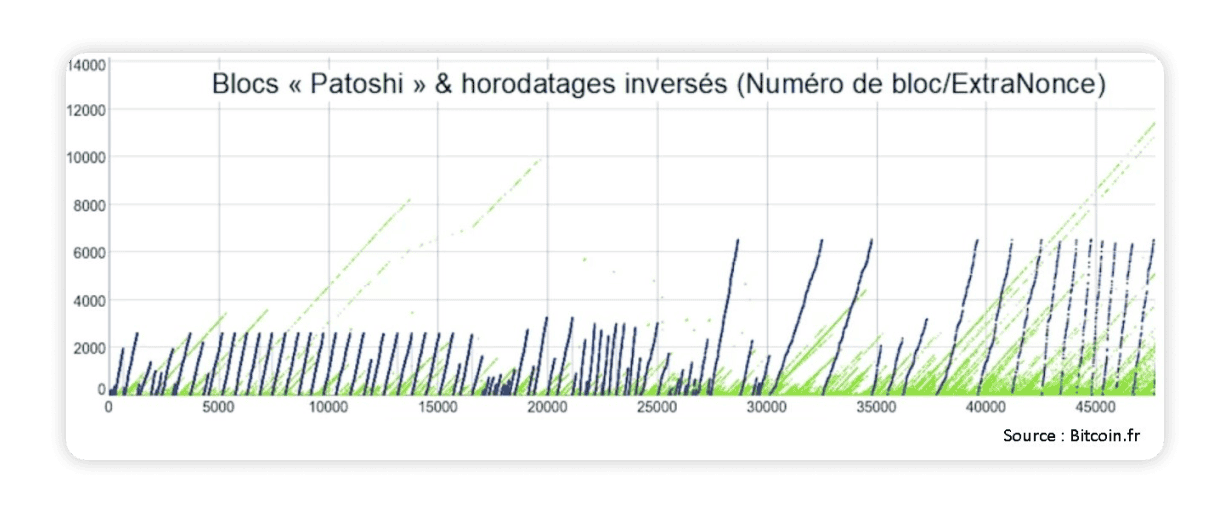
Moreover, the Patoshi miner shows an abnormal restriction in the nonce values found in his blocks, which makes them identifiable. The most likely theory is that he ran a different software.
Patoshi’s crucial role in Bitcoin’s security
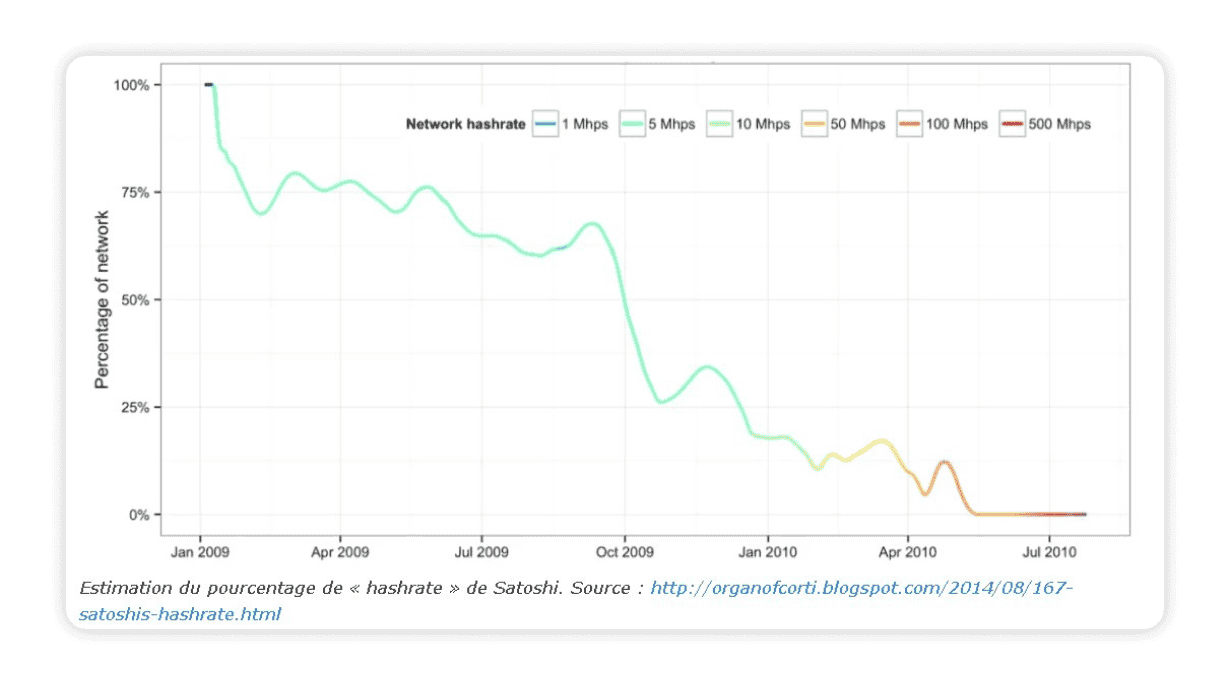
In 2009, Bitcoin was extremely vulnerable to attacks because of its small size and low adoption. An attacker with enough resources could have launched a 51% attack, taking control of the network. Patoshi seems to have deliberately dominated mining to prevent this, ensuring the protocol’s stability until enough external miners joined and took part in decentralization. According to the analyses, Satoshi held more than 70% of the network’s power during the first six months.
Self-limited mining: could Satoshi Nakamoto have mined more than a million BTC?
One of the most interesting aspects of the Satoshi/Patoshi miner is his self-limitation. Although he had the capacity to mine almost every block, he left a significant share to other participants. This shows a well-thought-out strategy of balancing network security with encouraging participation — the goal being to keep the network healthy and decentralized over the long term. The Patoshi Pattern is interesting because it shows a temporal irregularity in the distribution of mined blocks: more than five minutes separate each mined block from the previous one.
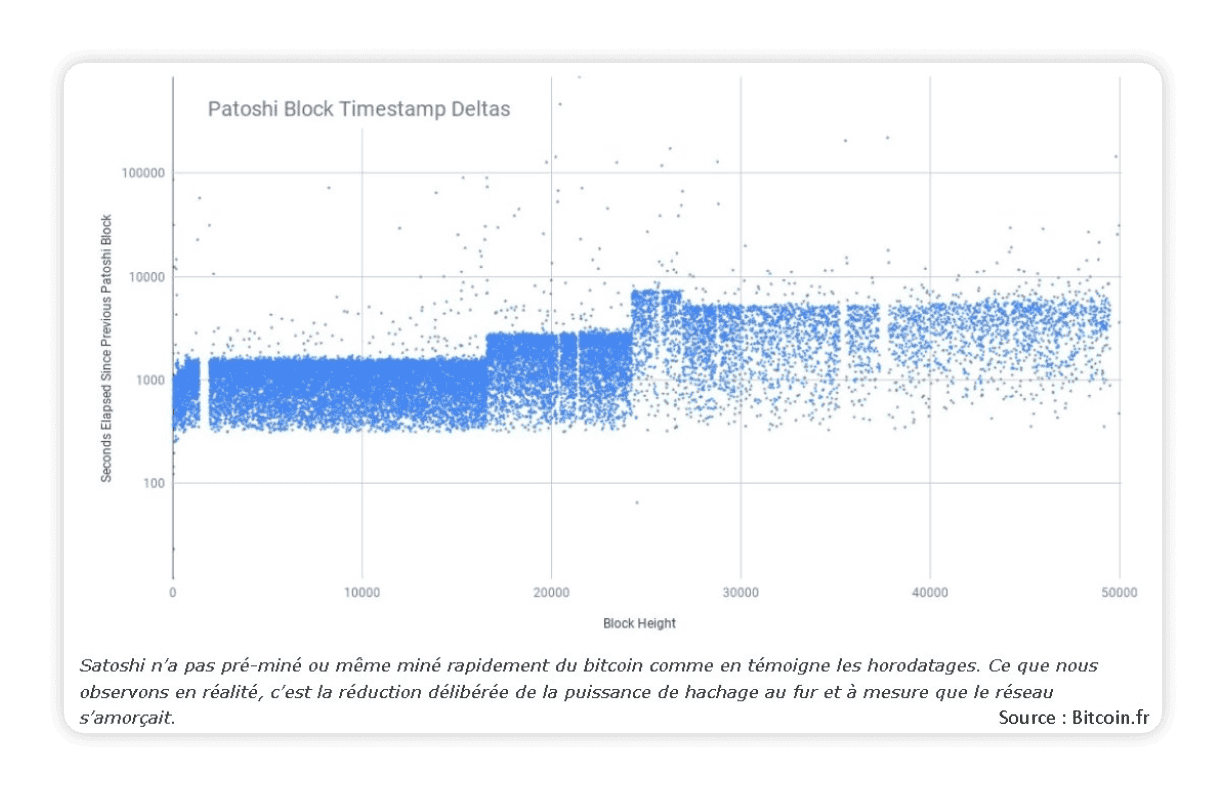
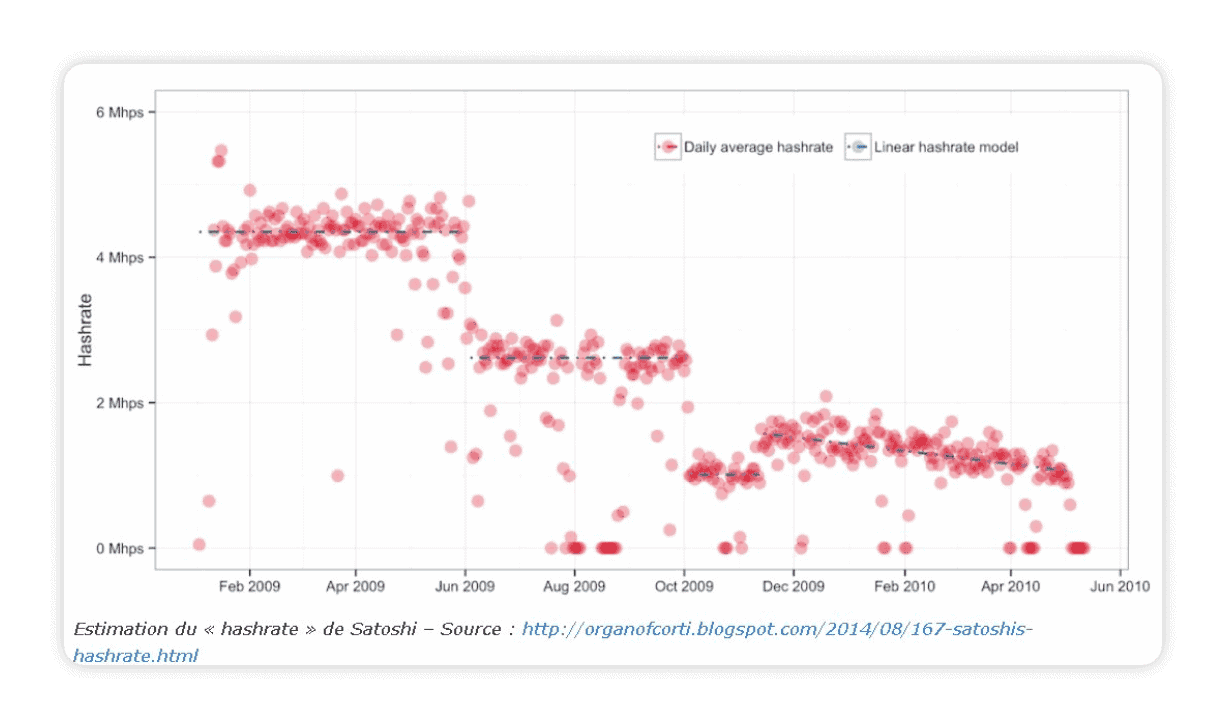
The most likely explanation is that he let the network reward other participants to encourage them to keep running Bitcoin. This means that, in addition to a software different from the public version, he held significant computing power. Looking at Satoshi’s hashing period shows several deliberate reductions in his hashrate — the first irregular, the later ones linear. Had he found the right script by then? For the time, his power was considerable.
If you’re wondering about the trade-offs between mining or directly buying bitcoins, read our detailed analysis: Buying vs. Mining Bitcoin.
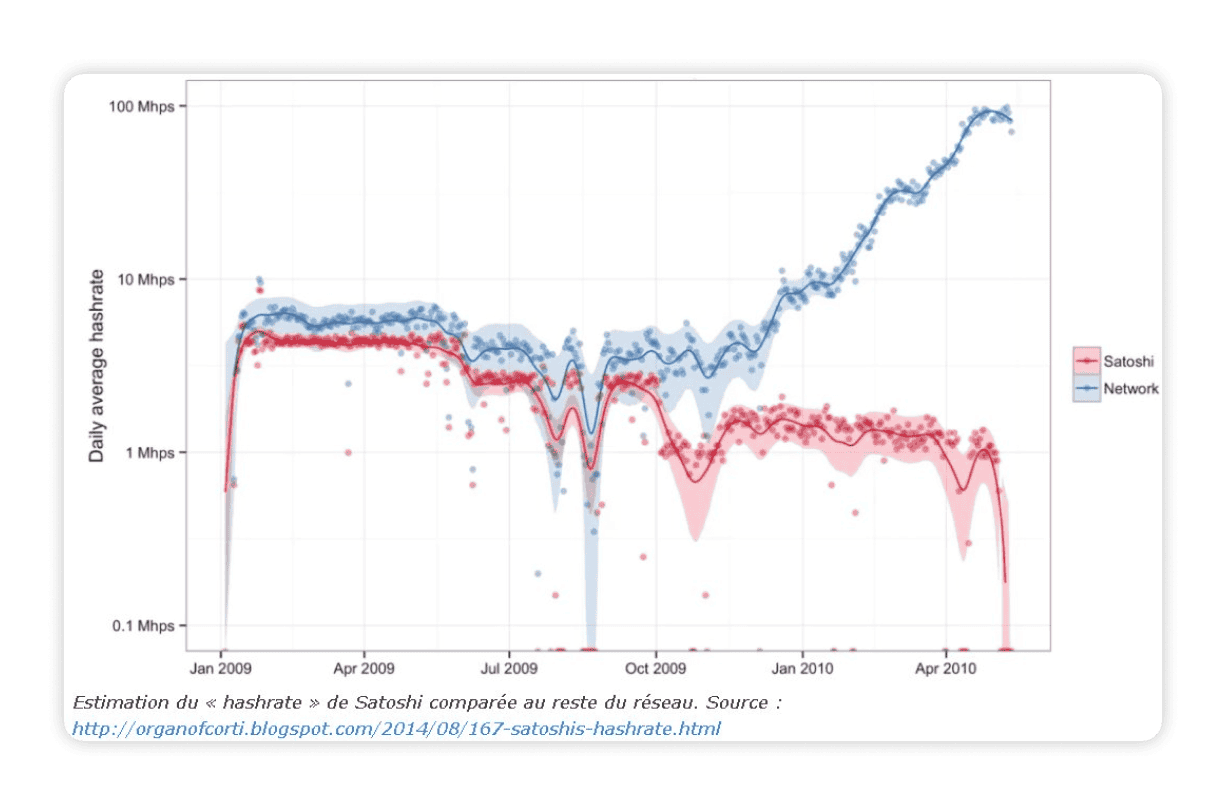
Comparing Satoshi’s power with that of the network lets us visualize how the hashrate evolved in this period. With each reduction in Satoshi’s power, the network hashrate dropped before being offset by other participants.
Is Patoshi Satoshi Nakamoto?
Here are some key elements feeding the hypothesis about Patoshi’s identity:
- Timing and technical access: Patoshi’s mining begins immediately after Bitcoin’s creation, coinciding with the period when Satoshi Nakamoto was an active miner.
- Volume of bitcoins mined: Patoshi mined around 1 million BTC — a gigantic amount. These bitcoins, dormant since they were mined, have never been moved. This reinforces the idea that Patoshi acted to protect the network rather than for personal gain.
- Ethical behavior: the fact that these coins were never spent could indicate a strict ethic aimed at not disrupting Bitcoin’s emerging economy.
However, some researchers put forward the theory that Patoshi might not be a single person, but rather a group of individuals working together to protect the network.
The impact of Satoshi Nakamoto and Patoshi’s million BTC
Patoshi’s influence goes beyond mere mining. By dominating the process in the early days, he protected the blockchain from attacks, contributed to its resilience and played a key role in its later success. This mysterious figure continues to fascinate the community, not least because those 1 million BTC remain intact and unused.
Sergio Demian Lerner’s analysis opened a debate about this miner’s motivations and Satoshi Nakamoto’s identity. Whether or not Patoshi is Satoshi, his impact is undeniable and will remain a pillar of Bitcoin’s history.
Conclusion
The Patoshi mystery will probably remain one of Bitcoin’s central enigmas. While research has revealed crucial information about his patterns and actions, his identity is still unknown. Nonetheless, it is clear that without this miner associated with Satoshi, Bitcoin might never have survived its early years of vulnerability. Patoshi secured the network and built the foundations of the Bitcoin ecosystem — an essential role that cannot be ignored.
Enjoyed this article? To learn more about the techniques miners use to boost their ASIC’s hashrate, see our complete guide on ASIC overclocking vs. underclocking. And if you’re wondering whether it’s better to mine other proof-of-work coins than Bitcoin, our analysis of the profitability of other PoW coins may help.
Passez à l'action
Ready to mine Bitcoin with Startmining?
Browse our ASIC shop or simulate your profitability in real time.