Bitcoin Hashrate and ASICs: How Are They Distributed?

The distribution of Bitcoin’s hashrate around the world
Bitcoin runs on a fascinating technology: the blockchain. For it to work, it needs an essential resource: hashrate. But what is hashrate, and why does its geographic distribution matter so much? In this article, we explore the concept and discover how Bitcoin mining is spread across the world, with millions of ASICs (mining machines) installed in hashrate farms.
Wondering how we got to Bitcoin? Dive into our article on the history of money, from barter to Bitcoin.
What is Bitcoin’s hashrate?
The hashrate is a measure of the computing power used to mine bitcoins and verify transactions on the blockchain. The higher the hashrate, the harder it is for an attacker to falsify data. In other words, it contributes to the security and reliability of the Bitcoin network.
Why does Bitcoin’s hashrate distribution matter?
First, a decentralized distribution of hashrate is crucial for Bitcoin’s security. If too much hashrate is concentrated in a single country or region, it increases the risk of attacks.
The distribution of coins in circulation is also an important network metric — discover it in our article on how Bitcoin’s supply is distributed.
A country’s regulatory changes can have a direct impact on mining. For example, the bans in China pushed miners toward other regions, shifting the global dynamic — as we saw in 2021, when China banned mining on its territory and the hashrate moved abroad. Finally, the energy source used for mining also affects the carbon footprint: countries using renewable energy have a smaller environmental impact.
Analysis of Bitcoin’s hashrate in 2019/2020
In October 2019, Bitcoin’s hashrate was around 90 EH/s, versus 140 EH/s at the end of 2020 — a 50% increase in one year. At that time, one country dominated the mining and ASIC landscape: China.
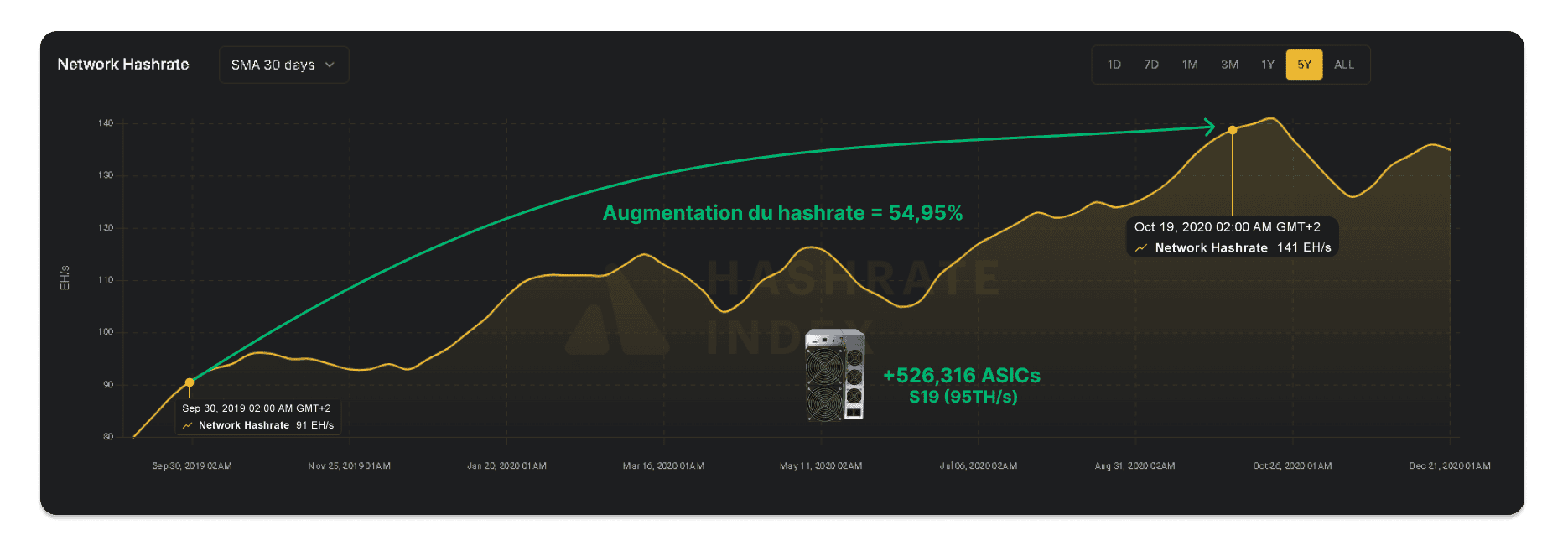
With energy-producing regions, China was one of the first countries to industrialize mining on its territory, notably in regions producing cheap energy.
Sichuan & Yunnan — Energy source: hydroelectric. These regions are famous for their hydroelectric dams, producing cheap green electricity, especially during the rainy season.
Xinjiang & Inner Mongolia — Energy source: coal and renewables (solar). Rich in coal resources, these regions made it easy to develop mining farms; Xinjiang also benefits from emerging solar projects.
This cheap energy made China the first mining El Dorado, creating a centralization risk as it reached a concentration of 70% of the hashrate on its territory.
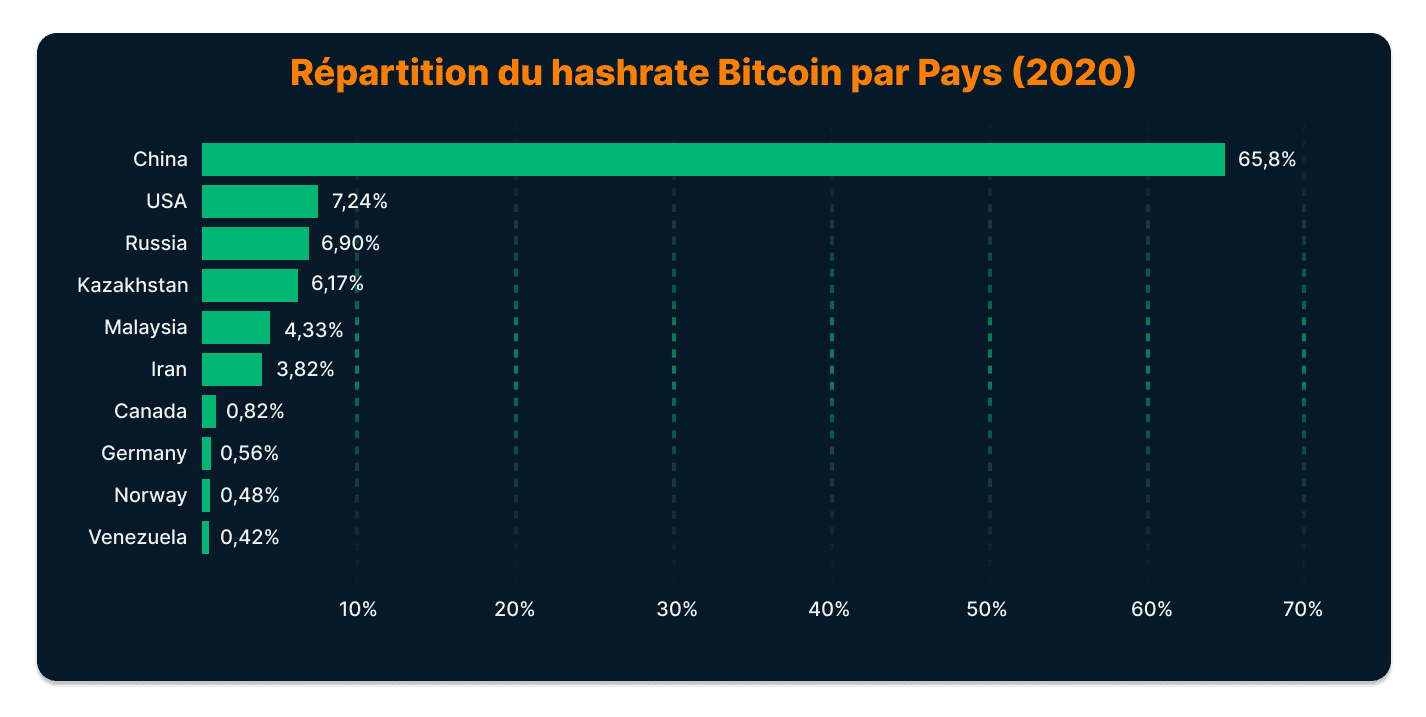
China was followed by the United States, Russia and Kazakhstan, each holding between 6% and 8% of the hashrate.
Impact of China’s ban on the market
The Bitcoin bull market that began in 2021 increased the visibility — and the fears — of sovereign states facing its exponential growth. China saw a risk in mining developing on its territory and decided to ban the activity: the “China ban.” This decision came despite the fact that Bitmain, a Chinese giant producing some of the most powerful ASICs by hashrate, held a monopoly with more than 70% market share.
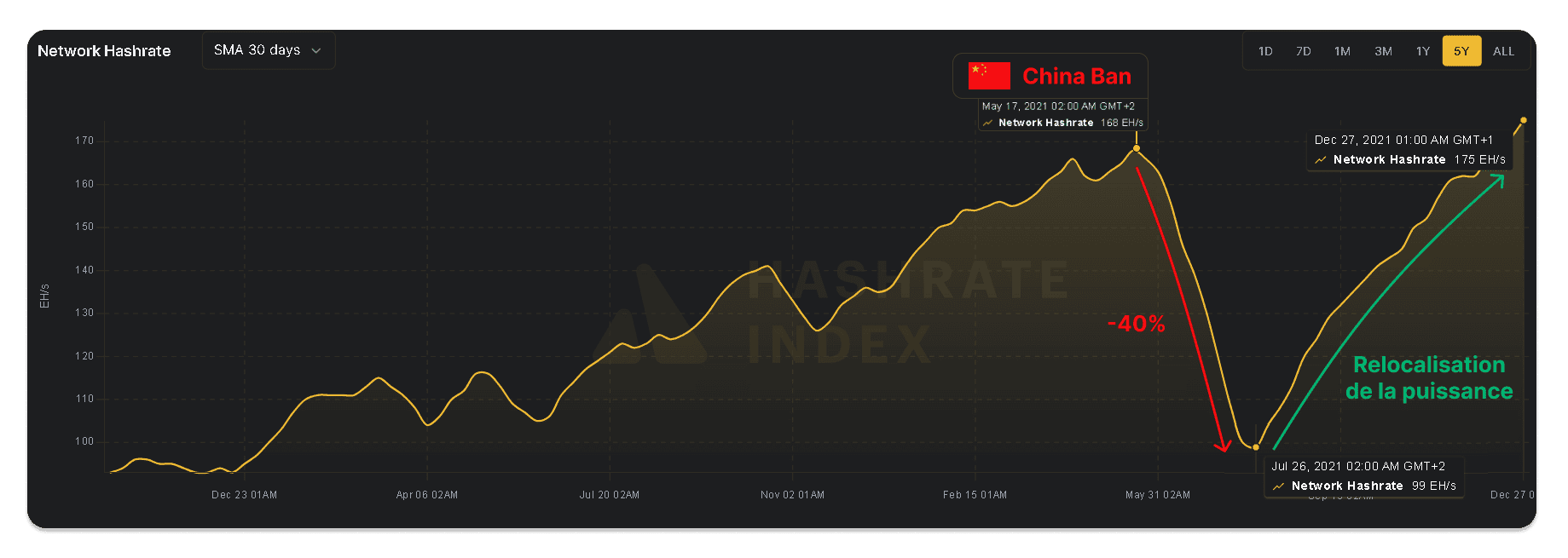
When China banned mining on its territory, the network’s power fell by more than 40% before being relocated to new territories. Bitcoin’s hashrate dropped considerably, with millions of ASICs to plug back in. This event demonstrated the network’s resilience: less than nine months after the China ban, at the end of 2021, the Bitcoin network’s power exceeded its previous all-time high.
Bitcoin’s hashrate evolution up to 2024
Major changes post-2021
The China ban resulted in miners migrating to other countries, notably the US and Kazakhstan, which alone represented more than 50% of the network in 2021. This is largely because they took measures to regulate and encourage Bitcoin mining in order to attract the Chinese miners looking for new places to operate. These efforts contributed to a significant redistribution of the global hashrate toward these countries.
United States — Favorable regulation: several states, like Texas and Wyoming, put in place attractive policies, particularly competitive electricity rates and a regulatory environment favorable to crypto mining.
Kazakhstan — Regulation: Kazakhstan also took advantage of the situation by offering favorable conditions, notably low electricity prices, largely thanks to its coal resources. The government introduced a legal framework for mining, attracting many Chinese miners and thousands of ASICs producing significant hashrate for the network.
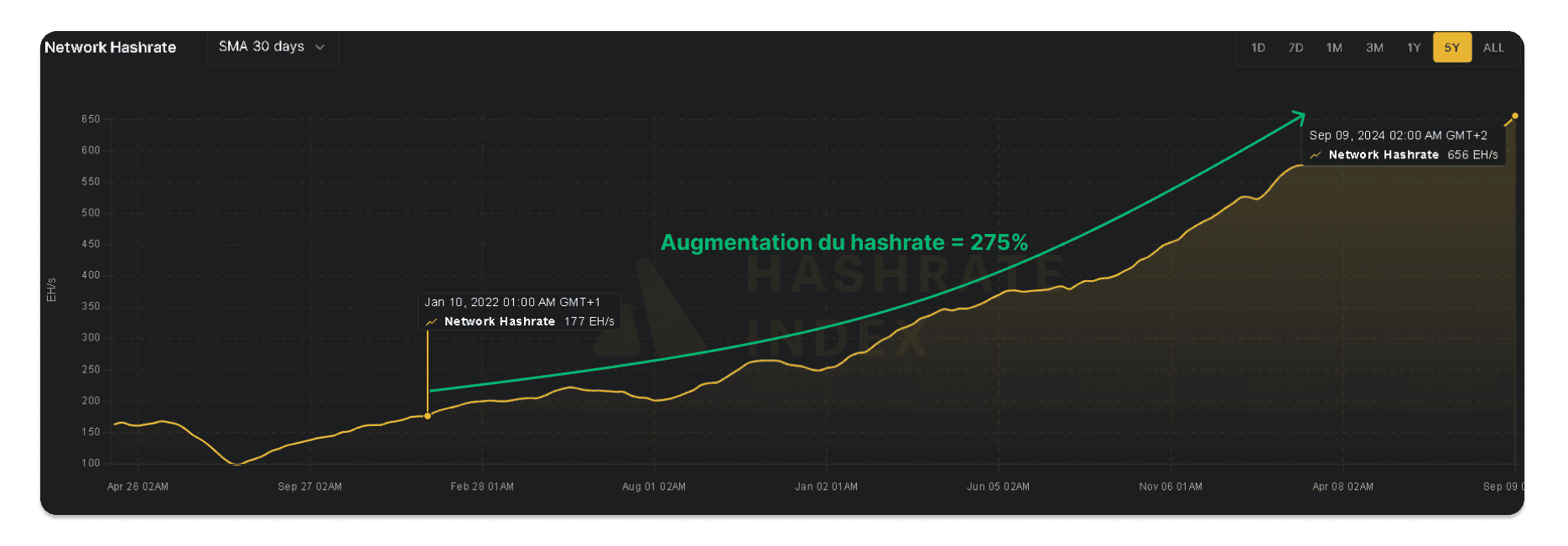
Since January 2022, the network’s hashrate has grown considerably, reaching 656 EH/s in 2024 — a 275% increase in under two years.
Analysis of Bitcoin’s hashrate in 2024
With the strong rise in hashrate since 2022, its geographic distribution has consolidated. Despite the mining ban in China, a significant share of the hashrate developed there again, reaching 20%.
Since 2019, Canada has multiplied its share of the network more than sixfold, reaching 6% in June 2024. Russia has lost half its hashrate share since 2021, explaining its recent desire to put in place regulations favoring the activity. The US clearly maintained its level at 35%, mining nearly 40% of new Bitcoins in 2024. Kazakhstan, by contrast, saw its crypto mining develop with little regulation, part of it opaque and illegal — which weakened the power grid and ended the development of mining there.
Analysis of Bitcoin’s hashrate held by listed companies
Since 2021, many listed mining companies have grown their activity. Through numerous fundraising rounds and debt issuance, they have considerably increased their respective power, with orders of hashrate and acquisitions of thousands of latest-generation ASICs often making headlines in mining media. In Q1 2024, all miners raised $1.8 billion — the highest amount collected in the past three years. By Q3 2024, the public hashrate of the top 12 listed companies was close to 25% of the Bitcoin network’s hashrate. Is it better to start your mining journey with a new or used ASIC? Find the answer in our article on new vs. used Bitcoin ASIC miners.
This share represents a clear increase since 2021. At that time, only 3% of the hashrate belonged to listed companies, reaching nearly 20% of the network a year later. Since then, these companies have gained 5% of the network’s hashrate share, with an increase of just under 300% in total power. If you’re wondering whether it’s better to mine other proof-of-work coins than Bitcoin, this article is for you.
Future trends
Beyond the Bitcoin market itself, the future trends of mining distribution essentially depend on regulation and access to cheap energy for miners. On that note, is it better to buy or mine Bitcoin? See our article on buying vs. mining Bitcoin.
Russia and the development of mining
2024 marks the official recognition of the activity in Russia. On August 8, 2024, Vladimir Putin ratified the legalization of crypto mining in the country. With its many production surpluses, yet hemmed in by Western sanctions, Russia sees Bitcoin mining as a way to obtain an international means of payment while subsidizing energy production. According to analysts, mining in Russia will see strong development in 2025.
Reopening mining in China
The possibility of mining reopening in China remains a topic of debate among market players. Although the government imposed a strict ban in 2021, signs of regulatory easing are emerging. Some provinces, drawn by the chance to recapture a share of the mining market, might consider reintroducing mining operations under a regulated framework. If that happened, China could quickly regain a dominant position — knowing that the top ASIC manufacturer, Bitmain, is Chinese and holds a near-monopoly on the industry (more than 80% of the market).
The US elections and their consequences for Bitcoin mining
The 2024 US elections could also play a crucial role in the future of Bitcoin mining. Depending on the results, energy and regulatory policies could see significant changes. A change in leadership could lead to a tightening or loosening of crypto regulations, influencing the investment climate and miners’ confidence. Discover how Trump wants to make the US the world’s largest Bitcoin producer in our article on Trump and Bitcoin.
Conclusion
The distribution of Bitcoin’s hashrate around the world reflects complex economic, political and environmental dynamics. The mining landscape evolves very quickly, with or without the blessing of the policies in place. Now a billion-dollar industry, Bitcoin mining increasingly has a role to play on the global chessboard. For a French Bitcoin mining company like Startmining, understanding these dynamics is essential to anticipate trends and adapt to market changes.
At Startmining, our experts offer the best machines on the market. Discover our mining offers, with or without hosting.
Passez à l'action
Ready to mine Bitcoin with Startmining?
Browse our ASIC shop or simulate your profitability in real time.